Building a Better Future, with guest Tom Shaw
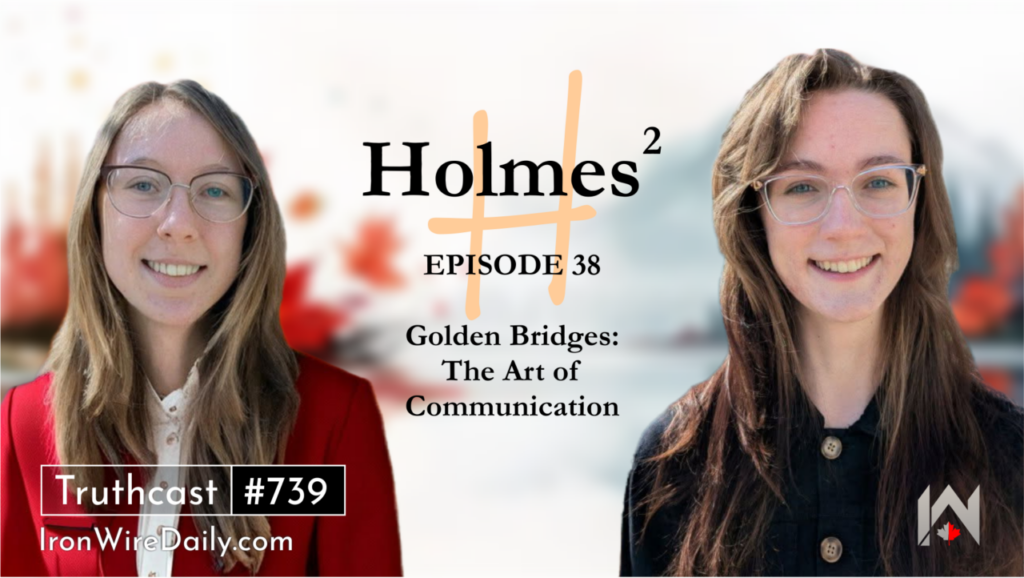
Madison and Maycee Holmes
Madison and Maycee Holmes, with Tom Shaw, on the role of fun and joy in life, the importance of poetry, and how art and culture can influence personal growth and societal change.
Want more Holmes?
Find them on Substack, Rumble and YouTube
You can also contact the Holmes sisters directly at Connect@at-home-with-holmes.com
Buy precious metals at wholesale prices right here in Canada. https://info.newworldpm.com/154.html
Get Sound Financial Advice: adrian@itstartswithgold.com
Take back Canada! Find and Join your LOCAL Freedom Community FREE. https://freedomcoms.org
(0:00 - 0:07) Hi everybody, I am Madison Holmes. And I am Maycee Holmes. And you're watching Holmes Squared. (0:08 - 0:12) So this is going to be a fun episode. Take down the picture. I am working on it. (0:14 - 0:23) I was so tempted then to try and derail the whole intro but it looks like the tech was derailing it. There we go, yep. It's already derailed. (0:24 - 0:32) So this is our British leprechaun friend who likes to cause mischief. Wow. I don't know how the Irish would feel about you calling me a leprechaun. (0:32 - 0:37) Yeah, you do the Irish dirty. You guys did the Irish dirty. That's dishonouring them. (0:37 - 0:47) For those of you watching and not just listening, I mean, actually it applies to everyone, but Tom's looking like left and right because he's actually in our in-person studio. I am. I've come across the pond. (0:47 - 0:54) Yeah. Oh, Madd, he's trying to flip. There it is. There it is. Let's go. There we go. (0:54 - 1:35) Exclusive behind the scenes for everyone. Will's going to be like, I have to edit that. No, keep it in. It's the sense of fun. I think, yeah, it's fun. And I think we're missing a sense of fun at the moment with how crazy things are going in the world. Because for me, fun is the antidote to fear. And it's the fear that keeps people locked in going along with narratives that aren't serving them or acting in a certain way that's still feeding a lot of the control systems that we're seeing across the world over in my native UK, here in Canada. It's all of that. (1:35 - 1:44) And yeah, joy is the absolutely cuts through all of that. So I'm here for more joy. It sounds cheesy, but that's very, very true. (1:44 - 2:24) Though I would specify like fun, because especially if people are our age, I would specify things like joy or love over fun, because fun can also mean doing. Is this you saying we're not allowed to have fun? No, we don't want to be degenerates is what we're specifying. Some people find, you know, drinking and partying fun. I wouldn't recommend. Is that fun or is that from a place of fear of missing out or not going with the crowd or It would depend on the hemisphere because each hemisphere values different things. So one hemisphere would totally do it out of FOMO and all. (2:24 - 4:12) And I almost can't. I mean, I've been in that place as well of indulging in those kinds of lifestyles because it is an escapism of how soulless and drained the whole environment for young people has become. I've been there and done that. And I don't blame young people who want to do that because it is scary. And when there isn't the support systems or even the adults who've got enough skills and tool sets and wisdom to also see what's happening and be able to guide those young people, of course, they're going to end up in situations like that. We've got across the Western world, we've got a situation where societies, the role of parents and families and even responsible adults have been hollowed out. And oftentimes it's the state that then intervenes and takes over and tries to mould the children through the education systems into their view. And so they don't develop the actual skills that they need to be their own independent, critical thinkers. So then the moment they're thrown out of childhood to say, OK, you're in the adult world now, they don't have anything they need to survive by themselves. Yeah, that's I think why me and Maycee and the clan believe in the hemispheres so much, because what makes adults and young people and seniors all the same, their brain, regardless of the age. So when parents learn about their own brain, they intuitively learn about their kid's brain as well. So then you learn about your bad habits and what your brain is doing, and then it translates onto what other people are doing. It's that simple. Like if the more you try and pursue understanding how your brain and body works, it immediately imprints on other people. But that's not at all where I thought this conversation was going to start. (4:12 - 4:16) Yeah, that's not where they were going to take me. But that's honestly fun. That's part of the magic. (4:17 - 5:06) I know how I can loop this, though, because like it depends as well as like what kind of a thing we're talking about. Right. So it's like, what kind of version of fun do we mean? Because there's there's that argument all the time where it's like, oh, I want to do something career wise that I'm passionate about. Right. Not something that I'm stuck doing and all that. And then there's this line from Gladiator from Maximus. It was like, sometimes I do what I want to do. Most of the time I do what I have to. And sometimes when I'm listening to him say that, I think, well, why can't what you have to do be what you want to do? Right. Like, why can't fun be exactly what we're doing right now? This is fun and I want to do it. There is absolutely a path to doing both. And that's why I engage with the projects I do, because I realise that there's there's absolutely a way to do both. It doesn't mean it's easy. Yeah. No, definitely not. (5:06 - 5:58) But it's is it worth it? One hundred percent. Yeah. Thank you, Dumbledore. Dumbledore wisdoms. Honestly, it makes sense, though, to start there even for us, because for people that don't know, we actually met Tom because when COVID went down, an organisation came out with the son of Dr. Mark Trozzi, which everybody knows because he has his own segment on the Iron, Iron Wire Daily. So his son made an organisation called Over to the Youth, of which Tom, myself and then a couple other kids were the founders of. And so that's how we originally met Tom. When we were younger in that youth, trying to figure out when we were going to get old now. No, no, still young and dumb, clearly. (5:59 - 6:20) Well, maybe you, I don't know. You should learn some humbleness that'll make you wiser. We give him a mic. He's going to be listening to the sound of his own voice. I said just before we started recording, the first mistake you made was inviting me into your home and the second mistake you made was inviting me onto the podcast. It's a dangerous move. (6:20 - 7:23) Yeah, because this is not the first time we've met Tom in person. We actually had the whole Over to the Youth gang, I think back in 2023. They all came and then we went, maybe I'll send, when we post this on our sub stack, because I don't know if Will would want to include them, but we'll include some of the photos that we took because it was just a week's worth of fun and lesson learning. It really was something to behold. It was an experience because we were all navigating these different, even having different perspectives about what COVID did to the youth. People are still talking about it. People have invited even me and Maycee to talk to what it means to get through the COVID era. And that's one thing that I find very funny about people that want to say, let's go back to normal and, you know, hard suffering should be a sense of normality because then you can learn what to do afterwards. But I find that funny because people are still not back to that normal because you can't get rid of experience and context. (7:23 - 7:36) And the conditioning and the fear in this case that came along with that, which is big. Yeah, yeah. So it's supposed to change you, just like that's what experience is supposed to do. (7:36 - 7:59) You're supposed to learn from it. So everybody trying to go backwards or go, even the family's recapping Stranger Things right now. And what Nancy and Steve, after they went through the first season, we're in season two, their lesson was they're trying to go back to normal, go back to being teenagers, not taking life so seriously, even though they went through something traumatic. (8:00 - 10:04) And that's one thing about being in me and Maycee's position. And Tom, maybe you can talk to this because often kids our age and younger, they say, you guys got to lighten up some more. You guys got to have some fun. You guys should go out even as if me and Maycee don't because we go to events all the time. Yeah. Yeah. Well, I mean, it's funny because people's I get all the time that it's like it's you go out, but it's on upon conditions. Right. And so they'll tell me they'll be like, why can't you just like go out for a simple thing of coffee? Right. Like, why can't why can't you why does it have to be? Oh, we only can hang out at events or something like that, which is not true. I go for coffee all the time with people. Me and Maddie set up dates. But it's more like we can if we're going out for it, sometimes it's either because we are just building rapport with the friends that we do have. And so we'll do it for them. They may invite us to do stuff that we don't even like, but we'll still do it because we're like, oh, we're trying to build connection with this person. And so I have no problem doing this thing. Right. There's a value to you being there beyond the actual activity itself. Yes. Yeah, exactly. And that's why it's funny because when it's like, oh, why can't you go out and have fun and but it depends on who you're doing it with. Like, I'll say that. Like, I actually I'm not opposed maybe to what the activity is just as long as it's like, who am I doing it with? Right. And then other times it is the stuff where it's like, I am glad to meet people at events and do catch ups at things that are important to me because it's like, hey, you're coming into my world. And then I would want them to invite me to activities that they have had because I think Maddie and I got invited by like Eric Bouchard and his family to come over to like a youth gathering thing. And like, it's political and it can be awkward because you're like, with a bunch of kids basically that don't know each other, but they're interested in this one topic. So at least you have that in common. And then you try to figure out how to talk to each other. And it's just practising social skills in general. So it's nice to be able to go out and explore those different things that also kind of make you uncomfortable too. (10:05 - 10:33) Right. Yeah. And if you were always pursuing a state of fun and joy, you wouldn't do anything uncomfortable. I mean, unless you learn to have the value of like you were just saying uncomfortable things, but then... Finding fun in the discomfort and knowing that in the... Yeah. That I experienced as a result of that, that there's joy and fun to be had in that. Yeah. No, I agree with that. Yeah. With that. (10:36 - 10:57) Maycee, you had the two main topics. Do you want to continue from here on? Yeah. So we brought on Tom because he's our friend and we just enjoy his company. I mean, I don't know if I enjoy all of his company. It makes two of us. But so I describe him to a lot of people as like a poetry enthusiast. (10:58 - 11:10) Right. And I think that we'll kind of go down that path first before we... Oh, wait, do you want to do UK or poetry first? Which topic? Surprise me. Okay. Let's do poetry first. So... Good choice. I want to... You would have said that either. (11:10 - 11:35) That's not the point. So I guess the first question would be, and then for those of you listening, for people listening, Tom has written a lot of different poetry works, and he's done a lot of workshops, and he's also done a lot of just open poetry readings, which unfortunately, by the time this comes out, we will actually be... Well, not unfortunate for us. We'll be hosting some and attending it, but y'all won't get to come. (11:36 - 12:21) I'll just have to come back and do some more. Exactly. But I guess... So for me and Maddie, to give our context, and then we'll kind of switch it over to you. Poetry, you getting into it. A, why did you decide that that was a thing that you wanted to get into? And why is it that you've gone down that path? Even in your own journey in terms of your context with books, with poetry writing, with just all of the, I guess, lessons that have come from that, reading it, writing it, etc. For me and Maddie, it's funny because poetry is not our avenue in the way that we choose to pursue culture because we've done it through podcasting, right? But we like... I love poetry and when I take the time to write it, I actually genuinely really appreciate it. (12:21 - 16:14) But why do you feel like, as well as your journey as to why you got into it, why it's so important now than, I guess, any other time for you personally to get yourself into it and dive into it now? Well, to say that I decided to pursue poetry is a bit strange because really it found me. I was originally studying to be a dental student when the whole COVID rocked around. And when I saw all the tyranny and the unscientific nature of what was happening in that realm, I realised that, well, there was so much unscientificness and ultimately poisoning that was happening even in my own field of dentistry that I was going into. And I realised the vision and the expectation that I'd had of what this field was going to be was completely on its head. And I felt completely out of integrity being in that system. I ultimately chose to leave and not complete my studies because I didn't see a path where I could be honest and integral in that system without compromising some of my values and ultimately poisoning people. I felt so lost. I was like, what the fuck am I going to do now? You may have to bleep that. No, you don't. Don't worry. I swear on this old ex. So I'll repeat that. What the fuck was I going to do? Yeah. And that was a very lonely place and a scary place. And I had so many different ideas and perspectives swirling around my head. I soaked up a lot of information from so many podcasts and events and meeting people and conversations. But I needed to do something with all of that to make it make sense to me. The dry information by itself wasn't firmly sitting within me. And so I just naturally found myself writing poetry to put all of that into a new perspective and into a new format. And it was in that process where it started to click with me. Fine. Even if by some objective or rational measure, it might not have made sense to someone else. That very act of reworking that information into a form of art, into something that speaks to a higher value, to a beauty, to something beyond. That was the process that really helped cement that in me and helped me to find what is my place within this new narrative that I'm building for myself with this new information I've gathered about the world I inhabit. Yeah. I feel like we should take a moment to address the value of poetry inherently in and of itself, because even we, since the first conversation was on, you know, getting out there, making friends, we, me and Maycee attended an APP event where we made a new friend. And then we went for coffee while dropping off posters for your events. Because, you know, fun and work can be totally exact. And we had invited her. And the first thing she says was, isn't that some liberal like stuff to do? Because poetry is often painted as because there's that false dichotomy of the conservatives being rational facts and then the liberals being the feeling, touching, creative side, which it's a very, very bad dichotomy that needs to be completed. Yeah. And it's, I don't think it helps that a lot of the conventional and as much as I don't like using this word, but it will be useful for people listening. The mainstream of the poetry and publishing world has gone very liberal and very woke and ultimately just some really shit poetry. (16:15 - 19:22) And I write shit poetry. I, I'm not always going to put it out there if I know that what I write is absolutely shit, or I might put it out just to make fun of the fact that it's bad. That's, or you might put it out and somebody else said, and that's, that's absolutely fine. It starts as a, I think we can still have a process of writing and sharing poetry and there's still being a value hierarchy of how well it speaks to different things, how well it acts as a poem. And I do think that part of the poetry by definition is an art form that uses rhythm and pacing and structure to convey things beyond the words themselves. And the free verse movement of poetry, at least in, it's interesting because this brings up a divide between Europe and the UK and the Americas, is that the trend in the Americas was to ditch all the rules entirely. There are no rules, go wild. But the whole point of why poets of the past and of the, of classic poets gravitated towards those forms is because it forced them to put it in a lens and in a view and with a flow that they wouldn't have done otherwise. To turn it into art. Well and it still resonates a bit, like not all rules. And that's the thing I don't like about anarchists is because they discard everything. They throw the baby out with the bath water, but the baby has to. As a self-identified anarchist, I would disagree, but we can, we can go into that. That'll be another one then. Yeah. Well, this, we can bring this together because for me, anarchy is my ability to choose my own rules and choose how I show up and negotiate an agreement with someone else directly. It doesn't mean that anarchy doesn't mean there are no rules. It means that I've not got a third party with no stake in my life or the life of the other person that matters here dictating what those rules should be. If it has nothing to do with them, why are they involved in setting the rules? Okay. So I guess we could differentiate also between anarchy as a system and anarchy as a mindset, I guess would also be fair to differentiate. Yes. Cause I, I, the idea, and I've even reading there's the anarchist handbook and there's a lot there that makes perfect sense for like looking at life and then how to demonstrate yourself. There's stuff there that makes sense. Just like even Marxist, when you look at just some of the way, cause we interviewed somebody that identifies as a Marxist and he's completely easy to get along with. It's when you look at the system and I think that's the case with all systems. You look at democracy, you look at Republic and some of them sound good. Even anarchy can sound good, but as a system, because it's just like trying to implement anything. You can agree with maybe even not doing abortion, but how are you going to actually put that into law without infringing on people's rights? Cause that's also something that people don't want to do. Typically, if you also don't like abortion. So I guess that's a fair difference. (19:22 - 20:20) Yeah. And for me, there's also, I go in with the lens of what different communities in different geographies with different access to different resources, different cultural histories need. There is no one size fits all approach. But that's where for me, anarchy and as a extension of that, voluntarism comes in because that's to say for me, there's an acknowledgement when it's used as a mindset is, okay, what we need in our community is different from what you need in your community. So that's discuss it as a community with all of us showing up as sovereign individuals with the space to think critically about, okay, what do we actually need here? And it comes to an agreement through discussion. And by that definition, I mean, I've met Marxists, communists, conservatives, all of those that literally say the exact same thing. That's how the mindset works, which is why me and Maycee don't like labels. Now we can add anarchism into that. There we go. (20:22 - 21:14) It's interesting. Cause like for my take, I still think that it comes down to, we talk about hemispheres and the importance of it. Cause it's like, if you don't understand that, then any system picket can still get manipulated by someone's left hemisphere. So it's like in a system of anarchy, it's the idea of like no government. It doesn't even make logistical sense because human beings aren't wired that way. It's like when we are in negotiation, we make hierarchies and we make negotiated type of like, even the idea of rights, right? Like what, what is the right to property and the right to happiness and all of these things we say that they are guaranteed under God. Right. But our negotiation of how that looks is still something that we have to negotiate. And eventually it does become systematic and not systematic as in status. (21:14 - 23:03) Like it has to stay a certain way. It's like it becomes systematic in almost like it's ebb and flow of how we've tried to manage and function. We're literally in the middle of it, right? It's like Canada wasn't always this fucking totalitarian state, right? Our system started to ebb and flow towards a certain direction, right? And this is just the negotiation that has happened, unfortunately, which or lack of negotiation, right? But that's still producing a sort of system. We know the label for it, right? Based on historical context, but even tiny little instances of where there might be attributes of anarchy or where there might be attributes of even socialism here in Canada or in the UK, for instance, right? It's like, these are the things that happen kind of overall when you're in the negotiation of your system. It's just, that's why when me and Maddie don't really necessarily do the label thing, it's because when we are talking about things like what maybe we learned from Matthew Ehret about like nation states, we think about the mode of attention. It's like, well, if your governing body is great, like in the past, it was great historical figures like Benjamin Franklin and Abraham Lincoln. So, you had actual men of character. And this comes back into our discussion overall as to why poetry is something that's important and it's overall, like why we always say that culture is the thing that's going to save us, not politics, right? And we can kind of go a little bit of a step further where it's like, it's the individual and the culture, right, together. Then those two things are going to save us over the politics and the system, like anarchy, socialism, that example, right? Because it all is derived downstream from the type of mode of attention of the people and what it is that they're trying to figure out and negotiate and come to consensus with, right? So, that's what my take on that would be. (23:03 - 23:35) We, me and dad watched V for Vendetta last night. It's a phenomenal film. It's really gross too, because thinking about when it was made, and it's still relevant today. But there was this part where V was talking to the governmental agent that was starting to wake up understanding, oh shoot, it was the government that did all of these outbreaks of viruses and pandemics. It was their plan. It wasn't just spontaneous. (23:36 - 29:33) And so, he ended up meeting with V, but V was in disguise, so he didn't know. And he was asking, why the agent? Why did you wait? Why tell me this now? You know, out of all this time, you could have been blowing the whistle on this whole story, but why did you wait for this moment to finally tell the truth about and come out about what's been going on? And then V responded, well, I've been waiting for you. And that's what you're saying, Maycee, because it's about the individual. This individual chose to wake up and start paying attention to things, and that's the thing that started the change. That was the whole point of the V for Vendetta. It's an idea, but the idea is really the individual. And that's why poetry is so important for me. Well, for me, in my personal life, it's helped me to find that sense of being an individual and a way for me to stand in my ideas and in what I know resonates with me and how I communicate with others and share in what I see as a sacred space of soul with people to try and find a solution that works for all of us to see them as people and not to meet them as a label or an idea or all of those things. That's interesting because I remember I was reading Socrates, one of Plato's dialogues, and in it, Socrates was making fun of poets in a sense, because to him, he was like, sometimes they write about that which they have never experienced, right? Or they write about that which they have no idea about, but it's a sort of romanticism, right? But the thing that's interesting is, and what I like so far that you've touched upon, is the fact that it's like, when you're talking about poetry and you described in your own journey, it was like, what the fuck am I going to do, right? You have, okay, so I'll like, vouch for Tom when I say he's an information, like a holic, like he grabs so much information and you want to know, like, we listen to podcasts and read shit. He listens to like that times a thousand. It's interesting though, because in the past year, that has massively declined, the amount that I listened to. I almost got to the point where I was so saturated with information and needing to almost clear things out before I took new things in. I'm at the point now where I'll only go after a podcast or a book or a documentary if I'm researching something specific to add to another piece of work that I'm doing. I'm not consuming information anymore just for the case of, oh, this podcaster that I really like has put out something new. Well, that's why it's cool, your evolution, because when you started, when we first met Tom, he was kind of like information for the sake of information, right? Constantly, exactly. And then some, I think it was like he said, the cult of interesting, the cult of you were kind of a part of the cult of interesting. Yeah. But it's cool though, because what I'm hearing, if I'm correct me if I'm wrong, but what I'm hearing from you is you kind of use poetry as kind of a way to filter a lot of what it is that you learned into something a bit more purposeful, a bit more, I need to hone in, otherwise I just have this, but I will lose it if I don't put it somewhere purposeful, right? Like if I don't really make this my own thought, right? And why do I even care, right? And so then you put it into your work. And so it's kind of like when people go to journal or something, right? I feel like sometimes it's like they need to solve a problem. And so they go and they write it down. And that's what I feel like your poetry and based on your yes, it sounds like I'm correct. But I like the fact that you're saying that now you're actually trying to solve questions and your poetry has helped you in guiding how, which questions you want to solve and when. Yes. And it's really interesting that I've found a reference as well, that the act of poetry is an enquiry and I don't know what the answer is going to be and where it's going to take me. And even by choosing to use a particular form or going for a rhyme scheme or wanting to work in certain metaphors that it takes me in a direction to really see all the angles that I might've neglected otherwise, because of my blind spots or thinking, oh, I have a perfect vision of what the solution to this problem might be. The exploration is in its own almost mystical and magical way helps me to find those areas where I'm like, oh, hang on. I have a blind spot here. Oh, there's an idea here that I wasn't considering in a way that I think poetry is very unique at doing because in those metaphors that come up in that imagery is something that isn't that rational and scientific and concrete or perhaps left hemispheric zoomed in pinpointed idea. It does speak to something more broad and speaks to a wholeness of the situation that I don't think other, certainly other written forms, I don't think do that. It's literally the limitation of language. That's why poetry transcends it because metaphors. So even the left hemisphere has metaphor. We've talked about this. That's where you compare the brain to a computer or you compare people to cattle, you know, crap like that, that we hear from the oligarchs all the time. And that's why even poetry is another thing to reveal about you as a person and your culture. So you, what you talked about earlier, looking at the West versus maybe poetry from the East is that you would also see the different uses of metaphor. And then you can get a reflection and pattern recognise where the cultures are versus here based off of even the poetry because we use different metaphors than somebody from the East. Yeah. And even going into that, the, I mean, if you look at the alphabets for in Chinese and Japanese and Korean, they're pictorial in nature. (29:34 - 30:26) The characters and how they're drawn represent direct representations of an image. And that was originally the case for the Latin alphabet, but it, and it's, but it's been so construed over time that a lot of that hasn't been maintained nearly as well as it has in a lot of these languages. So how the poetry evolves there is very, very different to how it evolves in Western languages. And that's part of, it goes back to different cultures and different communities in different geographies with different histories and resources and contexts are going to find their own ways to understanding these things and working out, yeah, how to make sense of it. It speaks to that. And all of that is valid and all of that can help reframe our perspective. (30:26 - 35:56) When I find myself stuck in a rut and unsure where to move in something in my personal life or in trying to comprehend something more broadly about what's happening around me. Well, it's interesting because all that, like, I like the fact that you're using poetry to try and connect it with what's going on today, like in terms of our culture and the issues that we're facing, because then it can also be used as a sort of educational tool, right? Where it's like, oh, I'm maybe making a parody off of what's going on with Gaza, for example, or something like that. And then people can kind of start to get aware of that. But I mean, at the end of the day, it's still one of those like poetry that's being like, because someone can make the argument that's like, oh, well, there's lots of poetry, right? Like there's classical poetry that you could read and you could learn all sorts of different lessons, right? So there's no need to like reinvent the wheel. Like there's so much that is out there that you could be inspired by that. Why even bother writing it today? And I think that the thing that's interesting is that it's still on the individual in the sense of if they're actually going to go out of their way to go and read one of the classics or one of Tom Shaw's, you know what I mean? Like it's still on the person to find the value in why they're going to go and do the thing at all or why they're not doing that thing. Right. And so I think that when we do connect it obviously to our time, it's it is also just showing that it's like, yeah, history does rhyme in this in this sense. And that's us trying to figure out how to map it. Right. It's like Maddie and I said that podcasting is kind of our version. And I've heard before the argument where it's like, you know, the podcast or the poem or the journaling or whatever, it's supposed to stop in the sense where it's supposed to help you map something. And then you have to kind of return to the real world in the sense where it's like because lots of the times, even when we're listening to podcasts and like they're situations that are going on currently. So current events is good. And you know, news is good because you're staying up to date. And that's good. And then there's other topics where some people go, especially older people, we've all interacted with older generations that are like, man, I'm just so like tired of hearing the same bad news or the same thing, or I'm getting a little blackpilled. Right. Because to them, they're like, I know. And I also feel like I know the solution, but no one's doing it. So I'm just kind of stuck in this place. Right. And that's why I think for us probably being younger, but I don't know for sure for older generations, it's still a continuous map because there's still so much to keep learning and to keep expanding. Right. But because we haven't reached that place where it's like, okay, we know we think we know we think we know what the solutions are. And we're still in the process of trying to find it. And then we're also in the process of trying to apply it. And that's why I would be keen to agree with Socrates when he made the critique about the poets in the sense where it's like, sometimes they don't exercise that which they're even talking about. But that's where it comes in of how do you do that? And that it's funny, because that's what even when we were way back in the day doing Audi, and why even to this day, me and Maddie have still been trying to continue it on forward is it was more like a how do we use things like poetry and group sessions and even podcasts and all of these things? How do we use that to yes, connect with souls and minds. So that way people feel like they have a connection and a circle. But then how do we show that we go and demonstrate it to try and get results in the real world. And that's why me and Maddie have deviated more towards the political path, because we're trying to figure out how the system works and how we can try and update it. Right. But so for you, what do you feel is kind of your been your journey in the poetry realm that has kind of helped you to try and figure out how you tangibly attain the results in the writings that you're putting forth? Well, I suppose my respect for higher values beyond myself that has come through in my exploration for poetry has shown up in how I communicate with people, how I collaborate with people on whatever project it is, it's, for me, it opens up a, it's a, it's a reminder of humanism that allows me to collaborate with people I might not have considered working with. Otherwise, to work on some of those tangible solutions for, I don't know how we organise communities or things like that. It's what's led me to, it culminated in me emceeing a panel for Anarchapulco, where we brought a bunch of amazing creatives on to show how art and the pursual of art communicates truth and changes minds, shapes the world in ways that couldn't be done otherwise. And that's, that goes to what you're saying about shaping the culture, which is how we win. And a great piece of art can be appreciated by anyone from any background for so many multiple reasons. And if they are inspired by that to go and change something else in an area of their own life, which I've seen absolutely happens, then it's absolutely worth it. (35:58 - 37:39) Yeah, I mean, even what you said earlier, because, I mean, I remember when we were in we were thinking of doing a poetry book and in our private chat groups, we would all and we share them and the poems were, they were like what we were personally doing. You've definitely, your poetry has transcended from that because earlier was what we're personally struggling with. And then we wrote poetry in order to map our experience, move on from whatever personal struggle we were going through. But now, like Maycee alluded to, you've been writing about bigger world problems. Yes. And I noticed my own focus moving towards how can I now bring my talents in poetry to specific projects, to specific causes. And I'm looking at the year ahead and thinking, okay, what are the organisations and movements that I want to provide a poem for to help promote their ideas? I did, I had the joy of this year of doing a poem to help promote a local food and music festival. And those are like, those are the places where the world changes. You know, there's, here we are, we've got a context where people can come and support local fishers, local restaurants. They're not spending their money on whatever big chains or global companies and they're supporting local musicians as well and bringing it back into the community, connecting with people directly and to be able to contribute to that with poetry as a way of reaching people and bringing them in. And as well as part of that event, getting people to write poetry with a typewriter, which was super fun as part of the event. That was, change happens in those moments. (37:40 - 49:02) Yeah, I feel like it's still that dancing that fine line between like, especially our age group it's like, we're still trying to figure out like, how do we engage with the world in a way where we feel most integral and most like we have a solid foundation, right? And like for some, they do feel like like, um, older generations, they do feel like they have their solid foundation and they gotta figure it out, right? They're stuck in their ways. Some are stuck in certain ways, yes. But it's, it's, it's that, that's where I feel like that constant negotiation is coming from, because someone could make the argument that it's like, oh, like, poetry, I'm not gonna lie, it's a luxury in the sense where when you actually find that you have the time as a culture to even have the time to write down some poetry and take the time to reflect and do that, that is a luxury because you're not stuck in survival mode, right? That's nice. And it's hard because a lot of people can make the argument, well, we are in some ways very much still in survival mode, right? And that's where it's trying to figure out the fine line between how you can still hold on to that beauty and take that time to reflect and try and take what it is that you're surviving from to better understand it, right? It's like, oh, I'm writing down about what oligarchs are and I'm writing down what these terrible schemes are and why, why are they bad in the first place? Well, I can put it through a poem and I can express the tragedy or express the horror, express like why it's such a bad thing, right? Or I can put it into poetry as to why the community aspect is such a good thing and I can start to... And in many ways that's more effective because it also taps into the emotional side of it as well as bringing in the ideas and the raw facts about what a case might be that does speak to a lot of people in a way that they would have shut off otherwise. Conveying that through arts, it does cut through, it cuts through whatever propaganda narratives and conditioning they might've had because, oh, suddenly there's an emotional piece that they can connect with in that as well that allows them to start to have those questions about, well, how is it I'm living my life? How is it I'm approaching the things around me? And is there something I can do differently? I want to give a really tangible example of where, of a place that is occurred. And it's probably quite fitting that I've got this Wellness Way with Philly JLA t-shirt on because this is where it happened. I was honoured to be involved in helping manage some of the volunteer staff at the Wellness Way festival that happened earlier this year. And as my night off, I engaged with the poetry session that someone who's now a very close friend to me organised as part of that. And there was a very intimate writing circle with a couple of prompts before that. And the participants all came up and shared what they'd written. And for one of the participants, it was a story about how her cancer had returned. And it was it was absolutely heartbreaking to hear it. Like everyone was in tears. And it's interesting that that invitation to write a poem about it allowed her to imbibe a lot more metaphor and language and feeling and in some ways rawness that I don't think would have been there if she'd just been asked to describe it plainly, which is what made it so powerful, impactful, even for her. The following day, she has a medical incident that I won't get into for details on here. The fear is that it's linked to the cancer. And there's a it's a site with a lot of natural healer around. So they're all trying to rush in and do some work here. And then safe to say the issue is resolved through the help of a lot of these practitioners. And the third day comes around and she's a lot better. And she has a conversation with Philly J. Ley, who spearheaded the festival towards the end. And she said, you know, as a result of all these experiences that I've had here at this weekend, which began with the poetry, she wasn't willing to go through the chemotherapy and all the artificial ways she'd managed a cancer before. It clearly hadn't worked with her. And now it comes back all this grief and the trauma of that whole process was resurfacing as well, resurfacing as a result of her going through the poetry. And so she decided from that moment that she was going to try natural methods to put this resurgence of the cancer down. That wouldn't have happened without the poetry at the beginning of the session. Well, yeah, that is what created the vehicle for her to have the emotional and the, I would say, a spiritual and a mindset release that then allows her to consider things differently. Yeah. I think that like the thing that I appreciate is again, the fact that it's like people need to figure out what it is that they value. Right. And then that's what's really going to be, as you said, the vehicle and the precursor to get you to get off your ass and do something. Right. Because you can say that you want to see something done. Right. And maybe you do. And everything is kind of like ratios. Right. Where some people say they value health. Right. And so maybe their version is they take it to a very extreme. Right. Like they are like the peak of the peak. It's basically like that saying where even like no matter what you do, someone's probably better at it than you. Right. Like there's always a bigger fish. Right. But at least you're kind of taking those steps forwards. Right. But it does show where your values are when you're not doing it at your best. Right. When you're not actually achieving it to the level that maybe somebody the bigger fish is doing. Right. And then hopefully you if you have the value to do it, then you'll actually start seeing yourself producing results. Right. And that's where I feel like poetry can act as a vehicle. Books can act as a vehicle like any anything that like even when I'm reading like Benjamin Franklin, for example, if I'm reading it with the mode of attention like you were before, it's like you're kind of just consuming information. Right. But not even because why would you even pick it up in the first place? Right. Like there's still something there where reading is not a valued there. A skill set today, as it was a couple of years ago. Like there's it's very it's almost like you see someone who's reading and you'll either think they're a nerd or you'll think they're like some sort of unicorn. My gosh, you read. You know what I mean? Because most people kind of freak out. Exactly. Exactly. Even for you to have the value to even want to go and pursue the knowledge. Right. That's where I feel like you're trying to hit that where you're trying to like poetry could maybe someone read something and it sparks something in them. Right. And then or maybe they saw someone acting in a certain way and they're like, oh, I'm really inspired by the way that they demonstrate themselves, because I sometimes see that it's like it's this intertwined thing. Right. It's not like one precedes the other. It's an intertwined thing where people can be like poetry. They can be like living art before your eyes. And that's why I feel like that. And when we feel like we want to imitate them, you're like, oh, my God, you're in awe. Right. How can someone give you the same sensation that a piece of art can because they are a piece of art? Right. And so, yes, a living piece of art. Right. And so that's why it's a cool little intertwined thing, because it's like they're bringing in forth something in you. And and then at the same time, it's like you're bringing forth something in them. Right. And then that's where the idea that Maddie was talking about in the beginning of the idea of metaphors. Right. And then what it is that that's how that's playing out into the real world. Right. In the sense of what metaphors are we choosing if we're using ones where it's like, oh, people are just cows or people are just machines or blah, blah, blah. Right. Then we're already imprinting on a lot of other people because Maddie and I were saying that it's like politics is just basically people's impressions. And so if you don't care about it, that's fine and all, but tensions, but not realising that their intentions will be put onto you regardless, then like regardless of your apathy, it's going to happen. Right. And so then that's that's kind of the point of those intentions. Right. Well, what is shaping those intentions and who are we shaping and like how do we want to shape and how do exactly. Right. And so then that comes into the scope of like, OK, what kind of metaphors do we want to use and what kind of metaphors are we going to put onto the world. What metaphors do I need to create in order to adequately demonstrate that. Exactly. Because it will come down to demonstration. Like it will play into the real world because everybody, I know it's cliche, but the whole like thoughts spark habits and then habits spark like behaviour and behaviour sparks culture and just all these little things. Right. Sometimes. I mean, that's the value of writing generally, whether it's poetry or journaling, even write the practise of writing a book, because sometimes because there's so much more of the world than there is of you, you can get swept up by the culture, by the politics, by the relationships, by whatever, by trying to meet the bottom line and the survival and trying to pay the bills. Then you start building habits and mindsets and you start using metaphors that you don't realise you're using. And so what writing does and writing poetry, whatever form it is, because it's a left hemisphere moment of stasis, because that's what a book is. It's a moment in time. It's not a living person anymore. It was, but it's not anymore. It forces you to reflect, like pause, make the world stop so you can start to analyse where am I, hence mapping. And that's one thing why I do believe writing everybody should do at some point. Maybe it's not poetry at the first stage. Maybe it's just screaming out all of your blah, but even that's a reflection about where your mind is, isn't because you're not yet in a place where you can organise your thoughts on a page and that takes work. And that's, and that's how a lot of my ideas start as an exercise of a free rights. Just like, okay, what am I working with that? I, I don't have a structure for that just needs a release for me to begin working with it and begin passing with it. Why I gravitate towards poetry specifically is that it's the most challenging in my opinion to get right. It is the ultimate mastery of words for me. There's no room for fluff in a poem, at least in a good poem. Whereas at least in a, I was going to say, some people are going to be like, poetry is so fluffy. What do you mean? But in a, in a novel or in prose, it's much easier to have bits of padding and pacing because they're the, the focus is really on a much broader overarching narrative that is told through those moments. Whereas in poetry, each line is the moment. Yes. And it's beyond that. So it's, Oh, sorry. Ignore that. And I thought I was the one who was going to be causing chaos on the podcast. (49:03 - 49:15) Watch. Nobody probably saw that except us or heard it. Well, I could hear it coming through the headphones. So I think it got picked up. Authenticity. Authenticity, integrity. (49:15 - 49:39) Yeah. Well, I mean, yeah, we have been talking for 50 minutes and we're going to have to, we didn't even talk about the UK, so we'll have you back on. Yeah. We'll probably do a part two to this as well. So that way we can get a bit more as well as like, speaking of the culture, let's talk about our culture and also what you've experienced actually back where you're from. Maybe I can bring some poems into that as well because we've not done that yet. (49:39 - 52:14) And if we have you, have you on at home with homes on our subsects and you can, we can, you can walk me and Maycee and maybe other people if they want to join a live workshop and then people can also see the exercise of thinking out our own brains. This is why I am so passionate about relaunching a podcast next year and having all the episodes be demonstrations of my writing exercises with the guests I bring on to show how do they work through the information, the knowledge that they've got as the whole being that they are and the demonstration of, well, what do I do with knowledge once I've acquired it? How do you hone it and make it yours? Absolutely. Yeah. And the online workshops is something I've done in the past and I'm passionate about doing. And next year will also be a, I'm also planning out a bunch of appearances and opportunities where I get to do writing workshops in person with people because there is a real magic about being in a room and sharing poems aloud once they're written and being willing to stand at that vulnerability of maybe what I've written is absolute shit and no one's going to get it. I'm going to read it anyway because something in there meant it to me and that's making it the living word, making it embodied and giving it that meaning. It's all a part of the process. And to keep up to date with all the plans he's talking about, this is his sub stack and he's got these socials that you can go and keep up to date with. On the Substack here are some of the actual poems that he puts in a conglomerate book. He has four poetry books in digital forms and then physical forms if you prefer that, because nothing beats reading by fire. I do. Yeah. The physical forms, there is something about being able to switch off all the tech, come off and then spend time with poetry and writing in the physical. That's why, that's the main reason for making the books available is to give people an option to enjoy my work outside of this digital rabble with all sorts going on, which I do think more and more is super useful to have. Yeah. So definitely go check out his stuff. Buy a couple of books if you want. You are supporting a young UK leprechaun and growing. And without further ado, Maycee. This has been... Holmes Squared!