UK government regulations for GMOs fail to protect the public and the environment – The Expose
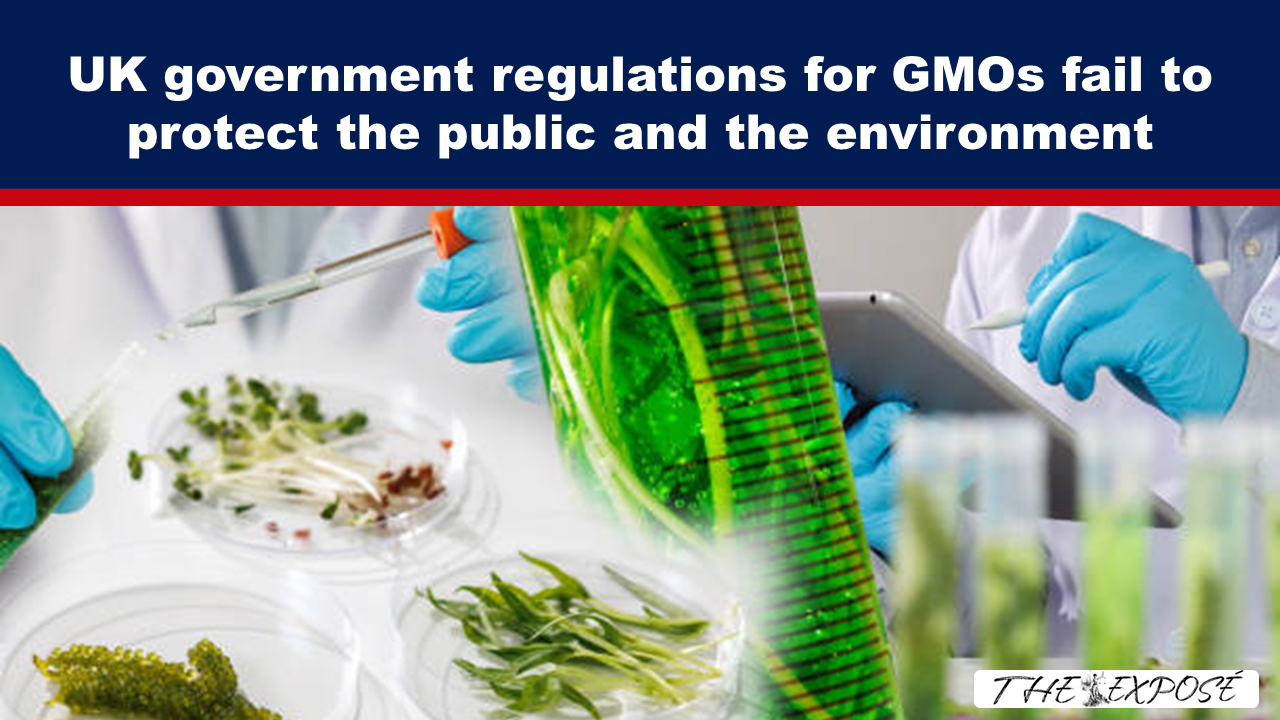
UK government regulations for GMOs fail to protect the public and the environment
At the beginning of May, GMWatch published a review of the UK government’s genetic technology legislation and supporting guidance.
The Genetic Technology (Precision Breeding) Act 2023 dismisses crucial genetic elements, including gene copy number, epigenetic status and location in the genome, which can impact the safety of genetically modified “precision bred” organisms.
Ignoring these elements can put public health and the environment at risk, as they can affect the function of newly introduced genetic features and the modified organism’s host genes.
And the Genetic Technology (Precision Breeding) Regulations 2025 fare no better. It lacks robust regulatory oversight, allowing gene-edited organisms to be marketed without thorough safety assessments.
The regulations ban regulators from requiring tests that could reveal risks associated with gene-edited, genetically modified organisms (“GMOs”).
The absence of mandatory detection methods and traceability means that problems caused by gene-edited organisms may never be traced and conventional and organic breeders may be vulnerable to patent infringement claims.
“The legislation and accompanying guidance fail to protect public health and the environment from the still poorly understood risks of gene-editing technologies,” the review concludes.
Let’s not lose touch…Your Government and Big Tech are actively trying to censor the information reported by The Exposé to serve their own needs. Subscribe to our emails now to make sure you receive the latest uncensored news in your inbox…
Don’t Look, Don’t Find: UK Government Blinds Itself to Risks of New GMOs
By GMWatch, 2 May 2026
GMWatch has published a scientific critique of the UK Government’s Genetic Technology (Precision Breeding) Regulations 2025 and the corresponding ACRE (Advisory Committee on Releases to the Environment) and FSA (Food Standards Agency) guidance documents on new genetically modified (“GM”), gene-edited, “precision bred” (“GM-PB”) plants.
The critique is authored by GMWatch co-director Claire Robinson and molecular geneticist Prof Michael Antoniou. It explains why the Regulations and guidance documents are scientifically invalid and fail to protect public health and the environment from risky new generation genetically modified organisms (“GMOs”).
In particular, the critique shows that the ACRE guidance document for applicants, published in November 2025, is so flawed that it significantly weakens the already ill-conceived 2025 Regulations. For example:
• ACRE fails to adequately define and characterise the “natural variation” to which GM-PB plants are claimed to be equivalent. The ACRE guidance document enables the applicant for approval of a claimed GM-PB plant to self-declare that it could have arisen naturally or through conventional breeding when in fact this is only one – idealised – potential outcome of gene editing, among many potential outcomes that go far beyond anything that could arise in nature or conventional breeding.
• The ACRE guidance document ignores evidence that gene editing can give rise to biological outcomes that are frequently very different from, and go far beyond, those that could arise in nature, or in conventional breeding, or in chemical- or radiation-induced random mutagenesis breeding, and that they pose different and potentially higher risks. This is because the processes of altering the DNA in each of these methods are different, causing different types of intended and unintended changes, which in turn lead to different risks.
• ACRE ignores the likelihood and scale of genetic changes in gene editing vs nature. While some types of changes caused by gene editing may also occur in nature, or conventional breeding, or mutagenesis breeding, the ACRE guidance document fails to take into account the likelihood, frequency, spatial scale and timescales with which such changes might occur in the different breeding systems. Upscaling mutations (DNA damage), as occurs in gene editing, also means upscaling risk.
• The tests needed to establish nature-equivalence are not required. The 2025 Regulations stipulate that to qualify as a GM-PB plant and thus escape risk assessment, monitoring and labelling, the gene editing process must not alter the plant’s toxicity, allergenicity and nutritional content in a way that would affect its safety.
Yet in order for an applicant for approval of a GM-PB plant to demonstrate that this is the case, they would have to consider the full spectrum of both intended and unintended changes caused by the entire process of gene editing (including the obligatory and highly mutagenic tissue culture stage). These changes would have to be analysed using adequate methods – long-read whole genome sequencing, followed by “omics” molecular analysis. However, the ACRE guidance document does not require these to be carried out. So, the declared natural-like status of a GM-PB plant would be nothing more than an evidence-free “wish,” as opposed to a verifiable fact.
Even worse, the secondary legislation that set out how the regulations would be implemented forbids government regulators from ever finding out that a GM-PB organism is different from, and riskier than, conventionally bred organisms. Even when it is.
The critique also shows that the UK Food Standards Agency (“FSA”) has deserted its responsibility of ensuring that food is safe to eat. It reflects without question the weak wording of the 2025 secondary legislation that only requires the applicant to avoid introducing genetic changes that are “expected to” alter the toxicity, allergenicity or nutritional content in a way that could affect the food safety of the GM-PB organism – entirely ignoring the way gene editing can result in unintended DNA damage that can lead to unexpected outcomes.
In a similar vein, the FSA’s guidance document states that all the applicant has to do to avoid independent risk assessment is to “consider whether genetic changes may be reasonably anticipated to alter levels of substances other than those targeted (including potentially harmful substances), or change nutritional quality (nutrition).”
So, if the applicant declares that they didn’t “expect” or “anticipate” their GM-PB plant to be toxic, allergenic or have an altered nutritional quality, they just might escape all legal consequences, even if the plant is later proven to have all three problems. Naivete, dishonesty, and irresponsibility are baked into the guidance as legal defences.
In sum, the Regulations and the accompanying guidance documents are a recipe for a “don’t look, don’t find” approach to the risks of new generation GMOs.
About the Author
GMWatch is an independent organisation that seeks to counter the enormous corporate political power and propaganda of the genetically modified organisms (“GMO”) industry and its supporters by providing the latest news and commenting on genetically modified (“GM”) foods and crops, their associated pesticides and related issues.

While previously it was a hobby culminating in writing articles for Wikipedia (until things made a drastic and undeniable turn in 2020) and a few books for private consumption, since March 2020 I have become a full-time researcher and writer in reaction to the global takeover that came into full view with the introduction of covid-19. For most of my life, I have tried to raise awareness that a small group of people planned to take over the world for their own benefit. There was no way I was going to sit back quietly and simply let them do it once they made their final move.
Recent Top Stories
Sorry, we couldn't find any posts. Please try a different search.