Net Zero: Premeditated Industrial Destruction (Part 12) – The Expose
Net Zero: Premeditated Industrial Destruction (Part 12)
Many economists conveniently blame Brexit for lower investment, lower productivity and significantly lower exports, but it’s not the case; it’s due to the UK government’s Net Zero polices.
The oil, gas and coal industries require large capital investments but they are the most productive and produce important materials for the UK’s export industries.
The loss of North Sea oil and gas production has a large economic impact in its own right and an even greater impact that extends further along the value chain, hollowing out industries that produce vital building blocks society depends upon, GBBC says.
Let’s not lose touch…Your Government and Big Tech are actively trying to censor the information reported by The Exposé to serve their own needs. Subscribe to our emails now to make sure you receive the latest uncensored news in your inbox…
On 1 April, the Great British Business Council (“GBBC”), a newly formed think tank, published a paper titled ‘Premeditated Industrial Destruction: How the UK Destroyed Its Industry and A Plan To Reverse This’.
The paper is authored by economist Catherine McBride, retired engineer and consultant David Turver and public relations consultant Brian Monteith. It demonstrates how the Government’s Net Zero policies are destroying the foundations of the UK economy and provides recommendations on how Net Zero could be reversed.
Because this paper is important in revealing some home truths, we are reproducing it in a series of articles, more manageable chunks if you will, so that, hopefully, more will read it, or at least read part of it. We have made some minor edits for readability purposes. For those who choose to read the paper in one sitting, you can do so HERE.
Chapter 11: Economic statistics
By Great British Business Council, 1 April 2026
The oil, gas and coal projects involve large capital investment; are highly productive, with large refineries employing a few hundred employees; and, produce important materials for the UK export industries. The closure of refineries and the decommissioning of wells have led to lower investment, lower productivity and significantly lower exports, which many economists conveniently attribute to Brexit without examining which exports have experienced the larger reductions.
GVA and Productivity Section
The importance to the economy of the oil and gas sector and downstream activities of refining, chemical production and pharmaceutical production can be illustrated by examining the Government Gross Value Added (“GVA”) and productivity statistics by industry sector.
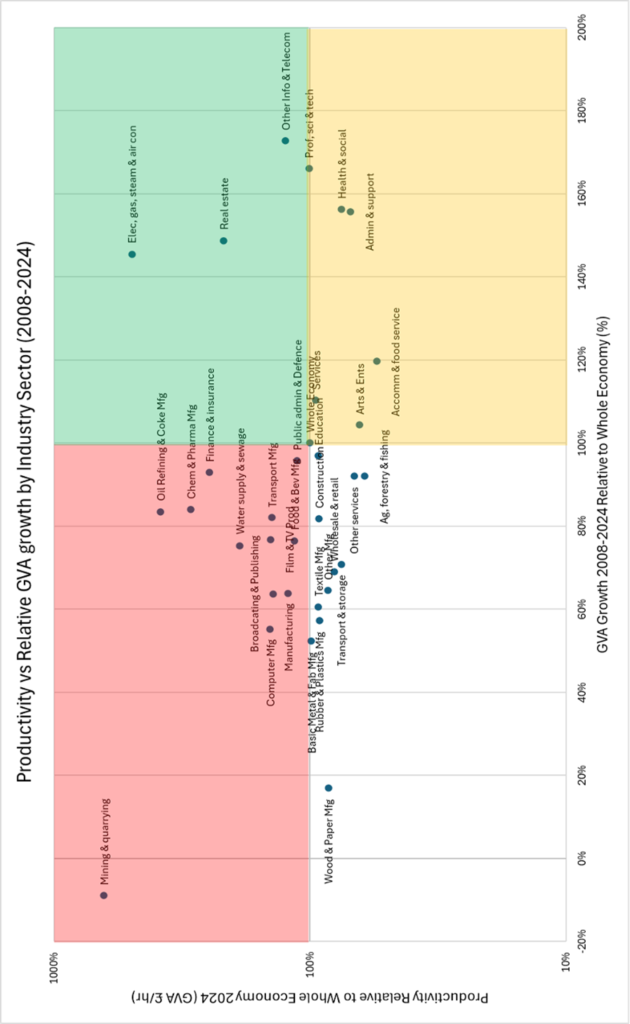
Figure 25 on page 101, analyses the period from the beginning of the Climate Change Act in 2008 to 2024, comparing the relative growth rates of GVA by industry with those of relative output per hour.
The x-axis shows the relative growth rate of different industry sectors over the period. The midpoint of 100% represents the overall economic growth rate over the period. The y-axis shows the relative productivity of each sector in 2024 on a log scale, with the mid-point of 100% representing the whole economy.
In the white segment, we can see that sectors such as wholesale and retail, agriculture, forestry and fishing, and transport and storage are growing more slowly than the overall economy and have below-average productivity, measured by gross value-added per hour worked.
The yellow segment shows that sectors such as accommodation and food service, health and social care, and arts and entertainment are growing faster than the whole economy but have lower-than-average productivity.
The green segment shows sectors such as real estate and information and telecommunications growing faster than the overall economy and achieving above-average productivity.
The red segment shows sectors with above-average productivity growing more slowly or shrinking in absolute terms compared to the whole economy. Included in this segment are mining and quarrying, which includes oil and gas extraction, where GVA has fallen in absolute terms by 7% over the period, yet productivity is 637% of the whole economy average. The red segment also includes oil refining as well as the chemical and pharmaceutical sectors, both of which have much higher productivity, 384% and 292% of the average, respectively. Both these sectors have grown more slowly than the whole economy, too.
Hours worked per week are down 9% in mining and quarrying, 14% in oil refining and 2% in chemicals and pharmaceuticals, indicating job losses over the period. While the job losses in the past have been relatively modest, the loss of GVA is much more significant because these industries add so much more value per hour worked.
Now, high taxes on domestic oil and gas producers, coupled with the effective ban on new exploration drilling has led to estimates of 1,000 jobs per month being lost in the oil and gas industry in the North Sea. The economic impact of these job losses is far greater than the headline figure, because this sector generates more than six times the value added per hour worked than the whole economy.
There are also additional impacts further downstream in refining and petrochemicals. Grangemouth oil refinery closed about a year ago, with the loss of 400 jobs. The oil refining sector produces about four times the GVA per hour worked as the whole economy, so again, the economic impact of these job losses is amplified. Although the refinery has closed, INEOS Chemicals Grangemouth continues to produce essential ethylene feedstock for the petrochemicals and plastics industry. The chemicals and pharmaceutical manufacturing industry generates about three times as much value added per hour worked as the whole economy.
The loss of North Sea oil and gas production has a large economic impact in its own right and an even greater impact that extends further along the value chain, hollowing out industries that produce vital building blocks society depends upon. This damages the domestic economy, negatively impacts the balance of trade and undermines economic and energy security.
Trade balance
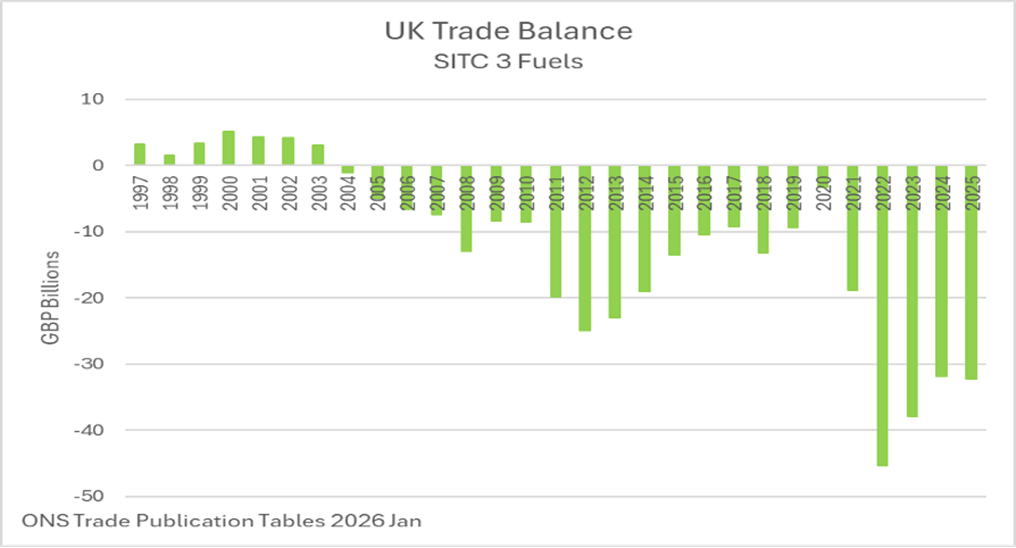
The UK government’s environmental policy has had a detrimental effect on UK exports, forcing the UK to import goods it once produced and leaving it with a goods trade deficit of £250 billion in 2025. The UK’s most heavily affected export sectors are fuel, chemicals, plastics, steel and other materials. UK chemical exports have been falling steadily for many years due to the UK’s uncompetitive energy costs, stringent environmental regulations, emissions trading schemes, limited investment in new production facilities and a shortage of raw materials from oil refineries.
Lower UK oil production, due to restrictions on new wells and field development, along with an excessive 78% tax rate, has caused UK production to fall by 42% since 2019, with a knock-on effect on exports. Fuel exports used to be among the UK’s largest exports. Since 2019, crude oil exports, measured in tonnes to remove price fluctuations, have declined by 37% through 2024. UK oil refinery output was down by 13% between 2019 and 2024, while oil product exports fell by 8%, having already fallen by a third since 2007.
UK environmental policy has also outpaced the UK manufacturing sector and manufactured goods exports. Lower UK oil production and refining have further reduced UK exports of chemicals and plastics: Using ONS data in ‘Current Prices’, organic chemical exports fell by 54% between 2019 and 2024, while plastics exports declined by 17%.
However, the most significant decline is in the UK’s exports of internal combustion engine (“ICE”) petrol and diesel cars. Car manufacturing is a major UK export industry. However, the UK Electric Vehicle (“EV”) mandates requiring its car manufacturers to transition to all-EV production have lowered production and exports. Total UK vehicle exports (HS87) were 15% lower in 2024 than in 2017, due to reduced exports of ICE cars. Although exports of hybrid, plug-in hybrid and EVs have increased from virtually nothing in 2017, they can’t make up for the loss of ICE sales; UK car exports in total remain £6 billion lower than in 2017.
The EU’s EV mandate, coupled with the UK’s lack of a large-scale domestic EV battery manufacturer, has made compliance more difficult and reduced vehicle exports. The UK’s high energy costs have made car production twice as expensive as in Germany or France, while the UK’s aggressive EV mandates have left UK producers struggling to meet even UK domestic requirements. Fortunately, the UK’s ICE car exports to the US have remained strong and the US’s recent abolition of its EV mandate should help UK vehicle exports going forward.
![Line chart of UK car exports by engine type (2014–2024): ICE declines; Hybrid and EV rise; Plug-in hybrid small; others negligible.] , but remove bracket here?](https://expose-news.com/wp-content/uploads/2026/04/image-102.png "image - The Expose")
Other exports
After vehicles and aircraft parts, the UK’s second largest export is Chemicals. Using Chain Volume Measures (“CVM”) to account for inflation, UK ‘SITC 5 Chemical’ exports fell by 15%.
‘SITC 5: Chemical’ exports include organic and inorganic chemicals, fertilisers, plastics, medicinal and pharmaceutical products, dyes, paints and pigments, and cleaning products. The UK used to be a major manufacturer and exporter of all of these products; however, since 2016, several UK chemical plants have closed or relocated production. Ten large chemical complexes have closed in the UK in the past 5 years and consequently, chemical production has fallen by 40% since 2021. Dow Chemical (Wales) closed in 2023, INEOS’ plant at Grangemouth closed this year and ExxonMobil’s Fife plant will close next year. The reasons cited for these closures are: high energy costs, rising carbon taxes and global competition, which has made UK production uncompetitive.
‘SITC 6: Material manufactures’ exports in CVM have dropped by 22% since 2019, but by 28.6% since 2013. This is not about Brexit, but due to the closure of UK steel works at SSI Redcar in 2015, the reduction in production at Tata’s plants in Scunthorpe and Scotland since 2015, the mothballing and then closure of Liberty Steel and Tata’s closure of its blast furnaces at Port Talbot in 2024 are the causes of the UK’s lower exports to the EU in this sector. High UK energy costs, global competition from cheaper imports, financial instability and the transition costs of moving from coal-based blast furnaces to electric arc furnaces have led to production closures in the UK.
About The Great British Business Council
The Great British Business Council (“GBBC”) was established to enhance public and political understanding of the advantages a thriving business community provides to local security, standard of living and wellbeing. It aims to support British firms and small businesses by promoting well-crafted, practical, evidence-based policy reforms that foster enterprise and innovation. It is independent of any political party, as it hopes that all parties will consider adopting the straightforward, practical policy suggestions it proposes.
The GBBC is funded by private donations from concerned citizens who want the UK to thrive economically as it once did. If you would like to join us or donate to their cause, please contact in**@**BC.UK or follow them on LinkedIn, X (Twitter), Facebook, YouTube, TikTok and Bluesky.
Featured image: Cover of the GBBC paper, ‘Premeditated Industrial Destruction: How the UK Destroyed Its Industry and A Plan To Reverse This’
The Expose Urgently Needs Your Help…
Can you please help to keep the lights on with The Expose’s honest, reliable, powerful and truthful journalism?
Your Government & Big Tech organisations
try to silence & shut down The Expose.
So we need your help to ensure
we can continue to bring you the
facts the mainstream refuses to.
The government does not fund us
to publish lies and propaganda on their
behalf like the Mainstream Media.
Instead, we rely solely on your support. So
please support us in our efforts to bring
you honest, reliable, investigative journalism
today. It’s secure, quick and easy.
Please choose your preferred method below to show your support.

While previously it was a hobby culminating in writing articles for Wikipedia (until things made a drastic and undeniable turn in 2020) and a few books for private consumption, since March 2020 I have become a full-time researcher and writer in reaction to the global takeover that came into full view with the introduction of covid-19. For most of my life, I have tried to raise awareness that a small group of people planned to take over the world for their own benefit. There was no way I was going to sit back quietly and simply let them do it once they made their final move.
Recent Top Stories
Sorry, we couldn't find any posts. Please try a different search.