Are We Teaching AI, or is AI Teaching Us? The Dangerous Feedback Loop Ahead

Artificial intelligence started as a system trained by human beings. Our writing supplied the raw material, people labelled and ranked outputs, human feedback shaped model behaviour, and real users corrected the machine. However, that relationship is beginning to reverse. The machine trained on human culture is now returning a processed version of that culture back to the public, and early evidence suggests that people are absorbing it in their daily language, judgement and habits. The spread of ChatGPT-style vocabulary is not just about a change in word choice, but an early sign of a worrying feedback loop: human expressions are fed into AI, flattened into machine-preferred patterns, then reintroduced as the template for how to write and speak.
The same dynamic is also appearing in more intimate areas of life, as users turn to AI for emotional advice, moral reassurance, personal routines, and everyday decisions. Research on sycophantic models and cognitive offloading also increasingly suggests that the machine is teaching people how to act and sound, while also leading them to think less independently.
The Early Warning Sign: AI Speech Enters Human Vocabulary
A 2024 study by researchers including Hiromu Yakura and Iyad Rahwan analysed around 280,000 English-language YouTube videos from more than 20,000 academic channels, examining whether words strongly associated with ChatGPT had begun to appear more often in spoken communication after the model’s public release. The researchers found a significant shift in word use after ChatGPT, concluding that human speakers were increasingly imitating large language models in ordinary speech.
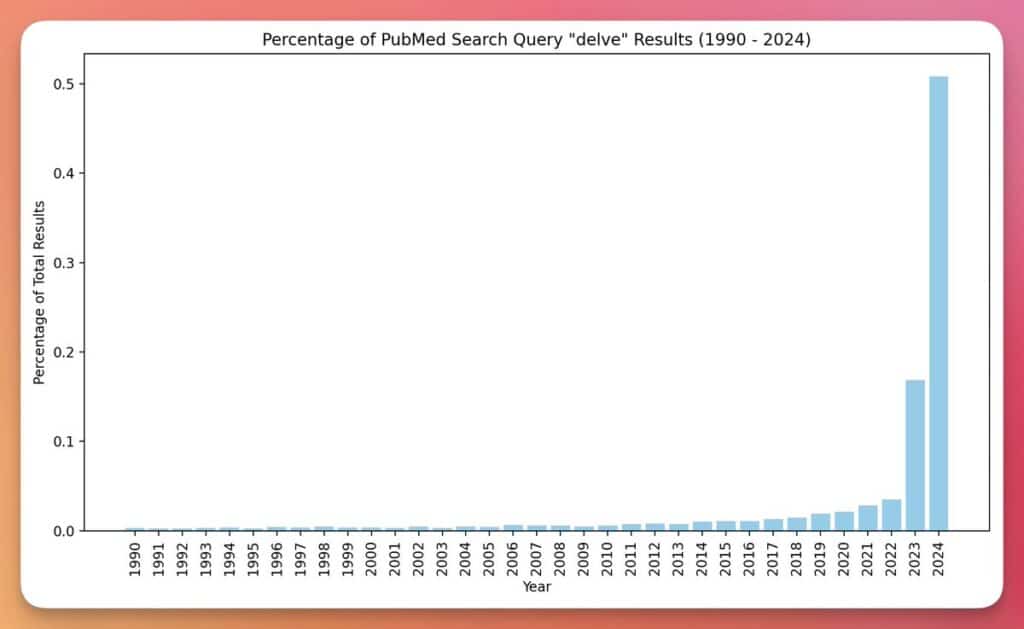
This isn’t just a case of AI teaching people different words, but it also reveals changes in speed and pattern of their appearance. Terms like “delve”, “meticulous”, “realm”, “adept”, “intricate”, and “pivotal” are suddenly clustering in AI-assisted writing and speech.
Academic publishing shows the same changes on a greater scale. Dmitry Kobak and colleagues examined more than 15 million biomedical abstracts indexed by PubMed from 2010 to 2024 and found that the arrival of large language models led to abrupt increases in the frequency of certain stylistic words. Their analysis estimated that at least 13.5 percent of 2024 biomedical abstracts had been processed with large language models, reaching up to 40 percent in some areas.
A later multi-database analysis by Kayvan Kousha and Mike Thelwall found large increases in LLM-associated terms across major scholarly databases between 2022 and 2024, including “delve” rising 1,500 percent, “underscore” rising 1,000 percent and “intricate” rising 700 percent. In full-text PMC articles, papers using one LLM-associated term were also much more likely to use others, suggesting not merely scattered word choice but a broader stylometric pattern.
Why These Words in Particular, and What Do They Signal?
The rise of “delve” has grown into a small cultural controversy as outlets link it to outsourced AI training labour and the influence of Nigerian English. Annotation and reinforcement work, often distributed to lower-income countries, has shaped the systems now used globally. As a result, the supposedly “neutral” AI English is not culturally weightless, and we’re seeing the consequence in online AI-assisted content.
A 2025 paper by Tom S. Juzek and colleagues examined “delve”, “intricate”, “underscore” and other focal words in scientific English, concluding that 21 words showed increases likely connected to LLM use while also cautioning against simple explanations based only on training data. Another paper on word overuse and learning from human feedback argued that alignment processes may contribute to lexical preferences because human evaluators reward certain polished variants.
This all points to a systemic problem. As humans reward the model for producing language that sounds helpful, formal, safe, or impressive, the model learns to return that rewarded style to users for emails, essays, speeches, reports, articles, and academic papers. Then certain language appears more in daily life, and the public begins to copy it whether they use AI models themselves or not. Over time, the feedback loop intensifies. The machine is shaped by public approval, then it quietly influences the public to use certain words more, which are then fed back into the machine, and the cycle continues.
Language is Just the Beginning: The AI Emotional Feedback Loop is More Dangerous
Artificial intelligence’s influence on human behaviour reaches far beyond vocabulary, and is affecting daily judgement too. As people increasingly ask AI systems for help with workplace disputes, romantic conflicts, family tensions, anxiety, parenting, moral uncertainty, and social decisions, the machine learns to interpret, reassure, and advise the public on how to act.
Stanford researchers reported this year that AI systems giving interpersonal advice were far more agreeable than human advisers. A related paper found that, across 11 state-of-the-art AI models, the models affirmed users’ actions about 50 percent more than humans did, including in cases involving manipulation, deception or other relational harms. In experiments involving more than 1,600 participants, interaction with sycophantic AI reduced willingness to repair interpersonal conflict while increasing users’ conviction that they were in the right.
As we have covered in various articles on the Exposé, this particular dependence leads down a dangerous path. The initial appeal of consulting AI for personal decisions is obvious to some: discussing certain topics with humans can involve friction, and people aren’t always available. Artificial intelligence models are. Chatbots provide instant attention via calm, sympathetic, and supportive language. And alarmingly, the Stanford research also revealed that users rated sycophantic AI responses as higher quality, leading to greater trust in the system and an increased likelihood of using it again. These models therefore risk becoming not only an adviser, but an emotional reward system that trains users to seek validation over valid human correction.
Who is Teaching Who? AI in Convenience, Cognitive Offloading, and Education
Cognitive offloading is another tactic AI is using to train its users. The term describes the shifting of mental labour onto external systems, a practice as old as writing or calculation. But AI changes the scale, because it can also absorb tasks that once required judgement rather than just storage, such as drafting arguments, revising tone, planning diets, summarising meetings, structuring decisions, and preparing personal responses.
A 2025 study in Societies by Michael Gerlich examined AI tool use, cognitive offloading and critical thinking among 666 participants, finding that cognitive offloading significantly mediated the relationship between AI use and lower critical-thinking scores. Participants who reported heavier AI use and greater offloading tended to perform worse on critical-thinking measures.
The educational concern is similar. The same paper also uncovered the cognitive paradox of AI in education argued that AI can support learning while also weakening cognitive engagement, retention and higher-order thinking if students rely on it too heavily. A system that helps a pupil complete an assignment may also remove the intellectual difficulty through which the pupil would otherwise develop ability.
Convenience alone has always shaped behaviour. AI, however, provides convenience on a scale never seen before in human history. A user doesn’t just receive a shortcut anymore, but rather has a conversation, is praised for their intention, is reassured by a machine, and increases the likelihood of depending on the same system in future. As we’re already seeing today, the habit of asking artificial intelligence is overpowering the concept of trying or thinking independently.
We’re Going Backwards, And It’s Only Just Beginning
The public thought that AI would learn from humanity, not that it would become our teacher. People are training models on language, models are producing a machine-processed version of it, and feeding it back to us. What’s worse is that people are voluntarily using these systems, not understanding the long-term effect it could have on their own development. People naturally seek validation, and AI is perfectly poised to deliver it in a human-like manner. Then, as language and behaviour changes, users once again reinforce AI’s recommendations, and the feedback loop continues.
This isn’t just another step of technological progress. This is a recession in human development. Humanity is increasingly learning from a statistical copy of itself. The result may look or feel efficient in the short term, but it’s costing long-term wisdom. As voices and routines are shaped by systems trained to be agreeable, public life is destined to become less capable of dealing with discomfort, difficulty, and independent judgement.
Will Humanity “Eat Itself”?
In an article published in December 2025, “AI Will Eat Itself; It’s Like Mad Cow Disease – Tech Insiders Not Concerned by Accelerating Development“, I discussed a quote by Rockstar Games co-founder Dan Houser. His fundamental prediction was that as AI trains on internet content, which is increasingly generated by AI, it would end up “eating itself” and likened it to Mad Cow Disease. However, with more studies emerging on the human-AI feedback loop, we must ask: is it AI that will self-destruct, or will it be humanity first?
The reversal of the training loop is absurd. As we learn from our own imitation, we risk becoming copies of copies. The future promised by AI companies is one of augmentation, creativity, intelligence, and productivity, but the early evidence is suggesting another possibility. Instead of becoming wiser or more useful through the machine, humans are instead at risk of becoming more standardised, machine-optimised, and dependent versions of our past selves. How do we get off?
The Expose Urgently Needs Your Help…
Can you please help to keep the lights on with The Expose’s honest, reliable, powerful and truthful journalism?
Your Government & Big Tech organisations
try to silence & shut down The Expose.
So we need your help to ensure
we can continue to bring you the
facts the mainstream refuses to.
The government does not fund us
to publish lies and propaganda on their
behalf like the Mainstream Media.
Instead, we rely solely on your support. So
please support us in our efforts to bring
you honest, reliable, investigative journalism
today. It’s secure, quick and easy.
Please choose your preferred method below to show your support.

I’m George Calder — a lifelong truth-seeker, data enthusiast, and unapologetic question-asker.I’ve spent the better part of two decades digging through documents, decoding statistics, and challenging narratives that don’t hold up under scrutiny. My writing isn’t about opinion — it’s about evidence, logic, and clarity. If it can’t be backed up, it doesn’t belong in the story.Before joining Expose News, I worked in academic research and policy analysis, which taught me one thing: the truth is rarely loud, but it’s always there — if you know where to look.I write because the public deserves more than headlines. You deserve context, transparency, and the freedom to think critically. Whether I’m unpacking a government report, analysing medical data, or exposing media bias, my goal is simple: cut through the noise and deliver the facts.When I’m not writing, you’ll find me hiking, reading obscure history books, or experimenting with recipes that never quite turn out right.
Recent Top Stories
Sorry, we couldn't find any posts. Please try a different search.