Net Zero: Premeditated Industrial Destruction (Part 6) – The Expose
Net Zero: Premeditated Industrial Destruction (Part 6)
Compared to 2000, UK fertiliser output has halved. The decline in production has been driven by plant closures, energy costs, environmental regulation and global market restructuring.
Most fertilisers for crops are made from ammonia (NH₃) produced from natural gas. In 2004, UK gas production was equal to UK consumption. But by 2024, UK gas production had fallen to about half of UK consumption, even though UK consumption had fallen by 40% over the same period.
The government’s carbon-related policy costs is one of the reasons for the decline in the UK’s fertiliser industry and rise in food costs.
Let’s not lose touch…Your Government and Big Tech are actively trying to censor the information reported by The Exposé to serve their own needs. Subscribe to our emails now to make sure you receive the latest uncensored news in your inbox…
On 1 April, the Great British Business Council (“GBBC”), a newly formed think tank, published a paper titled ‘Premeditated Industrial Destruction: How the UK Destroyed Its Industry and A Plan To Reverse This’.
The paper is authored by economist Catherine McBride, retired engineer and consultant David Turver and public relations consultant Brian Monteith. It demonstrates how the Government’s Net Zero policies are destroying the foundations of the UK economy and provides recommendations on how Net Zero could be reversed.
Because this paper is important in revealing some home truths, we are reproducing it in a series of articles, more manageable chunks if you will, so that, hopefully, more will read it, or at least read part of it. We have made some minor edits for readability purposes. For those who choose to read the paper in one sitting, you can do so HERE.
Chapter 4: Gas use in electricity, heating, chemicals and fertilisers
By Great British Business Council, 1 April 2026
Introduction
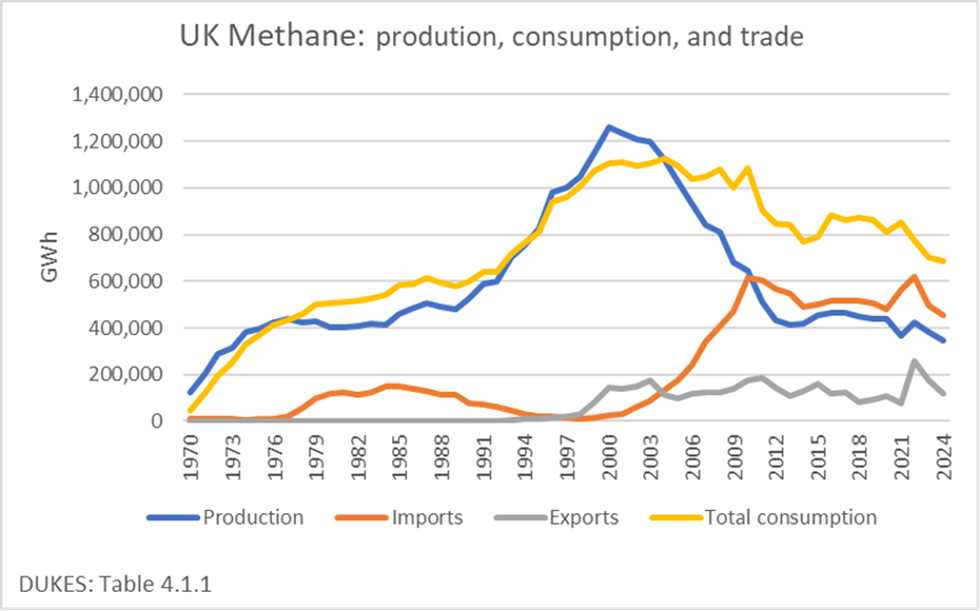
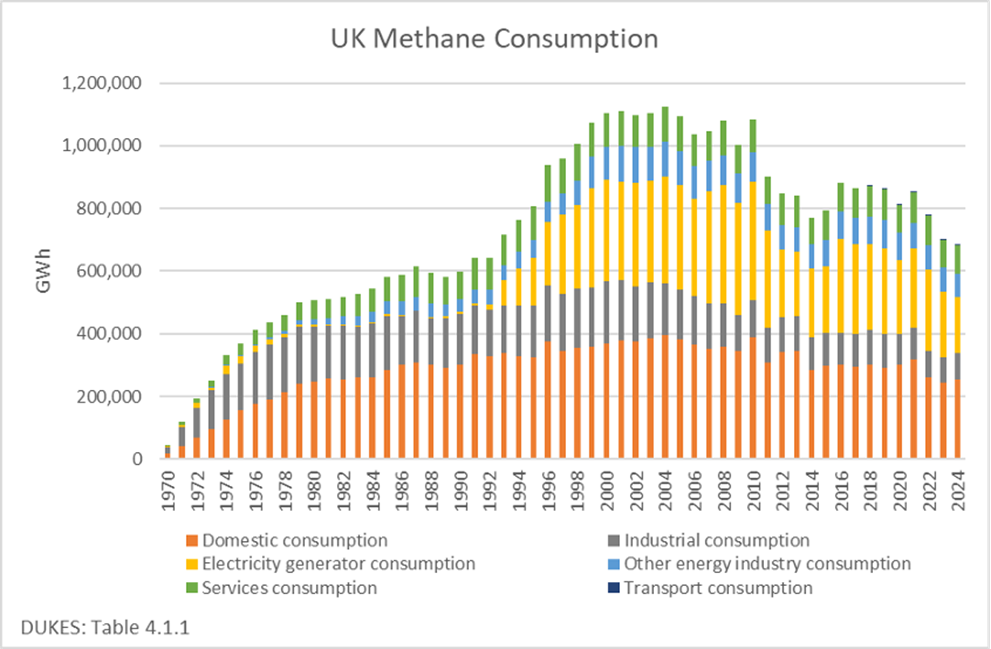
In 2004, UK gas production was equal to UK consumption; by 2024, UK gas production had fallen to about half of UK consumption, even though UK consumption had fallen by 40% over the same period. The biggest falls in consumption have been in industrial consumption and electricity generation, both now about half their 2004 levels. Surprisingly, UK imports account for about two-thirds of UK consumption because the UK acts as a land bridge for Norwegian gas and US LNG to reach Belgium, Ireland and the Netherlands via UK pipelines.
In 2024, the UK consumed 683,947 GWh of methane, of which
- 37% was used for domestic heating,
- 26% for electricity generation,
- 12% for industrial uses,
- 11% in other energy industries, and
- 13% for services.
In 2024, UK domestic methane production was 343,858 GWh, of which 118,427 GWh was exported and 453,301 GWh was imported.
Electricity production
In 2025, 31% of UK electricity production came from gas. The UK also requires gas-fired electricity to be on standby to step in when wind generation drops, at night or on cloudy days. Since the UK fracking moratorium in November 2019, UK non-domestic average electricity costs, including the Climate Change Levy (“CCL”), have risen by 68%, from 13.96p/kWh to 23.47p/kWh, while the cost for small companies has increased by 133%. (Calculations from Q4 2019 to Q3 2025.) Average non-domestic gas prices, including CCL, have increased by 101%, from 2.49 p/kWh to 5.0 p/kWh. Very large gas users have experienced a 114% increase in costs. (Again, calculations are from Q4 2019 to Q3 2025.)
Domestic heating
Gas central heating remains the dominant heating system in UK homes, providing heating for 21.2 million UK households, approximately 86% of all homes. This proportion increases to 90% in urban areas.
Fertilisers, ammonia and other gases
In 2025, the UK produces around 1.2–1.3 million tonnes of mineral fertilisers annually, with nitrogen-based products (ammonium nitrate, urea, NPK blends) accounting for most of it. Domestic production of phosphate and potash fertilisers has largely ceased, with the UK now reliant on imports. Domestic production made using imported ingredients now accounts for less than half of the UK fertiliser demand, with the remainder imported from the EU, North Africa and North America. Fertiliser production is gas-intensive, so fertiliser production has moved to regions with cheaper gas. UK ETS allowances, as well as strict nitrogen-emissions regulations, have made domestic fertiliser production less competitive with imported fertiliser.
Compared to 2000, UK fertiliser output has halved, and the product mix has shifted away from broad-spectrum fertilisers toward nitrogen-only and imported blends, driven by plant closures, energy costs, environmental regulation and global market restructuring.
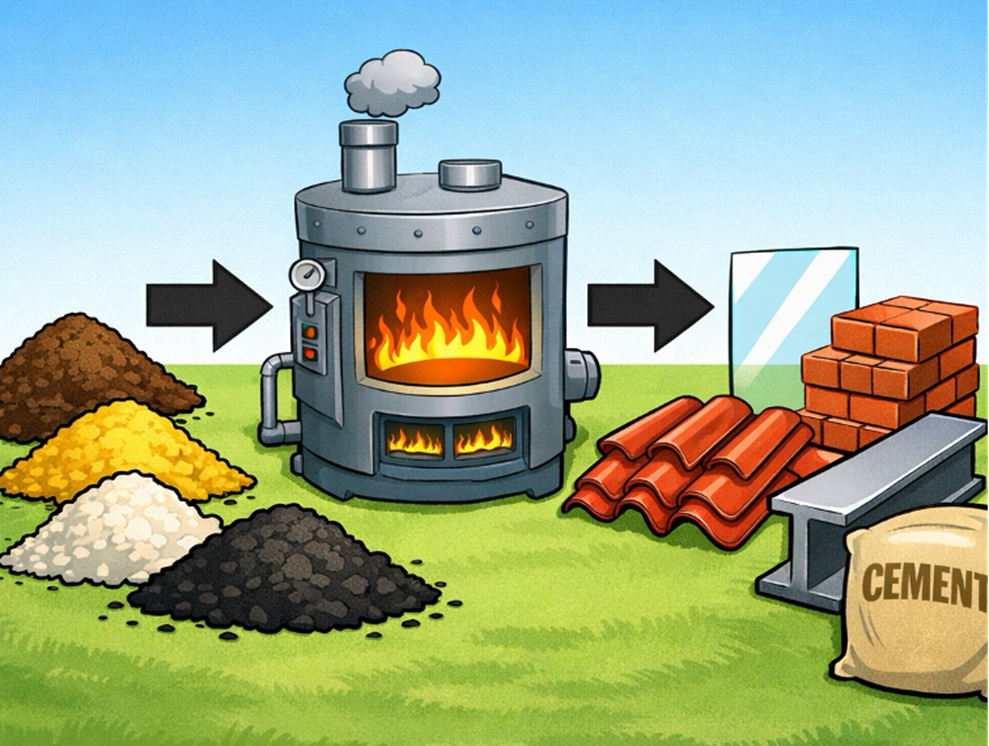
Most fertilisers are made from ammonia (NH₃) produced from natural gas. It takes about 0.9 tonnes of natural gas (methane, CH4) to produce 1 tonne of ammonia. The process requires high temperatures (400–500°C) and pressures (>100 bar), typically generated by coal or gas combustion, although it can also be powered by electricity. Conventional production emits about 2–3 tonnes of CO₂ per tonne of nitrogen fertiliser, plus nitrous oxide (N₂O) emissions from nitric acid production, which can add another 0.2–2 tonnes of CO₂-Equivalent (CO2e) per tonne, depending on abatement technology.
UK ammonium nitrate and other nitrogen-based fertilisers are still produced at Billingham, Teesside, by CF Fertilisers UK, which is the only remaining large-scale fertiliser producer in the UK; however, they use imported ammonia. The Billingham plant was the UK’s largest producer of ammonia, ammonium nitrate and CO2. However, the ammonia plant at Billingham was permanently shut in September 2022 due to high gas prices and was not restarted. The company operates entirely on imported ammonia to produce ammonium nitrate and nitric acid. The plant also no longer runs a steam-methane reformer, so it has no use for UK natural gas.
CF Fertilisers also closed its Ince manufacturing facility in Cheshire in 2022, when European gas prices spiked. The CF Fertiliser plant was one of the dominant industries in Ince; its closure resulted in the loss of 283 jobs directly and many more indirectly. CF Fertilisers’ UK Managing Director described the Ince plant as a “high cost producer in an intensely competitive global industry.” He also explicitly warned that carbon-related policy costs were among the reasons for the loss of competitiveness of UK ammonia production. The UK’s Emissions Trading Scheme (“ETS”) applies to ammonia production. Producing one tonne of ammonia requires 28-35 GJ of natural gas.
The Agricultural and Horticultural Development Board (“AHDB”) estimates that the UK imports about 60% of the fertiliser it uses. This will result in a Carbon Border Adjustment Mechanism (“CBAM”) of approximately £50 per tonne being added to the price of imported fertiliser from 2027. The government also intends to add a CBAM on imported ammonia, which would increase costs for domestically produced fertilisers. This will be passed on to farmers, raising the price of domestically produced food. Despite current politicians from many parties promising to reverse the “cost of living crisis,” they do not address these increased input costs.
In the UK, fertiliser use typically increases arable crop yields by 30–50% and grassland productivity by 40–60% compared to unfertilised systems. Without fertiliser, most soils cannot supply sufficient nitrogen, phosphate and potash to sustain high yields; therefore, fertiliser is critical for both food security and livestock forage production. Making fertiliser more expensive than it needs to be, through the addition of an ETS or a CBAM, makes UK-produced foods more expensive or discourages farmers from using it, thereby lowering crop yields. This has been the result of higher fertiliser costs as UK fertiliser use has fallen by 19.3% in the ten years up to 2024,
Although CBAMs are intended to equalise the cost of imported and domestically produced goods, this doesn’t work when the majority of the goods are imported, and the ingredients needed to produce them domestically are also imported. In 2024, the UK imported 3.22 million tonnes of the types of fertilisers and fertiliser ingredients covered by the latest update to the UK’s proposed CBAM. Almost all these imports will have a CBAM applied to both their CO2 and their nitrous oxide emissions. This will increase the cost of food production, as there is no alternative domestic supply.
An alternative market-based solution is to remove the additional 38% Energy Profits Levy (“EPL”) on gas production, thereby lowering the UK’s domestic feedstock cost for fertiliser production. And encourage new oil and gas exploration. There is already an ETS for the energy used in combustion, and an ETS is charged for the production of ammonia and nitric acid. The EPL constitutes a form of triple taxation, making UK fertiliser uncompetitive with imported fertiliser. Removing these costs would also eliminate the need to impose a CBAM on an essential input for food production and food security.
Hydrogen
Hydrogen is used in refining, fertiliser production, ammonia and methanol production, and in some bus transport.
Almost all hydrogen in the UK is produced by combining methane (CH4) with Steam (H2O) at temperatures between 700 °C and 1,100 °C, releasing 3 molecules of hydrogen (H2) and 1 molecule of Carbon dioxide (CO2). The furnaces use natural gas to generate the required heat, thereby producing CO2 that contributes to the total CO2 emissions from the chemical reaction. The CO2 emitted by the steam methane reforming plant will require the purchase of ETS allowances for the CO2 emitted during hydrogen production.
In 2025, the UK produced approximately 27 TWh, equivalent to about 0.8 million tonnes of hydrogen. Most of this, 25 TWh, or 0.75 million tonnes, was generated from natural gas using steam methane reforming without emissions capture. The hydrogen produced is known as Grey hydrogen. The UK also made a small amount, 1-1.5TWh (30 to 40 kt), of hydrogen using electrolysis powered by renewables, which is known as green hydrogen. And an even smaller amount, 0.5TWh or 15kt, of hydrogen from natural gas, where the CO2 emissions are captured. This is known as blue hydrogen. There are currently 2 GW of low-carbon hydrogen production under construction, of which 1 GW will be green hydrogen and 1 GW blue hydrogen.
The government plans to develop 10 GW of low-carbon hydrogen capacity by 2030, with at least half of it generated by renewable-powered electrolysis, and several hydrogen plants are under construction. Although several hydrogen projects have also been cancelled: BP’s H2Teesside blue hydrogen project, a 1-1.2 GW natural gas-based hydrogen plant, has been cancelled due to weak industrial demand for hydrogen. Scottish Power’s Cromarty and Whitelee green hydrogen projects, expected to produce 17.7 MW, were suspended in 2024 despite receiving government support through the Hydrogen Allocation Round 1 (“HAR1”).
The closure had a knock-on effect on Aberdeen’s two hydrogen refuelling stations at Kittybrewster and Cove. This grounded the 25 hydrogen-fuelled hydroliner double-decker buses operated by Aberdeen City Council. The Buses were out of service for over a year because they could not be refuelled. Aberdeen City Council has ended its joint venture with BP and decided to sell its entire hydrogen bus fleet and move to battery-electric buses instead. The buses were funded by the Scottish Government with £15 million for buses, station upgrades and the Aberdeen Hydrogen Hub, the European Commission JIVE programme invested €2 million, and the Council invested £2.5 million. It was hoped that the programme would create 700 jobs.
There is a large cost differential in the various ways of producing Hydrogen: grey hydrogen H2 made from methane, CH4, is relatively cheap at around $2/kg; blue hydrogen, also made from methane but with the released CO2 captured, is $3/kg; while green Hydrogen made using electrolysis to split water powered by renewable energy is $6/kg.
Although the closures of the production plants and hydrogen buses have been a setback for the hydrogen industry, Hydrogen UK believes there will be 30,000 direct jobs in the industry by 2030, with 64,000 direct, indirect and induced jobs, and predicts its annual Gross Value Added (“GVA”) will be £7 billion, with direct GVA of £2.9 billion. Hydrogen UK also believes there will be over 100 organisations across the value chain.
About The Great British Business Council
The Great British Business Council (“GBBC”) was established to enhance public and political understanding of the advantages a thriving business community provides to local security, standard of living and wellbeing. It aims to support British firms and small businesses by promoting well-crafted, practical, evidence-based policy reforms that foster enterprise and innovation. It is independent of any political party, as it hopes that all parties will consider adopting the straightforward, practical policy suggestions it proposes.
The GBBC is funded by private donations from concerned citizens who want the UK to thrive economically as it once did. If you would like to join us or donate to their cause, please contact in**@**BC.UK or follow them on LinkedIn, X (Twitter), Facebook, YouTube, TikTok and Bluesky.
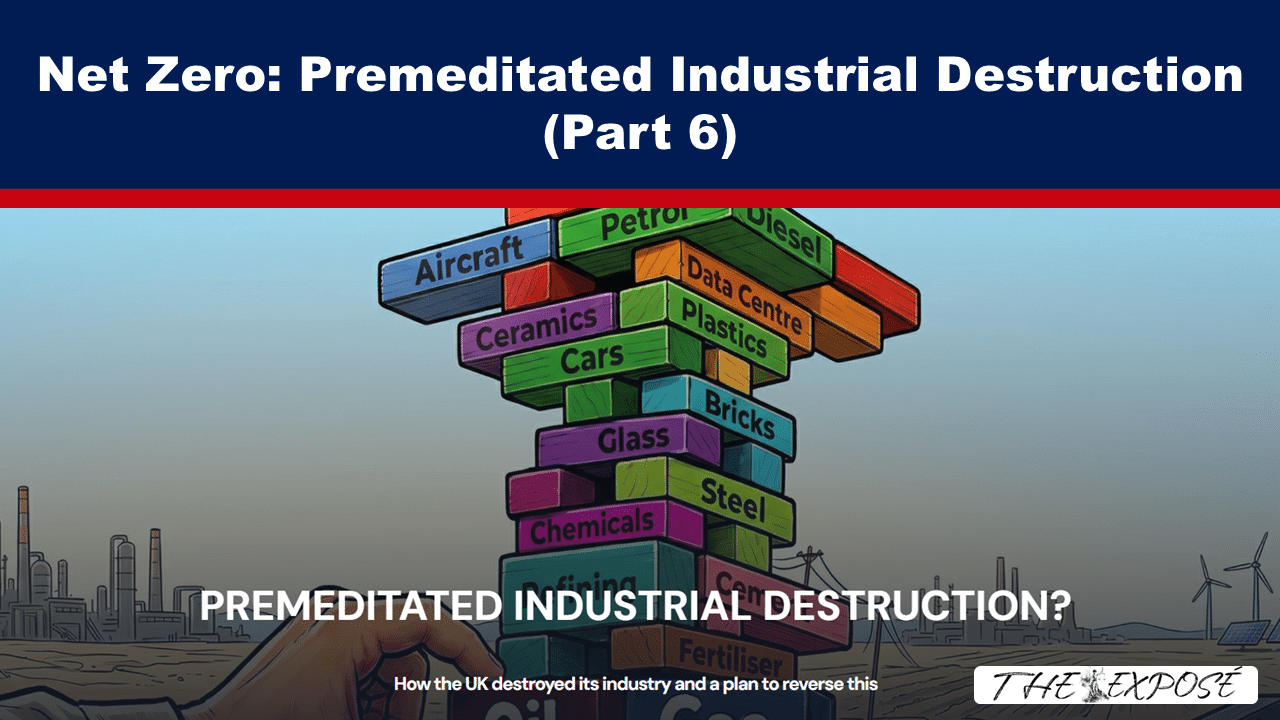
Featured image: Cover of the GBBC paper, ‘Premeditated Industrial Destruction: How the UK Destroyed Its Industry and A Plan To Reverse This’
The Expose Urgently Needs Your Help…
Can you please help to keep the lights on with The Expose’s honest, reliable, powerful and truthful journalism?
Your Government & Big Tech organisations
try to silence & shut down The Expose.
So we need your help to ensure
we can continue to bring you the
facts the mainstream refuses to.
The government does not fund us
to publish lies and propaganda on their
behalf like the Mainstream Media.
Instead, we rely solely on your support. So
please support us in our efforts to bring
you honest, reliable, investigative journalism
today. It’s secure, quick and easy.
Please choose your preferred method below to show your support.

While previously it was a hobby culminating in writing articles for Wikipedia (until things made a drastic and undeniable turn in 2020) and a few books for private consumption, since March 2020 I have become a full-time researcher and writer in reaction to the global takeover that came into full view with the introduction of covid-19. For most of my life, I have tried to raise awareness that a small group of people planned to take over the world for their own benefit. There was no way I was going to sit back quietly and simply let them do it once they made their final move.
Recent Top Stories
Sorry, we couldn't find any posts. Please try a different search.