Zelensky sends drone defence teams to Middle East, touting Ukraine’s expertise
James LandaleDiplomatic correspondent in Kyiv

 AFP via Getty Images
Teams of Ukrainian military experts have been sent to Qatar, the United Arab Emirates and Saudi Arabia to help them defend against drones being launched from Iran in retaliation for the massive US and Israeli air attacks.
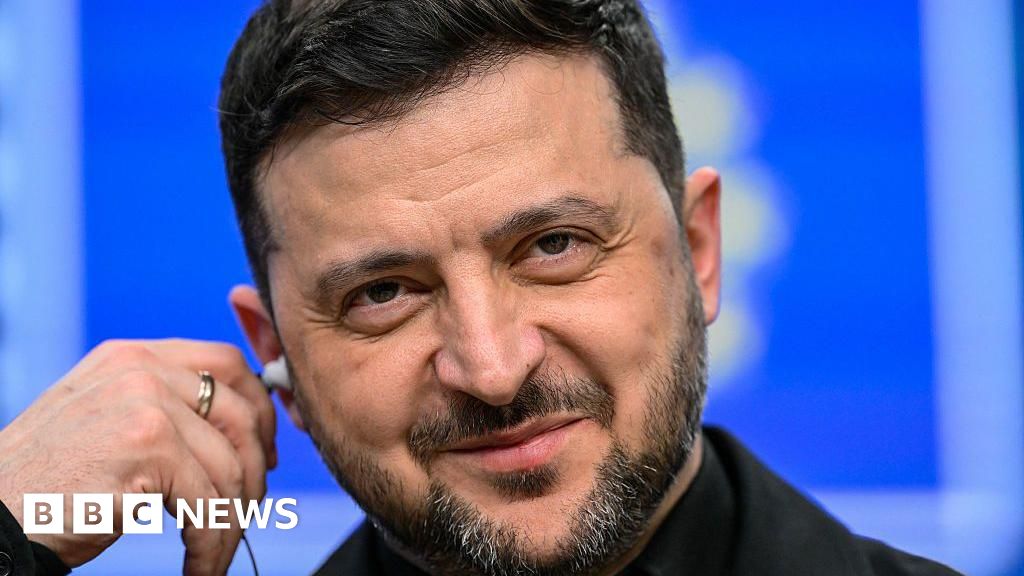
Others are also helping the US defend its military presence in Jordan, according to Ukrainian President Volodymyr Zelensky.
In a video address, Zelensky said Ukraine had “the greatest experience in the world in countering attack drones” – a reference to expertise built up over the more than four years of attacks by Russia on its neighbour.
Ukraine says the US and 10 more countries across the Middle East and Europe have asked for help countering the threat of drones that have wrought much damage.
There has been no comment by any of the countries concerned. Last week President Trump said he would take help from “any country” that offered it, including Ukraine.
In his address, Zelensky said one of Ukraine’s top officials, Rustem Umerov, secretary of the National Security and Defence Council, was on his way to the Gulf, along with military, intelligence and defence officials to prepare what he called “concrete agreements”.
“Ukraine has the greatest experience in the world in countering attack drones,” Zelensky said, adding that “without our experience, it will be very difficult for the Gulf region, the entire Middle East, and partners in Europe and America to build strong protection”.
“We are ready to help those who help us, help Ukraine.”
The air defences of some countries in the Middle East have struggled to cope with incoming Iranian drones, using million-dollar missiles against cheap Shahed unmanned aircraft.
Ukraine, instead, uses cheap, mass-produced interceptor drones to keep their skies relatively safe. It is now offering Gulf countries both its weapons and its expertise.
But there are political risks if people in Ukraine were to ask why drones are being sent to the Gulf when they are badly needed here.
That is why Zelensky is repeatedly making clear that Ukraine must get something back in return for any help.
“Those now seeking Ukraine’s help must continue to assist our own defence – first and foremost, our air defence,” he said. Primarily that would mean giving Ukraine more Patriot and other air-defence that Kyiv needs not to bring down Russian attack drones but its fast missiles that are much harder to defend against.
Ukraine also hopes to use the sale of interceptor drones not only to earn more funds for its depleted coffers but also to win more friends and allies in the Gulf which have tried to avoid taking sides in Russia’s war on Ukraine.
The fact the tables have been turned and Western allies are now asking Ukraine for help has not been lost on people here in Kyiv.
But some Ukrainian figures fear there are risks of Zelensky asking too much of his Western allies and overselling his country’s drone expertise.
Eyebrows were raised when the presidential office confirmed that it had offered the US a drone deal a year ago and it had been turned down.
In an interview with an Irish blogger, Caolan Robertson, Zelensky said it was a “good feeling” that so many partners were asking Kyiv for help. “The Americans asked us and, of course, I’m very proud that we can help American partners.”
Asked if he had cards to play, Zelensky said: “We held them like a good player. You can have good cards, but it’s important not to show everyone that you have them. I think we had them a year ago, too, but we didn’t show them. Now, however, everyone understands that they are there.”
It is a reference to Donald Trump’s repeated statements that Kyiv held no cards in its talks with Moscow and Washington – and that it should make concessions in order to reach a deal to end the war with Russia.
Trump has led efforts to mediate a peace deal, but his proposals to do so have been seen as favouring Russia.
One of the biggest obstacles to the peace negotiations has been the demand for Kyiv to give up to Russia areas it does not currently control in the Donbas – an industrial area composed of the administrative regions of Donetsk and Luhansk.
Russia currently controls more than 80% of those areas – which Ukraine refuses to give up.
Since coming to power more than a year ago, Trump has also cut US aid to Ukraine, criticising his predecessor for wasting US taxpayers’ money.
Instead, much-need US hardware, including Patriot missiles, are now being bought by Ukraine’s European allies before being handed over to Kyiv.
Their supply, however, has been slow and insufficient.
Recent Top Stories
Sorry, we couldn't find any posts. Please try a different search.