Winter Olympics 2026: Russian athletes linked to pro-war activity
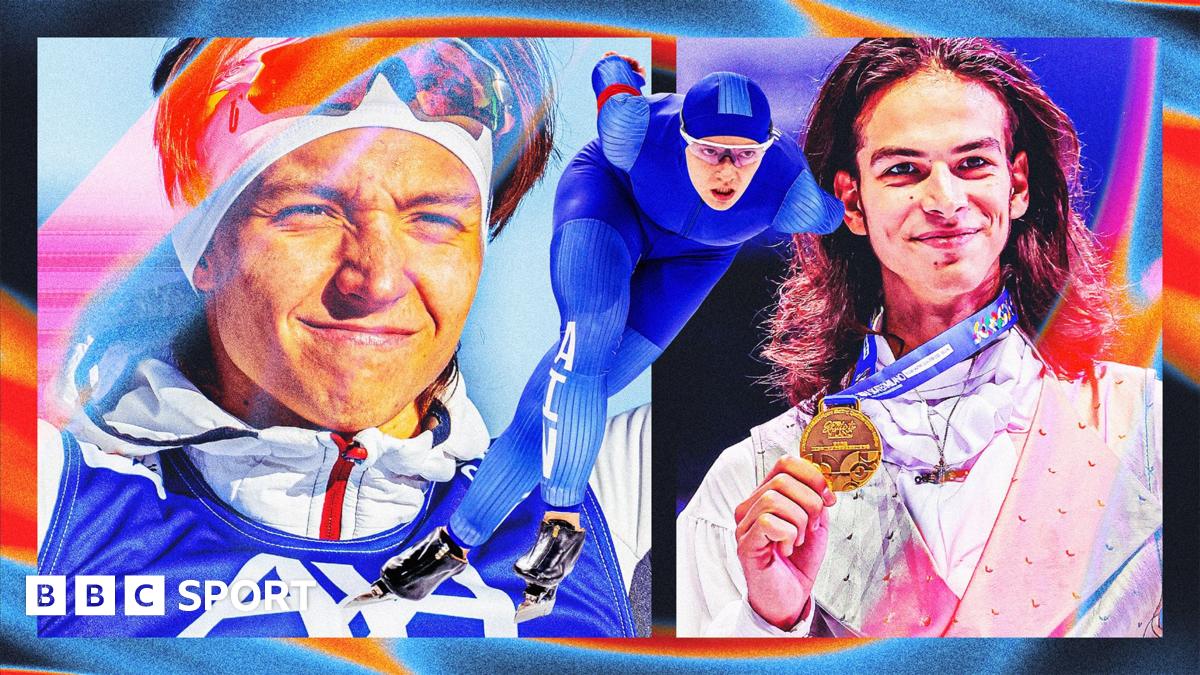
Several Russian athletes approved to compete as neutrals at the Winter Olympics have links to activity supporting the war in Ukraine, according to evidence seen by BBC Sport.
The International Olympic Committee has cleared 13 competitors, external from Russia to participate as Individual Neutral Athletes (AINs) in Milan-Cortina.
Their eligibility was assessed by a three-person IOC panel, external, with athletes deemed ineligible if they were found to have actively supported the war, including through social media activity or participation in pro-war events.
However, material shared with the BBC by the Molfar Intelligence Institute, external and investigative journalist Artem Khudolieiev raises questions over whether some of those approved meet the IOC’s broadly-framed criteria.
Meanwhile, one member of the panel – Morinari Watanabe – was filmed embracing a Russian gymnast sanctioned for his involvement with Russia’s war effort during a visit to Moscow in March, prompting further questions about the vetting process.
Ukraine’s flag-bearer for the opening ceremony believes the IOC should review its neutral eligibility framework.
“Getting ready for competition in occupied territories, or supporting the war on social media, it is definitely not right to call them neutral because they’re not,” said skeleton racer Vladyslav Heraskevych.
The IOC said it could not comment on individual cases but that the panel had “reviewed the athletes in accordance with the executive board decision and the principles it had established”.
The final decision on whether the four athletes could compete in Milan-Cortina was taken by the IOC’s Individual Neutral Athlete Eligibility Review Panel.
Watanabe sits on the panel as the representative of international sports federations, by virtue of his role as president of World Gymnastics. He was also a candidate in last year’s IOC presidential election.
In March 2025, Watanabe was filmed embracing Nagorny during a visit to Moscow.
Nagorny, an Olympic gold medallist at the Tokyo Games, has been a prominent supporter of Russia’s war in Ukraine.
He served as head of Yunarmiya, Russia’s youth military organisation, between 2020 and 2024 and has been sanctioned by the UK, European Union and United States, external.
The UK sanctions notice accuses Nagorny of involvement in the forced deportation and re-education of Ukrainian children.
“It’s crazy,” said Heraskevych, who held up a ‘No War’ sign at the Beijing Games.
“He’s still hugging this person and still friendly with him. And then he decides whether these Russians are guilty or not guilty, whether they are engaged in the war or not.”
World Gymnastics, responding on behalf of Watanabe, said it would not comment on the IOC panel or its decisions.
It said Watanabe’s visit to Russia “took place a few days after he visited Ukraine” and that its purpose “was to show support to athletes affected by the war, on both sides”.
“Mr Nagorny has not been allowed to participate in World Gymnastics competitions since the beginning of the conflict,” it added.
Russia’s full-scale invasion of Ukraine began just four days after the end of the last Winter Olympics in Beijing.
At those Games, 209 Russians competed under the name of the Russian Olympic Committee (ROC) because of sanctions linked to a state-sponsored doping scandal. They finished second in the medal table, winning 32 medals including five gold.
Since the invasion, athletes holding Russian or Belarusian passports have been barred from many international sports competitions.
But the IOC has created a pathway for individuals to compete as neutrals, provided they meet strict criteria.
That framework was first applied at Paris 2024, where 32 competitors from Russia and Belarus took part as AINs.
To be eligible, they had to show they had not actively supported the war and were not contracted to the military. They competed without national flags or anthems.
The same conditions apply in Milan-Cortina. Thirteen Russians and seven Belarusians have been approved across eight sports. Team events such as ice hockey and curling remain off limits.
The IOC says every neutral competitor must also be cleared by their international federation.
Some bodies, including the International Ski and Snowboard Federation (FIS), attempted to exclude neutrals altogether but that position was overturned by the Court of Arbitration for Sport in December, a ruling that came too late for many athletes to qualify.
Recent Top Stories
Sorry, we couldn't find any posts. Please try a different search.