What could happen if the US strikes Iran? Here are seven scenarios
Frank GardnerSecurity correspondent

 EPA
EPA
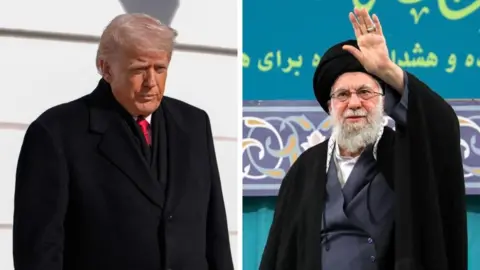
The US appears poised to strike Iran.
For weeks, Washington has been building up its forces in the Middle East – and now looks set to assemble more air power in the region than at any time since the 2003 invasion of Iraq.
This could, of course, still be a bluff designed to pressure the Iranian regime into a deal they do not want to make. America’s Gulf Arab allies are known to have cautioned against a US attack that could have unintended results.
So while the potential targets of a US attack are largely predictable, the outcome is not.
If negotiations fail and President Donald Trump decides to order an attack, then what are the possible outcomes?
1. Targeted, surgical strikes, minimal civilian casualties, a transition to democracy
US air and naval forces conduct limited, precision strikes targeting military bases of Iran’s Islamic Revolutionary Guards Corps (IRGC) and the Basij unit – a paramilitary force under the control of the IRGC – ballistic missile launch and storage sites as well as Iran’s nuclear programme.
An already weakened regime is toppled, transitioning eventually to a genuine democracy where Iran can rejoin the rest of the world.
This is a highly optimistic scenario. Western military intervention in both Iraq and Libya did not bring a smooth transition to democracy. Although it ended brutal dictatorships in both cases, it ushered in years of chaos and bloodshed.
2. Regime survives but moderates its policies
This could broadly be called the “Venezuelan model” whereby swift, powerful US action leaves the regime intact but with its policies moderated.
In Iran’s case, this would mean the Islamic Republic survived, which won’t satisfy large numbers of Iranians, but is forced to curtail its support for violent militias across the Middle East, cease or curtail its domestic nuclear and ballistic missile programmes as well as easing up on its suppression of protests.
Again, this is at the more unlikely end of the scale.
The Islamic Republic leadership has remained defiant and resistant to change for 47 years. It appears incapable of changing course now. The Supreme Leader, Ayatollah Ali Khamenei, now well into his 80s, is especially resistant to change or compromise.
3. Regime collapses, replaced by military rule
Many think this is the most likely possible outcome.
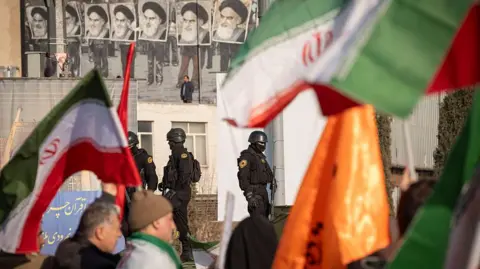
While the regime is clearly unpopular with many, and each successive wave of protests over the years weakens it further, there remains a huge and pervasive security deep state with a vested interest in the status quo. The IRGC, for example, is deeply involved in Iran’s economy.
The principal reasons why the protests have so far failed to overthrow the regime is because there have been no significant defections to their side, while those in control are prepared to use unlimited force and brutality to remain in power.
In the confusion of the aftermath of any US strikes it is conceivable that Iran ends up being ruled by a strong, military government composed largely of IRGC figures.
 Getty Images
4. Iran retaliates by attacking US forces, Arab neighbours and Israel
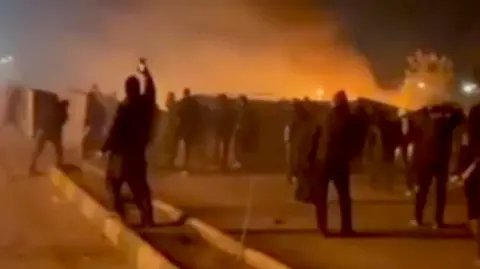
Iran vowed last month to retaliate against any US attack, saying that “its finger is on the trigger” and Ayatollah Khamenei promised to deliver “a slap in the face” to US forces if attacked.
Iran is clearly no match for the might of the US Navy and Air Force but it could still lash out with its arsenal of ballistic missiles and drones, many concealed in caves, underground or in remote mountainsides.
There are US bases and facilities dotted along the Arabian side of the Gulf, notably in Bahrain and Qatar, but Iran could also, if it chose, target some of the critical infrastructure of any nation it considered was complicit in a US attack, such as Jordan or Israel.
The devastating missile and drone attack on Saudi Aramco’s petrochemical facilities in 2019, attributed to an Iranian-backed militia in Iraq, showed the Saudis just how vulnerable they were to Iranian missiles.
Iran’s Gulf Arab neighbours, all US allies, are understandably extremely jittery right now that any US military action is going to end up rebounding on them.
Last month, Saudi Arabia and the UAE said that they would not allow the US to use their airspace for any attack. That may not necessarily spare them from Iranian retaliation.
 UGC
UGC
5. Iran retaliates by laying mines in the Gulf
This has long loomed as a potential threat to global shipping and oil supplies ever since the Iran-Iraq war of 1980-88 when Iran did indeed mine the shipping lanes and Royal Navy minesweepers helped clear them.
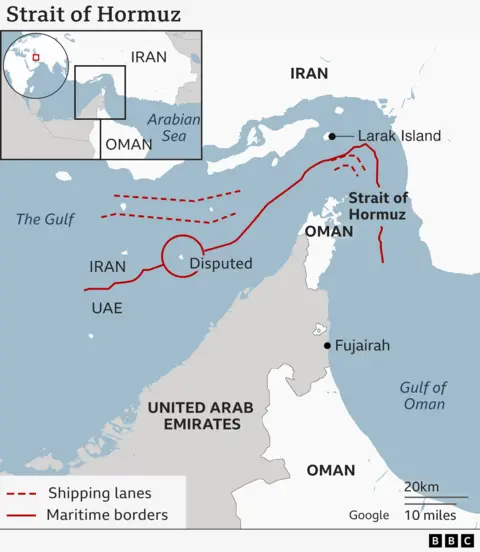
The narrow Strait of Hormuz between Iran and Oman is a critical chokepoint. Around 20% of the world’s Liquified Natural Gas (LNG) exports and between 20-25% of oil and oil byproducts pass through this strait each year.
As talks over a US-Iran deal took place in Geneva earlier this week, Iran closed the Strait for a few hours to conduct live fire drills – the first time it’s been closed since the 1980s, and a symbolic show of force.
On Thursday, it reportedly carried out military drills alongside Russian sailors in the Gulf of Oman and the Indian Ocean.
And it’s also conducted exercises in rapidly deploying sea mines. If it did so again then it would inevitably impact world trade and oil prices. The biggest losers in this scenario would be Iran itself, as it relies on oil exports for revenue, and its principle customers in Asia, notably China.
6. Iran retaliates, sinking a US warship
A US Navy Captain onboard a warship in the Gulf once told me that one of the threats from Iran he worries about most is a “swarm attack”.
This is where Iran launches so many high explosive drones and fast torpedo boats at a single or multiple targets that even the US Navy’s formidable close-in defences are unable to eliminate all of them in time.
The IRGC Navy has long replaced the conventional Iranian Navy in the Gulf, some of whose commanders were even trained at Dartmouth during the time of the Shah.
Iran’s naval crews have focussed much of their training on unconventional or “asymmetric” warfare, looking at ways to overcome or bypass the technical advantages enjoyed by their primary adversary, the US Navy’s Fifth Fleet.
The sinking of a US warship, accompanied by the possible capture of survivors among its crew, would be a massive humiliation for the US.
While this scenario is thought unlikely, the billion-dollar destroyer the USS Cole was crippled by an Al-Qaeda suicide attack in Aden harbour in 2000, killing 17 US sailors.
Before that, in 1987 an Iraqi jet pilot mistakenly fired two Exocet missiles at a US warship, the USS Stark, in the Gulf killing 37 sailors.
The US is set to have two carrier strike groups in the region when the USS Gerald R Ford – which is currently transiting the Mediterranean – arrives in the coming weeks.
 Anadolu via Getty Images
7. Regime collapses, replaced by chaos
This is a very real danger and is one of the major concerns of neighbours like Qatar and Saudi Arabia.
As well as the possibility of a civil war, such as experienced by Syria, Yemen and Libya, there is also the risk that in the chaos and confusion, ethnic tensions could spill over into armed conflict as Kurds, Baluchis, Azerbaijanis and other minorities look to safeguard their own people amid a nationwide power vacuum.
Much of the Middle East would certainly be glad to see the back of the Islamic Republic, none more so than Israel which has already dealt heavy blows to Iran’s proxies across the region and which fears an existential threat from Iran’s suspected nuclear programme.
But nobody wants to see the largest Middle East nation by population – around 93 million – descend into chaos, sparking a humanitarian and refugee crisis.
The greatest danger now is that President Trump, having amassed this powerful force close to Iran’s borders, decides he must act or lose face, and a war begins with no clear end-state and with unpredictable and potentially damaging repercussions.
Recent Top Stories
Sorry, we couldn't find any posts. Please try a different search.