Trump Warns Of ‘Severe’ Tariffs On Canadian Fertilizer If Needed

Authored by Jennifer Cowan via The Epoch Times,
U.S. President Donald Trump says he is considering “very severe” tariffs on fertilizer imports from Canada as the United States readies a $12 billion aid package for farmers grappling with the repercussions of the ongoing trade war.
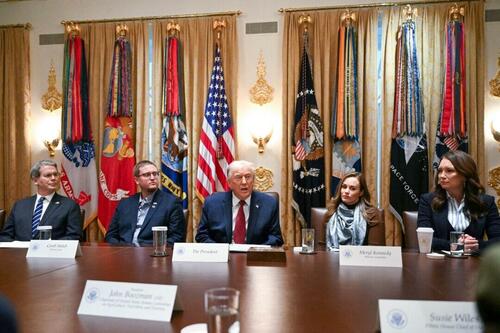
Trump mentioned the increased levy on Canada while responding to reporters’ questions at a Dec. 8 White House roundtable where he announced the tariff relief fund for U.S. farmers, who have been paying more for agricultural products like seed and fertilizer due to Trump’s global trade policies.
“A lot of it does come in from Canada,” Trump said, referring to fertilizer. “And so we’ll end up putting very severe tariffs on that, if we have to, because that’s the way you want to bolster here.”
Trump said high import prices on Canadian fertilizer would encourage the United States to produce its own.
U.S. Agriculture Secretary Brooke Rollins said her team is developing a strategy to bring fertilizer production back to the United States, while also instructing fertilizer manufacturers and other industrial entities to reduce their prices.
“The president has been very unequivocal in saying we have to figure out why all these input costs are skyrocketing and all of our farmers are struggling,” Rollins told reporters.
Trump said that it doesn’t make sense for the United States to rely on other countries for the products farmers need.
“All of a sudden, we don’t do it anymore [and] they start charging very high prices from other countries, whether it’s Canada or somebody else,” he told farmers at the roundtable event. “And we’re not going to let that happen.”
The Epoch Times contacted the Prime Minister’s Office for comment on Trump’s remarks but did not immediately hear back.
Many farmers in the United States depend on potash fertilizer from Saskatchewan to increase potassium levels in their soils. Saskatchewan is the only Canadian provider of potash, which is a group of minerals and chemicals that contains potassium. Potassium is an essential nutrient for plants and a key component in fertilizers.
Roughly 95 percent of the fertilizer produced in Canada is exported and the United States is the country’s largest market. It accounts for more than half of all total fertilizer exports each year, according to Fertilizer Canada.
The United States imported approximately 12.1 million tonnes of Saskatchewan potash in 2024, according to S&P Global. It also imported roughly 4.9 million tonnes in the first five months of 2025, representing more than 50 percent of Canada’s total potash exports during that timeframe.
The United States also imports Canadian nitrogen-based fertilizers, including ammonia, ammonium sulphate, urea, and urea ammonium nitrate.
More than 99 percent of Canadian urea and urea ammonium nitrate exports are directed toward its southern neighbour, while 69 percent of Canada’s ammonia and 49 percent of its ammonium sulphate are also sent there, according to 2023 figures from a World Bank platform.
Trump implemented a sweeping 25 percent tariff on Canadian goods this spring as well as sectoral tariffs, but reduced the tariff on fertilizer to 10 percent after receiving negative feedback from U.S. industry groups and Republican legislators in agricultural states. That tariff is applicable solely to fertilizer export quantities that surpass the thresholds established by the United States-Mexico-Canada Agreement (USMCA) on free trade.
Canadian and U.S. farmers have said they are facing higher fertilizer bills because of Trump’s tariffs.
Then-Foreign Affairs Minister Mélanie Joly said in March that Ottawa could use Canadian exports of fertilizer and other products such as energy or minerals as bargaining chips in negotiations with the United States, but said the country’s premiers would need to be on board.
Saskatchewan Premier Scott Moe had previously spoken out against such a move, saying tariffs applied on either side of the border are “harmful to North America.”
“[We] are not supportive in any way of export tariffs, whether that be electricity coming out of Manitoba, Quebec into the U.S. or whether that be energy or potash products that are coming out of our province or Alberta,” he said at a February news conference.
Saskatchewan potash producer Nutrien recently announced tentative plans to construct a new export facility for global markets in Washington state, instead of British Columbia. The news was criticized by B.C. Premier David Eby who said he believes such a decision would place the fate of Saskatchewan potash “in the hands of Donald Trump.”
Federal Transportation Minister Steve MacKinnon told reporters last month that he was “hoping to persuade the company” to choose a Canadian port over one in the United States.
Farm Aid
The recent emphasis by the Trump administration on agriculture indicates a potential for further trade disruptions. The president said proceeds from tariffs will be allocated to support farmers.
“This relief will provide much-needed certainty to farmers as they get this year’s harvest to market and look ahead to next year’s crops, and it’ll help them continue their efforts to lower food prices for American families,” Trump told reporters during the Dec. 8 event.
Trump also provided aid to farmers during his first presidency amid trade disputes. He disbursed more than $22 billion in 2019 and nearly $46 billion in 2020, although the latter figure also included support related to the COVID-19 pandemic.
Rollins said US$11 billion from the new aid package will be allocated to row crop farmers and is expected to be distributed by Feb. 28. She noted that the White House will hold on to the remaining US$1 billion to finalize the funding allocation details for farmers of fruits, vegetables, and other crops.
The money is meant to offer certainty to farmers as they market the current harvest and make plans for next year’s yield, she said.
Soybeans and sorghum were hardest hit by Washington’s trade dispute with Beijing because more than half of those crops are exported each year with the majority going to China.
Trump met Chinese leader Xi Jinping in South Korea in October, where the president said they made a deal that China would buy at least 12 million metric tons of U.S. soybeans by the end of 2025, as well as 25 million metric tons a year in each of the next three years.
China bought more than 2.8 million metric tons of soybeans since Trump announced the agreement at the end of October, but the amount represents only one-fourth of what U.S. officials said the country had committed to purchasing.
Trump signed an executive order on the weekend directing the Justice Department and Federal Trade Commission to look at “anti-competitive behaviour” in food supply chains —including seed, fertilizer and equipment—and consider taking enforcement actions or developing new regulations.
Loading recommendations…
Recent Top Stories
Sorry, we couldn't find any posts. Please try a different search.