‘The People Showed Up’: South Carolina Lawmakers Side With Parental Choice in Two Vaccine Votes

Source: Children’s Health Defense
South Carolina senators clashed Wednesday over childhood vaccination policy, but ultimately sided with parental choice in two key votes, the South Carolina Daily Gazette reported.
A Senate Medical Affairs subcommittee voted 7-1 to advance legislation prohibiting vaccine mandates for children under age 2.
Minutes later, the panel voted 6-2 to reject a separate proposal that would have removed religious exemptions for the measles-mumps-rubella (MMR) vaccine.
Advocacy groups supporting parental rights called the outcome a major statement on constitutional protections.
“Yesterday was a remarkable day for South Carolinians — and a reminder to the rest of the nation and the world that constitutional rights still matter,” Andrea Lamont Nazarenko, Ph.D., of the South Carolina Health Rights Cooperative said in a joint statement with Ashley Jones and Christi Dixon of South Carolina Family First.
“At a time when inalienable liberties are increasingly restricted in the name of public health, the South Carolina Senate made it clear: not here,” the groups said.
Dawn Richardson, director of advocacy for the National Vaccine Information Center, said the decision to halt the MMR proposal sends a broader message about vaccine mandates.
“It sends a strong message nationally that forced vaccination with the MMR or any vaccine holds no legitimate place in health policy or law in the U.S.,” she said. “Vaccine mandates need to be repealed, not entrenched.”
The debate unfolded amid South Carolina’s largest measles outbreak in decades. State health officials reported 990 measles cases as of March 3.
Linda Bell, the state’s epidemiologist, told lawmakers that about 95% of measles cases involve unvaccinated people. She said infections appear to be slowing after a surge in vaccinations last month, which rose about 70% compared with February 2025.
Federal health officials from the Centers for Disease Control and Prevention are expected to arrive next week to help contain the outbreak, according to Reuters.


MMR doesn’t prevent infection or transmission
One of the most contentious debates centered on legislation that would have removed the state’s religious exemption for the MMR vaccine.
South Carolina requires several vaccines for school entry, including MMR. However, parents can opt out for religious reasons by submitting a notarized exemption form to a school nurse.
The subcommittee voted to “carry over” the bill, a procedural move that often signals a measure will not advance. Sen. Shane Martin said afterward that the proposal is effectively “graveyard dead,” according to the South Carolina Daily Gazette.
Sen. Margie Bright Matthews, who introduced the bill, said parents should have the right to refuse vaccines, but unvaccinated children should not attend school.
“If you as a parent, regardless of whether it’s religious or non-religious, decide that you don’t want any vaccination in your child’s body, that is your right,” Matthews said. However, “If you don’t want that, you still should not be allowed to send your unvaccinated child to school.”
Matthews’ sister-in-law died years ago from complications related to measles.
Opponents argued the proposal would undermine parental rights and restrict access to education.
“Certain state lawmakers need to stop demanding healthy children, in order to receive an education, take a real risk with a vaccine that the pharmaceutical manufacturer failed to produce in a way that works safely and effectively for everyone,” Richardson said.
She also challenged assumptions about the vaccine’s ability to stop transmission. The bill, she said, rests on “a misinformed and incorrect assumption that the MMR vaccine stops transmission and infection.”
According to Richardson, immunity can wane, and subclinical infections can occur in vaccinated individuals. “The imperfect MMR vaccine is not capable of producing herd immunity. There have been outbreaks in the fully vaccinated,” she said.
Sen. Larry Grooms also criticized the proposal.
“This proposed violation of individual conscience and parental rights will not be tolerated,” Grooms said in a statement shared with the South Carolina Health Rights Cooperative and South Carolina Family First.
The people showed up, and the ‘legislature listened’
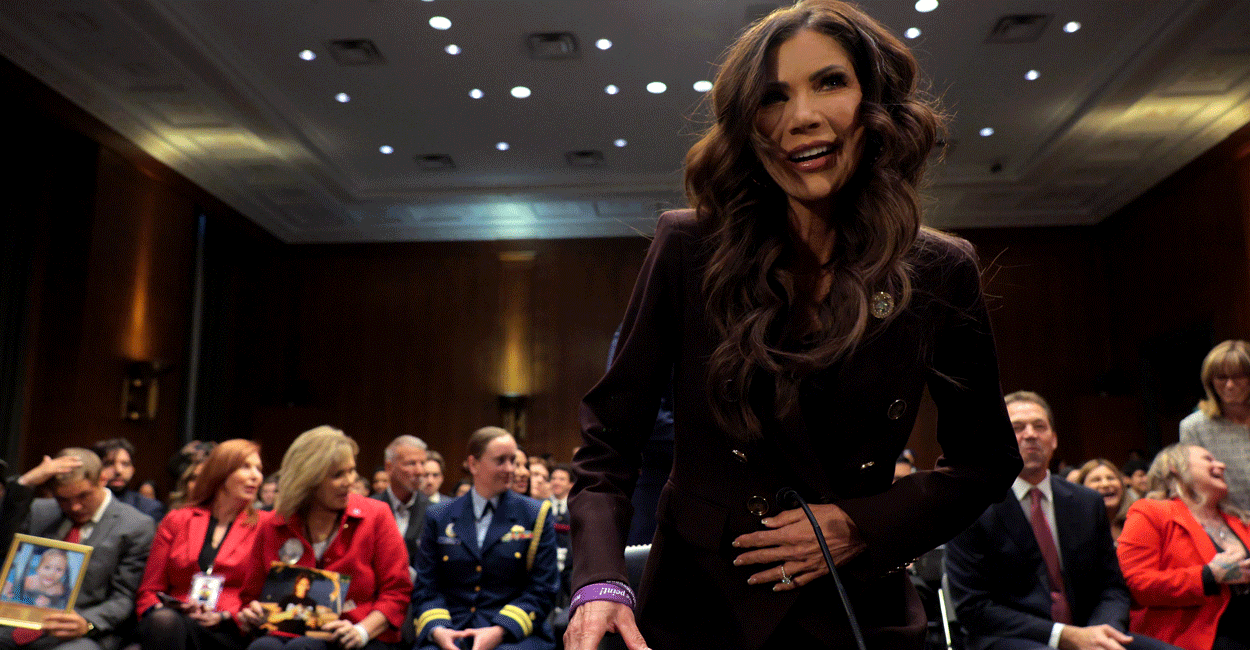
The two advocacy groups said grassroots engagement played a major role in the outcome. Dozens of supporters wearing red attended the hearing to defend religious exemptions.
“Importantly, this was not a fight waged against our legislators — it was a fight waged alongside them,” the advocacy groups said. “Many South Carolina Senators listened carefully to the concerns of their constituents and engaged with the issue in good faith.”
The groups said the debate showed that public participation can still shape policy.
“In the weeks leading up to the hearing, citizens across the state worked to reinvigorate the cultural pride that defines South Carolina,” the statement said. “Legislators publicly reaffirmed their commitment to constitutional protections.”
“It was a reminder of something many Americans have begun to doubt in recent years: that the system can still work when citizens engage and insist that their representatives honor the Constitution,” the groups added.
“In South Carolina, the people showed up, spoke clearly about their values, and their legislature listened.”


This article was funded by critical thinkers like you.
The Defender is 100% reader-supported. No corporate sponsors. No paywalls. Our writers and editors rely on you to fund stories like this that mainstream media won’t write.
‘Novel’ bill to block vaccine mandates for infants advances
In a separate vote, the subcommittee advanced legislation sponsored by Sen. Carlisle Kennedy that would prohibit vaccine mandates for children younger than 2.
Kennedy said his concern grew after his son was born last year with nonfunctioning kidneys, the South Carolina Daily Gazette reported.
“It protects the parents and the child and protects parental rights to make the decision as to when would be the best time to proceed with medical products like vaccines,” Kennedy said.
Although South Carolina does not mandate vaccines, Kennedy said the law should explicitly affirm parental authority over medical decisions for their children.
Supporters described the measure as an added safeguard for parental choice.
Michael Kane, director of advocacy for Children’s Health Defense, called the proposal an innovative approach. “I love some of these new novel legislations,” he said, adding that he was “proud of what happened in South Carolina.”
The bill now moves to the full Senate Medical Affairs Committee for further consideration.
Related articles in The Defender
- South Carolina Measles Outbreak Spurs Renewed Debate About MMR Vaccine
- California, Connecticut ‘Scrambling’ to Sue HHS Over Vaccine Schedule
- Arizona Medical Freedom Bill Goes to Senate After Successful House Vote
- COVID Vaccine Injuries to Take Center Stage at Upcoming ACIP Meeting
- Rand Paul Introduces Bill to End Liability Shield for Vaccine Manufacturers
Recent Top Stories
Sorry, we couldn't find any posts. Please try a different search.