MI6 chief: ‘We are operating in space between peace and war’
Frank GardnerSecurity correspondent
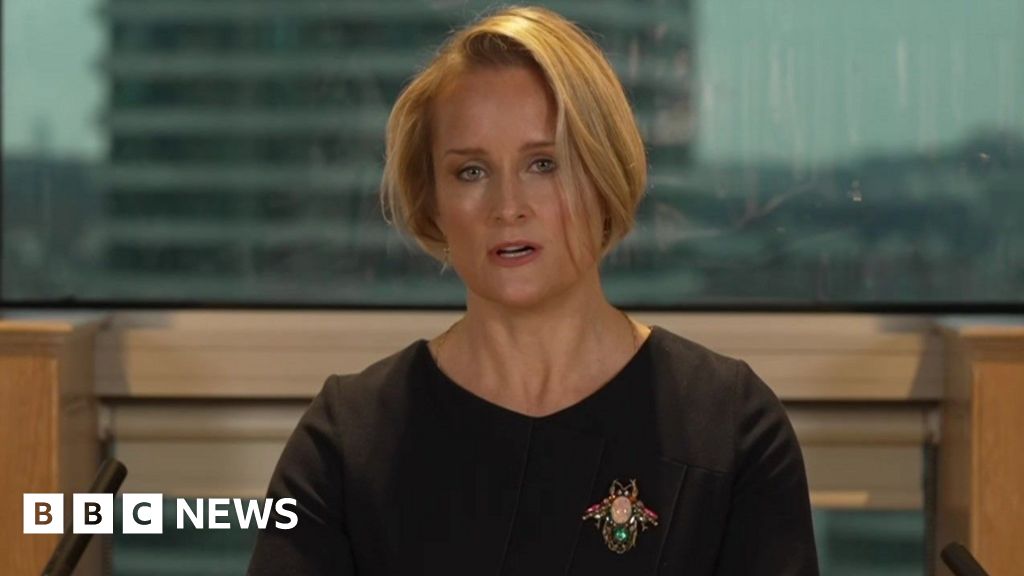
The new MI6 chief has said “we are now operating in a space between peace and war” as she laid out the “interlocking web of security challenges” that the service is working to tackle.
Blaise Metreweli’s first public speech since taking the role focused on the multi-faceted threat posed by Russia, which she said was “testing us in the grey zone with tactics that are just below the threshold of war”.
She also highlighted the “the menace of an aggressive, expansionist and revisionist Russia” while referring to the war in Ukraine, insisting the UK would maintain pressure on Russian President Vladimir Putin on Ukraine’s behalf.
Ms Metreweli is the first woman to head Britain’s overseas spy agency.
She took over as head of the Secret Intelligence Service from Sir Richard Moore on 1 October.
Ms Metreweli used her speech on Monday to point to instances of drones appearing over airports and airbases, and cyber-attacks on infrastructure as being among examples of Russia’s so-called hybrid warfare and grey-zone tactics.
She noted the recent sanctioning of Russian entities accused of conducting information warfare, saying: “The export of chaos is a feature not a bug in this Russian approach to international engagement.”
Western sanctions have certainly damaged Russia’s economy, driving its exports eastwards towards China and India. But they have singularly failed to change Putin’s determination to wage war on Ukraine until it gives in to his demands for territory and, ultimately, loyalty to Moscow.
The speech also made clear that a special area of interest for the new spy chief is technology.
Having joined MI6 in 1999, she has arrived at the top job via Q Branch. Named after the fictional MI6 division in Ian Fleming’s spy books, this is the real life, in-house, top secret part of the Secret Intelligence Service that designs the sorts of gadgets and gizmos that enable agents to communicate with their handlers, without being detected and caught.
Ms Metriweli called on all her intelligence officers to master technology, “not just in our labs, but in the field, in our tradecraft…
“We will become as comfortable with lines of [computer] code as we are with human sources, as fluent in Python as we are in multiple languages.”
Python, a programming language, may surprise some as an example to pick, since it has been around for more than three decades. But her point will not be lost on the men and women who have chosen to work in the shadowy world of espionage.
In an age where data is key, where spies can no longer rely on false identities when biometric scanning can unmask them in seconds at borders and checkpoints, MI6 needs to prove that it can still be relevant.
Elsewhere, the Chief of the Defence Staff Sir Richard Knighton echoed Ms Metriweli’s remarks on the threat posed by Russia, describing the risks facing the UK as a situation “more dangerous than I have known during my career”.
He spoke of the threat of Russia’s armed forces, and said the reform and investment into the country’s military had created a “hard power [which] is growing quickly”.
“We should be under no illusions that Russia has a massive, increasingly technically sophisticated, and now highly combat-experienced military,” Sir Richard told the Royal United Services Institute in London.
In response to this threat, he called for a “whole of society approach” to building national resilience beyond just strengthening the military, including harnessing the UK’s universities, energy and manufacturing industries, and the NHS.
The armed forces chief said this included “more people being ready to fight for their country”, and building industrial capacity “to meet the demands in the UK and of our allies to re-stock and re-arm”.
Addressing a skills gap highlighted in a recent report by the Royal Academy of Engineering, Sir Richard also talked about the need to work with industry and young people, announcing £50m for new defence technical excellence colleges.
In recent weeks, both France and Germany have outlined plans for voluntary national service.
Last year, the then-Conservative government set out its own compulsory proposals, which Labour dismissed as a gimmick.
But the debate about how the UK as a whole should respond to an increasingly uncertain world is gathering pace.
Recent Top Stories
Sorry, we couldn't find any posts. Please try a different search.