Is the UK Still a Liberal Democracy?
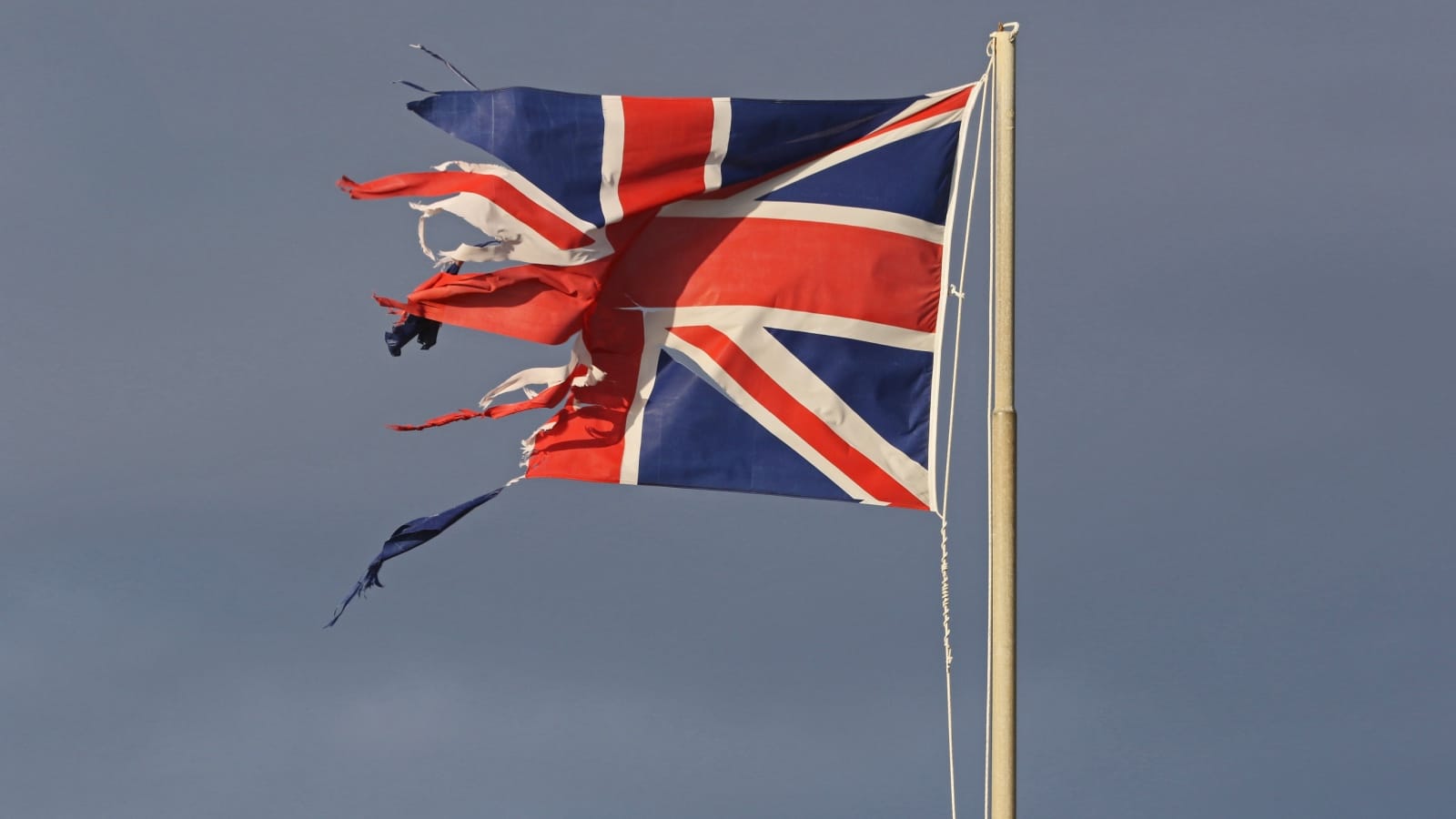
If the keening of pessimists is to be believed, this paper is written in the midst of the darkling dusk of an authoritarian age. Studies of the fate of democracy around the world—the countries that can be classified as democratic according to various criteria and the expansion and contraction in their numbers over time—has become a mini cottage industry in the academic and think tank worlds.
In theory, setbacks and curtailments can come from either or both conservative and liberal sides of the ideological political divide, often reflecting their differences in how best to reconcile the tension between the liberal and democratic components of the aggregative concept of ‘liberal democracy.’ Majoritarian excesses can ride roughshod over the liberal protections for individuals against the state and society as collective entities, while unbalanced liberal emphases can ignore majority policy preferences.
This was seen in the clash between the individual-centric civil libertarians and the collective focus of public health during the Covid years. Political polarisation in the age of falling confidence in the mainstream media and the amplifying potential of social media has exacerbated the pathologies of shifting perceptions of the other side as not merely people with a different point of view but as immoral and a threat to the system.
As the world’s most populous democracy by far, more than four times bigger than the US as the second most populous albeit the world’s most important democracy, India occupies a place of special significance in the global comparison of the measures of democracy and their rise and fall over time. Not too many would have rated its prospects highly against the apparently unfavourable correlates of poverty and illiteracy at independence in 1947, yet it has survived as a recognisably functioning democracy. Conversely, the UK, known as the mother of parliamentary democracy with Westminster as the mother parliament, seems to be backsliding on its democratic credentials. Concerns about the health of democracy in both India and the UK exist alongside worries about its status in several other countries.
I. Measuring the Health of Democracy
My interest in democracy has spanned my entire professional life. My very first academic article, exactly fifty years ago, was on ‘The Fate of India’s Parliamentary Democracy’ (Pacific Affairs, Summer 1976). This was a reaction to the declaration of an emergency by Prime Minister (PM) Indira Gandhi in 1975. It was followed by the more reflective ‘Liberalism, Democracy and Development: Philosophical Dilemmas in Third World Politics’ (Political Studies (September 1982). As someone who grew up in India; voted as a national in elections in Australia, Canada and New Zealand; with advanced degrees in political science; lived for periods of my life in Australia, Canada, New Zealand, and the US; and participated in discussions on the topic with real-world examples with colleagues in the United Nations, I have a particular appreciation of the role of electoral systems in mediating popular voting preferences into political outcomes.
When I last looked at the democracy ratings five years ago, the Economist Intelligence Unit classified India as a ‘flawed’ democracy; Freedom House called it only ‘partly free,’ and the Gothenburg-based V-Dem described it as an ‘electoral autocracy.’ That’s quite a dishonourable trifecta from three reputable international democracy ratings agencies. The disparate indexes have their individual flaws and strengths, but they do provide a latitudinal snapshot of almost all countries at any given time, permit a longitudinal analysis of trendlines in any given country, and are a useful externally validated prop for civil-society advocates in countries of concern that are trying to improve standards of governance within the framework of inclusive democratic citizenship.
That said, as a cross-country comparison, any classification like V-Dem’s that puts the likes of India, Iran, Pakistan, Palestine and the West Bank, Russia, Singapore, and Venezuela in the portmanteau category of ‘electoral autocracy’ in its 2025 report is prima facie suspect. If we look at the methodology, the core of it is ‘expert opinion’ utilising a total of 4,200 ‘country experts’ using their best judgment on a range of measures for democratic institutions and concepts. Yet, members of the media and intellectual elite inevitably reflect their prejudices, which includes disdain for populist leaders, parties, and voters (also known as baskets of deplorables, to paraphrase Hillary Clinton’s infamous characterisation of Trump supporters during the 2016 presidential campaign). ‘Experts’ skew overwhelmingly left in most contemporary Western democracies.
The pathology of lack of viewpoint diversity, ideological uniformity, and misalignment with public sentiments is undeniable. A study by Yale University’s Buckley Institute published in December 2025 examined the political leanings of faculty members across all degree-granting undergraduate departments and the law and management schools. Of the 1,666 faculty, 82.3 percent were registered Democrats and voters and just 2.3 percent were Republicans.
The student newspaper Yale Daily News scrutinised official federal election filings that showed 97.6 percent of 1,099 faculty donations in 2025 were to Democrats and not a single one to Republicans. A majority of undergraduate departments (27 of 43) had not a single Republican. Similarly, a faculty survey by the Harvard Crimson in 2022 showed 82.5 percent of Harvard faculty identified as liberal/very liberal and only 1.7 percent as conservative.
Are we to believe that this does not lead to an ideological disconnect between the legal-judicial clerisy in courtrooms and on the benches, and the American people? It should come as no surprise, therefore, that judges often reflect a more general elite contempt for the people that extends to the political choices made by people.
Similar comments apply to media bias. In some ways the more important measure of this is not what the media does report but that which they choose not to report. They speak truth to only one ideological side in the struggle for political power. Apparently, only this side of the political divide is filled with people and institutions to be held accountable while the other side gets a free pass from the media. Thus in the leadup to and during the last US presidential election, much of the hostile coverage of Trump was accurate enough and well-deserved.
Yet, most of the mainstream media was complicit in silence on or denial of President Joe Biden’s cognitive ability and who really was running the country in his name and with his authority. Nor did they highlight Vice President Kamala Harris’s inability to speak in coherent sentences and paragraphs and mostly stayed silent on her effective coronation by the Democratic Party after Biden pulled out, without the benefit of a primary contest.
II. The UK’s Democracy Slippages
At the time of writing, PM Sir Keir Starmer’s hold on office looks precarious. With the public having soured on him long ago, the scandal of his appointment of Lord Peter Mandelson as ambassador to the US despite his well-known past record called into question Starmer’s political judgment and competence and he lost control of parliament despite the party’s massive majority. This will only worsen after Labour’s defeat in the Gorton and Denton by-election on 26 February. Leaving that aside, there are six strains through which British democracy has been emptied of life-sustaining fibre.
1. Labour’s Loveless Landslide in 2024
Labour’s ‘landslide’ in the July 2024 UK general elections disguised the smallest vote share won by any governing party since 1945, possibly since 1923 when Labour won just 31 percent. Starmer’s majority was only 1.5 percent higher than Jeremy Corbyn’s in 2019 and five points lower and 3.2 million votes fewer than Corbyn’s in 2017. Far from Starmageddon, this was a collapse of the Conservatives. Consequently, Starmer had won a massive landslide but lacks a popular mandate. The foundations of Starmer’s ‘loveless landslide’ rest on the shifting sands of populist rage against the Tories. The vote share made it easy to imagine a one-term government, but only if the small c ‘conservatives’ draw the right lessons.
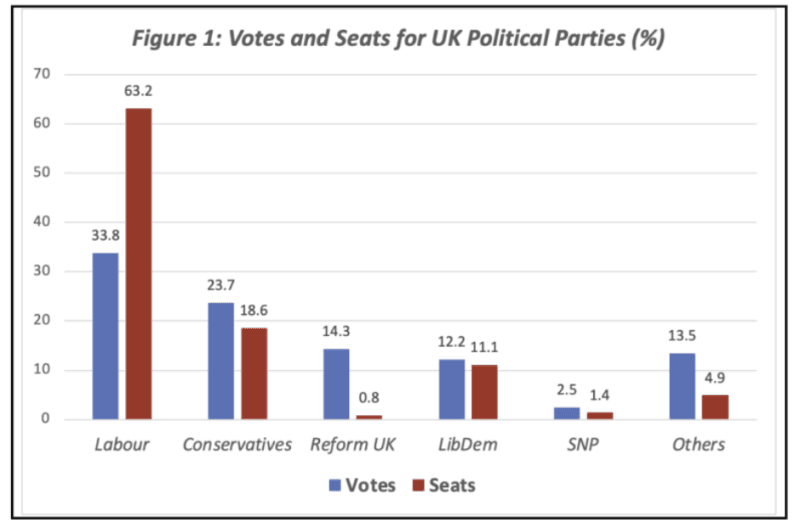
As shown in Figure 1, with 42.5 percent more votes than the Tories, Labour got 411 seats—3.4 times as many. Reform got 4.1 million votes, or 60 percent of the Tories, but only five seats. The latter won 24 times as many seats (121). Meanwhile, the Liberal Democrats, with 600,000 fewer votes than Reform, won 72 seats, 14 times as many.
To put it another way, the number of votes needed to win one seat was 23,600 for Labour, 56,400 for Conservatives, 49,300 for the LibDems, 78,800 for the Scottish National Party—and 821,000 for Reform. This makes a mockery of the central legitimising principle of democratic governance, namely one person one vote. For in practice, this works out as 35 Reform voters are worth the weight of just one Labour voter.
The distortion between voting shares and seats won by the various parties highlights a crucial flaw in the universal belief that ‘representative’ democracy based on free and fair elections delivers governments that the majority of citizens voted into power. For in reality, voters propose but electoral systems dispose who gets to form government. With the same voting shares, the distribution of seats on the treasury and opposition benches would be dramatically different across the various Western democracies.
2. Broken Manifesto Promises, Pursuit of Policies Not in Manifesto, and String of U-turns
According to a list compiled for the Spectator UK, by mid-January 2026 the Starmer government had engaged in seven policy about-turns in the 18 months in power, announcing and then swiftly retreating from new policies amidst the fierce backlash from party MPs and supporters. The list also included five broken election promises. The list did not, however, include major policy initiatives that never were part of the election manifesto, such as stripping ten million people (including 150,000 pensioners) of their winter fuel allowance (for a partial list of examples, see here.)
3. Record Low Polls and Net Unfavourability Ratings
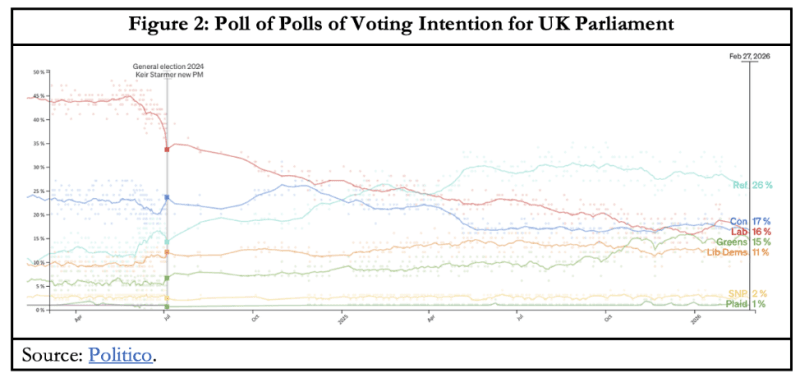
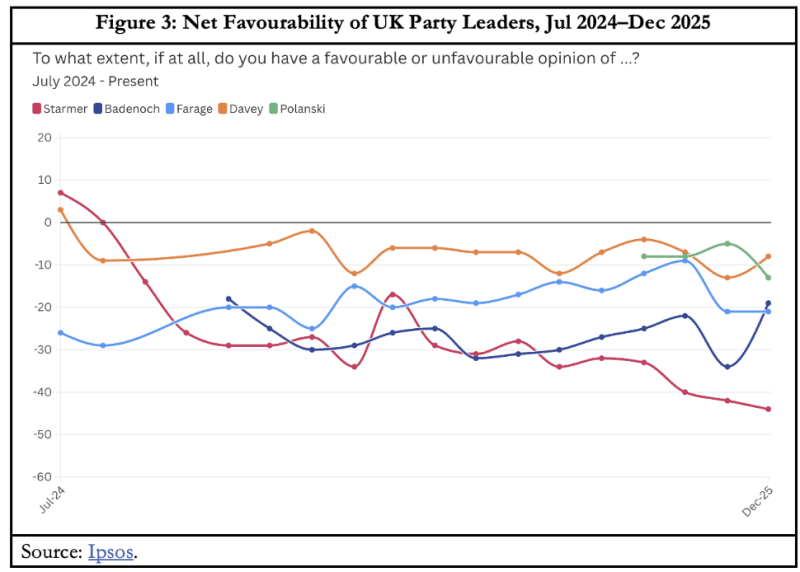
Thus Labour’s massive victory in 2024 was a quirk of the UK electoral system. The problem of a lack of electoral mandate this created has been exacerbated by the string of broken manifesto pledges, policy announcements in government that were not in the manifesto, and the serial U-turns on them in the face of fierce backlash. All this helps to explain the sustained and exceptionally steep fall in popularity, as measured by multiple opinion polls, of both the governing party and of the PM personally (Figures 2 and 3).
4. Free Speech Curtailments, Civilisational Erasure, Two-Tier Justice
No one is above the law in democracies; everyone is subject to the laws that apply without fear or favour to all. But equally, everyone is under the law and law protects everyone. Only when both conditions apply is everyone equal under the law. This is why the rise of two-tier justice is corrosive of democracy. Lucy Connolly has become the public face of the perception and reality of two-tier policing and justice in the UK, so much so that Policy Exchange published a special report on Two-Tier Justice in March 2025 and an article in the Times recommended that ‘‘Two-Tier Keir’ should ask why the name has struck.’
According to Shadow Justice Secretary Nick Timothy, ‘multiculturalism has turned Britain into a country that doesn’t treat people equally.’
People have been punished for praying silently inside prescribed ‘buffer zones’ around abortion clinics. There have also been numerous examples of police investigating and recording the Orwellian ‘non-crime hate incident’ (NCHI, which includes speech) committed by people. Toby Young pretty much founded the Free Speech Union (FSU) on the slogan that the police’s job is to ‘police our streets, not our tweets.’ The FSU’s membership has swelled to over 40,000, not the least because of its success rate in defending people in the high-profile cases who have been cancelled and censured essentially for speech offences against the official dogmas on immigration, gender ideology, Covid policies, etc. Its chapters are spreading to other countries including Australia, New Zealand, and Canada.
5. Attempt to Cancel Elections
Having cancelled several local elections that had been scheduled for May 2025, the Starmer government again postponed many elections to local councils that had been scheduled for May this year, until next year. The massive backlash wasn’t enough to force Starmer into another U-turn but the very real prospect of Reform winning its case against cancellations in the courts did compel capitulation by the government.
Matt Ridley, who retired from the House of Lords in 2021, drew on his parliamentary experience to write in the Spectator that no matter who the citizens vote for, the blob—the network of mighty quangocrats, technocrats, activist NGOs, and unelected and unaccountable judges—always wins. Dominic Cummings, Boris Johnson’s Svengali before a famous falling out, warns that the ‘blob’ will never allow Reform leader Nigel Farage to become PM.
6. Elections Marching to the Tune of Foreign Conflicts
The July 2024 general election midwifed the birth of an explicitly Islamic politics vibrating to a foreign conflict. Pro-Gaza independent candidates who won include former Labour leader Corbyn, Ayoub Khan, Adnan Hussain, Iqbal Mohamed, and Shockat Adam. That’s as many seats as Reform. Having milked Labour to the maximum, they were ready to cannibalise Labour and strike out on their own in pursuit of their sectarian agenda that has no roots in British traditions and culture.
Having sown the wind of imported religious sectarianism, Labour should have expected to reap the whirlwind. The Gorton and Denton by-election results show they didn’t. A seat in an area that Labour has dominated for 100 years and won with a 50.8 percent majority in 2024 saw them pushed into a humiliating third spot with just 25.4 percent of votes, behind the victorious Greens on 40.7 and Reform on 28.7 percent. Farage said the result was ‘a victory for sectarian voting and cheating.’ The latter refers to allegations from the independent Democracy Volunteers election observers of significant instances of ‘family voting’ that is illegal. If this happened in voting booths, the incidence of such practices in postal voting would surely be considerably higher. The integrity of the vote in areas with heavy immigrant concentrations requires independent and credible investigation.
Jake Wallis Simons concluded sadly that ‘a campaign that weaponised troubling sectarianism and open bigotry’ had delivered victory to the Greens ‘at the expense of our democracy,’ the result of unchecked immigration of ‘importing communities from non-democratic cultures,’ and the rise of ‘Islamist kingmakers.’ As if to underline the point, the statue of Sir Winston Churchill in Parliament Square was defaced with pro-Palestine graffiti: ‘Free Palestine’ and ‘Zionist war criminal.’
Liberal democracy is a product of Judeo-Christian culture. The extent to which it has taken root in a country like India is proof that not all other cultures are necessarily inhospitable to the central precepts and practices of liberal democracy. Yet, this does not invalidate the claim that some cultures could be deeply hostile. An emphasis on multiculturalism, as distinct from multiracialism within the overarching framework of a liberal democratic culture, seems more a projection of wishful thinking than an empirically grounded conviction. This is a conclusion that educated liberals feel queasy about and shy away from, preferring to scold the unenlightened masses as racists and bigots for rejecting state-sanctioned multiculturalism befitting a cosmopolitan modern democracy.
Yet, the confluence of high-volume immigration from different cultures, an emphasis on state-promoted multiculturalism as an implicit rejection of integration into the host culture, and the assumption that the host society should accommodate the different cultural norms and values of the immigrants rather than the other way round, has contributed to the crisis of democracy. We accept as a truism today that democracy cannot be exported to inhospitable societies and cultures. The proposition that it cannot be instantaneously inculcated in immigrants from clan-based non-democratic cultures is no more than a corollary of the truism.
Kemi Badenoch might well be the first leader of a major establishment party to put the issue front and centre in the political debate in the UK. In a speech to the Policy Exchange in London on 2 March, she said that the Gorton and Denton by-election highlighted the dangers of separatist identity-based campaigning that harvests votes along sectarian religious and ethnic lines instead of addressing domestic priorities:
Across the UK, there are groups whose political loyalties, when it comes to conflicts in the Middle East, do not align with the British national interest
The Muslim Council of Britain says that Muslims accounted for almost one-third of the UK’s population growth in the 2011–21 decade. According to demographic projections by Professor Matt Goodwin based on official data, the share of white British in the UK population will halve from 70 percent today to 34 percent in 2100. They will be in a minority by 2063, and the foreign-born and their descendants will be the majority by 2079. White Britons will be minorities in the three biggest cities (London, Birmingham, Manchester) by 2050 and by 2075, all three could well be Muslim-majority cities.
Mass inflows of people from diverse cultures with radically differing beliefs, values, and rights are not the best recipe for creating an integrated, harmonious, and cohesive new community. Immigrants from conflict-riven regions often bring inherited hatreds, creating major problems for adopted countries whose values they don’t respect. It is time to stop being tolerant of the intolerant or risk the destruction of the distinctive British culture.
To shake off complacency and acknowledge that the combination of mass immigration and multiculturalism has created ethnic enclaves that in effect are outposts of foreign cultures whose politics march to the tune of foreign conflicts in Gaza and Kashmir. Hence the dog whistle by the successful Greens of campaign posters in predominantly Muslim neighbourhoods showing photographs of PM Starmer welcoming India’s PM Narendra Modi and Israel’s PM Benjamin Netanyahu. Badenoch warned of the risk of creating tribes and committed herself instead to the vision of ‘One society with shared norms under the same laws.’
III. Setbacks Across the West
The quality of democracy is being strained not just in the UK but across the West. Increasingly, power and responsibility are shifting from individuals and families to the state, followed by demands and expectations from the state by citizens with a growing sense of entitlement for the state to look after them from the cradle to the grave. This is reflected in the increased tax take as a share of GDP, the rise in social welfare budgets, the extension of welfare programs to cover the middle class (for example subsidised childcare), the shift in balance from net financial contributors towards net beneficiaries with policy implications for voting patterns, and the growth in the public service as a share of the workforce. Over time, governments come to believe that they know best and begin to constrict citizen, industry, and consumer choices through subsidies, behavioural nudges, and other forms of inducements and pressures.
Concomitantly with these trends, it has become obvious in recent years that one of the gravest threats to the theory and practice of democracy comes from technocratic elites with barely concealed disdain for the political beliefs and voting behaviour of the ‘deplorables.’ The disparity between the two was starkly illustrated in the last constitutional amendment put to a referendum in Australia in October 2023. The amendment was supported across the board by the governing, cultural, educational, corporate, and media elite. Yet, it was defeated by a decisive 60-40 margin by the people.
The disillusion with party politics is building disengagement and an even more concerning erosion of faith in democratic institutions. On 30 June 2025, the Pew Research Center published its annual democracy satisfaction ratings in 12 high-income democracies. Across Canada, France, Germany, Greece, Italy, Japan, the Netherlands, South Korea, Spain, Sweden, the UK, and the US, a median of just 35 percent of adults expressed satisfaction with the way their democracy is working, while 64 percent said they are dissatisfied. In 2017, by contrast, an equal share (49 percent) of people had been satisfied and dissatisfied. When the polling was extended to 23 countries last year, the median dissatisfaction was 58-42 percent.
In Australia too party politics has become highly volatile since mid-2025. In the Newspoll published in the Australian on 8 February, support for the Liberal-National parties’ coalition had fallen from the already disastrous 31.8 percent in the election in May 2025 to a catastrophic 18 percent in February 2026; that for the ‘populist’ One Nation led by the once-notorious Pauline Hanson had climbed steeply from 6.4 to 27 percent; while Labor’s support at 33 percent was still below its historically low general election vote of 34.6 percent.
‘Populist’ is commonly used by commentators pejoratively. Yet, the word comes from the notion of the popular will to describe policies that are popular with a large number of voters who have come to believe that their concerns are derided and disregarded by the established policy, cultural, corporate, intellectual, and media elites. Hence the revolt of the masses against the homogeneous political establishment and against the scolds and sneers who are their cheerleaders in the commentariat.
The vortex of these developments explains why there is a spectre haunting the West today, the spectre of a New Right challenging and displacing the left-liberal consensus on immigration, net zero, and identity politics. The cumulative effect of these forces is to create fertile ground for the rise of insurgent movements that use blunt language on border security, economic insecurity, cultural integrity, social cohesion, and national sovereignty. Yet another reason for the rising dissatisfaction with the current state of affairs is the relentless negativity of the noisy activists towards the legacy of Western civilisations, culture, and values.
The response from the establishment parties is too often to weaponise lawfare in order to target the populist parties and leaders. As the firewalls of resistance to populist advance crumble one by one under assault from enraged voters, the final frontier of elite resistance is the courts. On 16 June 2024, a long, glossy spread in the New York Times described several progressive groups that were apprehensive of the threat to democracy from a potential second Trump administration. ‘A sprawling network of Democratic officials, progressive activists, watchdog groups and ex-Republicans,’ the Times reported, was gearing up to neuter the anticipated agenda by deploying lawfare as the weapon of choice and drafting several lawsuits that could be filed early in Trump’s second term.
Conclusion
Labour’s massive majority in Parliament was the result of a collapse in votes for the Conservatives that was distorted significantly by the quirks of the first-past-the-post electoral system. In addition, some major policy initiatives by the Starmer government never were part of their election manifesto while other promises that were included in the manifesto have not been implemented. The rule of law that applies equally to everyone is widely perceived to have been compromised. ‘Non-crime hate incidents’ is Orwellian as a concept and the fact that the police record them and make them available to employers to check the record of potential recruits should be a matter of deep concern to anyone who worries about concentration of power in the state. So should the ability of elected bodies to extend their terms in office without having to seek fresh elections on the whim of those in power.
Where does all this leave the state of British democracy? It will be interesting to see if next year’s democracy reports see it pushed down into the ‘flawed democracy,’ ‘partially free’ democracy, and ‘electoral autocracy’ categories by the Economist Intelligence Unit, Freedom House, and V-Dem.
The old left-right divide has become obsolete. Cultural questions about national identity and values now trump conventional left-right economics. And distrust of political, media, and professional elites has hardened into a defining feature of contemporary Western politics. Thus, the new divide is between the international technocratic elite in alliance with national elites against the interests, values, and policy preferences of national populations. This came to a head during the pandemic years that pitted the laptop Zoom class against the working class.
Few centre-right parties are perceived by their base as willing any longer to uphold the traditionally conservative values of individual liberties and responsibility, free speech, small government, and low taxes and spending. Hence the cynical belief that politics is monopolised by uniparties where on the issues that matter most to citizens, the difference in nomenclature of the two main legacy parties has essentially become a distinction without a difference.
Remarkably, instead of even trying to understand and respond to the grievances of their base, the major parties join the elites’ contempt in condescendingly dismissing populist parties as grievance vehicles, holding fast to the belief that at crunch time in the ballot box, their voters will have nowhere else to go. Except increasingly, they do, to insurgent parties that have greater clarity on what they stand for, are grounded in the concerns of everyday people doing it tough, and are offering voters real choices.
-

Ramesh Thakur, a Brownstone Institute Senior Scholar, is a former United Nations Assistant Secretary-General, and emeritus professor in the Crawford School of Public Policy, The Australian National University.

Recent Top Stories
Sorry, we couldn't find any posts. Please try a different search.