Chinese Grand Prix: ‘Best racing ever’ or ‘a joke’? Lewis Hamilton, Max Verstappen and Fernando Alonso on new rules
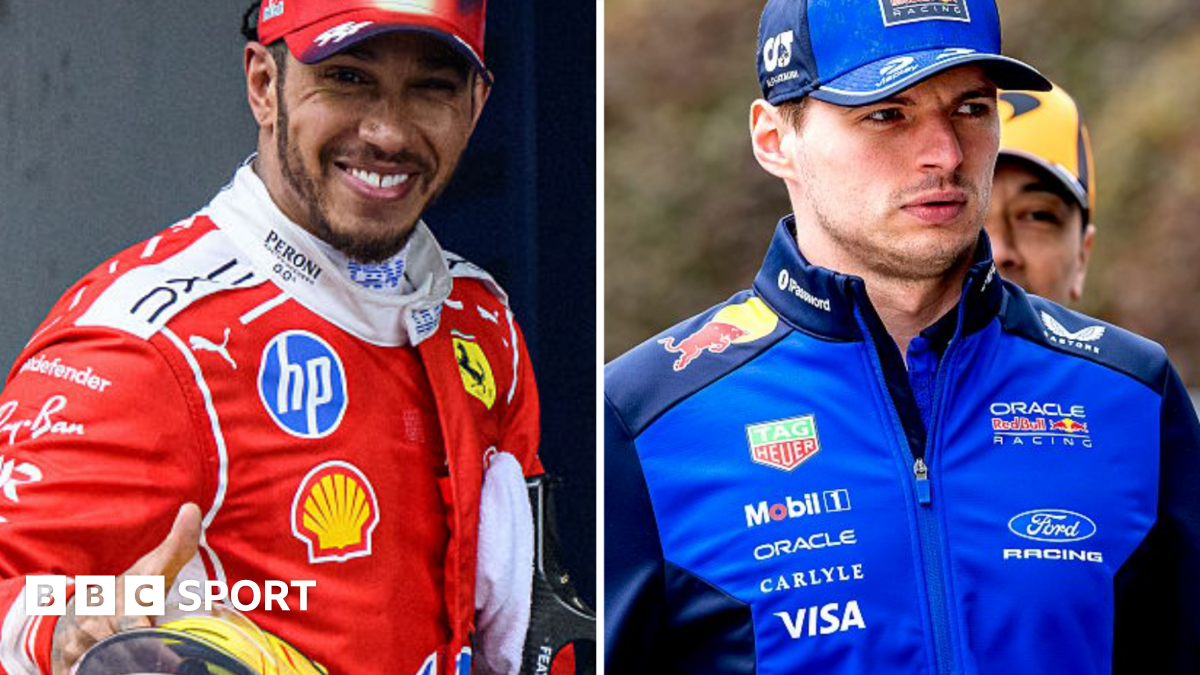
The three most successful drivers in Formula 1 summed up the conflict and paradox at the heart of the sport’s new look after a Chinese Grand Prix that showed off its best and worst sides.
Lewis Hamilton, fresh from his long-awaited first podium finish for Ferrari, called his battle with team-mate Charles Leclerc “awesome” and “the best racing I’ve ever experienced in F1”.
Max Verstappen, who retired with a problem in his Red Bull’s energy recovery system after a dispiriting race in the lower half of the field, said the new F1 was “terrible”.
“If someone likes this,” he said, “then you really don’t know what racing is like. Not fun at all. Playing Mario Kart. This is not racing. Boosting past, then you run out of battery, the next straight they boost past you again. For me, it’s just a joke.”
Fernando Alonso, meanwhile, often finds phrases of elegant simplicity that nail the heart of an issue.
Living a nightmare of deja vu from a decade ago with a Honda engine short of power and hybrid capability, Alonso described the new season as “the battery world championship”.
Their opinions, doubtless influenced by their own competitive positions, reflect layers of the same, complex issue.
The new hybrid engines – with their 50-50 split between internal combustion and electrical power, and energy recovery limited by regulatory choices – have led to a new style of racing wheel to wheel, and changed the fundamental nature of what drivers do.
Hamilton’s battle with Leclerc – and theirs in the opening laps with the Mercedes drivers of maiden race-winner Kimi Antonelli and George Russell – was a function of what many would consider the positive effects of the new engines on racing. Certainly, the most superficially attractive.
The “boost” and “overtake” modes provide extra electrical energy to help drivers pass their rivals. But then leave the driver who has used them short of battery charge, so they are vulnerable to being re-passed.
Even when a driver has a fundamentally superior car – such as the Mercedes – it can take time for this to balance out. While it does, the result is several laps of position-swapping.
This is even allowing the fast-starting Ferraris to mix it with the Mercedes in the early stages of race, for a few laps at least, even though Hamilton reckons Mercedes “have 0.4-0.5secs on us in race trim”.
In the case of Hamilton and Leclerc, in identical cars, the battle ebbed and flowed for two thirds of the race, with peaks of several laps of excitement interspersed with periods of stalemate, before Hamilton finally came out on top.
As Hamilton put it while sitting alongside Antonelli and Russell in the post-race news conference: “Of course, these guys are pulling past us at crazy speeds, but to be able to all be so close…
“Hopefully it was an exciting race to watch for you guys because it was awesome in the car. It felt like go-karting – back and forth, back and forth – and you could really position your car in a nice way where there was a thin piece of paper between us sometimes, but we didn’t exchange any paint.
“Great wheel-to-wheel battle, very fair and just what we want. I think that’s down to great drivers and respect.”
The flip side is the philosophical questions at the heart of this debate.
On a surface level, boost buttons and extra electrical energy smack of computer games – hence Verstappen’s remark about Mario Kart, the second time he had used the analogy in four days in Shanghai.
But the engines are also affecting what the drivers do on their own. The cars’ energy starvation has changed the nature of driving.
The job of an F1 team is to get their car around a lap as fast as possible. In 2026, that means keeping the battery levels high enough to deploy where it has maximum effect on lap time. And because the electrical components are so powerful – 350kw (470bhp) – they over-ride cornering.
In the lead battle, that’s why a car with a better engine, the Mercedes, is currently beating a car faster around the corners, the Ferrari.
Beyond that, it means that some elements of driver skill are being removed.
Some of the sport’s most demanding corners, which in the past would have been the most extreme tests of a driver’s skill and bravery, are no longer taken at the limit of grip because it is more effective to recover energy through them instead.
Among the corners drivers mentioned in this context in China were the Esses at Suzuka – considered by many the most challenging piece of race track on the planet – and Pouhon at Spa, a fearsome downhill double left-hander that is the most demanding corner on one of the world’s greatest circuits.
Verstappen said: “I speak for most of the drivers. Some of course will say it’s great because they’re winning races, which is fair enough. When you have an advantage, why would you give that up, right? Because you never know if you’re going to have a good car again.
“But if you just speak to most of the drivers, it’s not what we like. I don’t think it’s what the real F1 fans like. Maybe some fans like it but they don’t understand racing.
“This has nothing to do with racing – and I would say the same if I would be winning races. Because I care about the racing product. It’s not about being upset with where I am.”
F1’s bosses are caught in the middle of this debate, recognising the superficial appeal of the back-and-forth racing, but concerned about what the new cars are doing to the sport they grew up loving because they were attracted by its essence as the ultimate test of driver and machine.
Andrea Stella, team principal of world champions McLaren, said: “In qualifying, there’s some aspects of driving that could be counterintuitive.
“Like, occasionally there are comments from our drivers that once they make a mistake, actually save some energy, you go faster overall in a sector, because the energy you saved with the delay on the throttle because you had a problem is going to reward you at the end of the straight.”
Mercedes F1 team principal Toto Wolff said: “From an entertainment perspective, I believe that what we’ve seen today between Ferrari and Mercedes was good racing. Many overtakes.
“We were all part of Formula 1 where there was no overtake, literally. Sometimes we’re too nostalgic about the good old years.
“But I think the product is good in itself. We saw quite some racing in the midfield also. And that is, I think, the positive.
“Now, from a driver’s standpoint, when it comes to the qualifying lap, that is different. Clearly, lift and coast in the qualifying, I’m sure for someone like Max, who is a full-attack guy, it’s difficult to cope and digest.
“Qualifying flat-out would be nice. But when you look at the fans and the excitement that is there, live, the cheering when there’s overtakes and also on social media, the younger fans, the vast majority, through all the demographics, like the sport at the moment.
“So, yes, we can always look at how we’re improving it. But at the moment, all the indicators and all the data say people love it. And I spoke with Stefano (Domenicali, the F1 president). He says that, too.”
The cancellation of the Bahrain and Saudi Arabia Grands Prix gives the sport a little more breathing space to consider all this.
There is a meeting of team bosses with F1 and governing body the FIA this week, and another race in Japan in two weeks’ time before a five-week break before the next Grand Prix in Miami at the beginning of May.
A number of ideas to reduce the degree to which the purity of the driving experience has been polluted are already in the mix, such as removing a lower limit for energy recovery currently in force in a certain phase of the straights. And others may yet emerge.
Stella says: “Do we want to be faithful to the DNA of racing in a traditional sense? Do we accept that this counterintuitive situation belongs to the business or not? This is a high-level philosophical question.”
Recent Top Stories
Sorry, we couldn't find any posts. Please try a different search.