Cardinal John Joseph O’Connor: Born to Serve
Cardinal John Joseph O’Connor’s vocation to serve the spiritual needs of God’s children—in war and in peace, in life and in death—has left a legacy that transcends the bounds of today’s narrow, irreligious politics.
Born to Serve
John Joseph O’Connor was born in 1920 in the great American city of Philadelphia to an Irish Catholic father and a Catholic-convert mother of German Jewish descent.
The future prelate’s passion for the Catholic Church and thirst for knowledge was apparent at a young age.
O’Connor had already determined he wanted to be a priest upon graduating from West Philadelphia Catholic High School for Boys and enrolled at Saint Charles Borromeo Seminary. He subsequently received advanced degrees from Villanova and the Catholic University of America before completing a doctorate in political science at Georgetown University.
At Georgetown, O’Connor studied under President Ronald Reagan’s former U.S. ambassador to the U.N., Jeane Kirkpatrick. Kirkpatrick, declared O’Connor, “surely one of the two or three smartest graduate students I’ve ever had.”
Every year, Georgetown hosts the Cardinal O’Connor Conference on Life, which takes place around the March for Life and features philosophers, civic leaders, and distinguished clergy that make the case for the dignity of human life from conception to natural death.
Serving the Spiritual Needs of the Troops
O’Connor answered the call to serve in the military and provide for the spiritual needs of American troops.
In 1952, that meant joining the Navy as the Korean War raged. He subsequently worked as a military chaplain on ships stationed all over the world—from the Atlantic, Caribbean, and Mediterranean.
In Vietnam, O’Connor saw combat firsthand. Twice the Irish Catholic from Philadelphia earned the Legion of Merit for his outstanding military service. Later, O’Connor would author a book about his pastoral experience titled “Principles and Problems of Naval Leadership, A Chaplain Looks at Vietnam.”
After his service in Vietnam, O’Connor was named the chief chaplain of the U.S. Naval Academy at Annapolis in 1972. About three years later, he was appointed chief of chaplains for the entire U.S. Navy.
After serving as the bishop of Scranton for less than a year, O’Connor was elevated to lead the crown jewel of Catholic dioceses in America: New York. Pope St. John Paul II appointed O’Connor a cardinal in 1985.
O’Connor’s War Against AIDS
O’Connor used his high-profile role to champion Christian bioethics from ministering to those dying of AIDS, to protecting the unborn, to combating the scourge of antisemitism.
In the 1980s, O’Connor was known to visit the AIDS unit at St. Clare’s (Catholic) Hospital in Manhattan. O’Connor’s fight against the debilitating illness, while never capitulating on traditional Catholic values of life, family, and marriage, translated to the Catholic hospital system. In 1989, around 10% of his archdiocese’s health care beds were dedicated to those diagnosed with the horrendous disease.
And in 1987, Reagan appointed O’Connor to a national commission to combat the disease. From a public policy perspective, O’Connor was a stalwart advocate to secure more funding for research on the disease.
In spite of these efforts, the Catholic clergyman faced vehement protests for supporting the Catholic Church’s position on homosexuality. Perhaps most notably was a mass protest on Dec. 10, 1989, that disrupted his mass in the iconic St. Patrick’s Cathedral on 5th Avenue, which led to dozens of people being arrested inside the church. In his typical cheerful fashion, O’Connor led his congregation in prayer to overcome the protesters’ disturbances.
A Political, Diplomatic, and Spiritual Legacy
O’Connor was also honored by the American government for his international diplomacy, inter-faith outreach, and his ability to speak to people across the political aisle.
O’Connor was inspired to perform inter-faith ministry when he visited Dachau in 1975.
After he saw the remains of mass murder and torture, he was so moved that he looked to found a new religious order dedicated to protecting human life. Years later, O’Connor’s idea became a reality when eight women formed the Sisters of Life in New York in 1991.
For his work, he was also honored by the Anti-Defamation League and the American Jewish Committee. O’Connor’s advocacy for the Jewish people during his entire life occurred without him knowing that he was the grandson of a rabbi or his mother’s Jewish lineage.
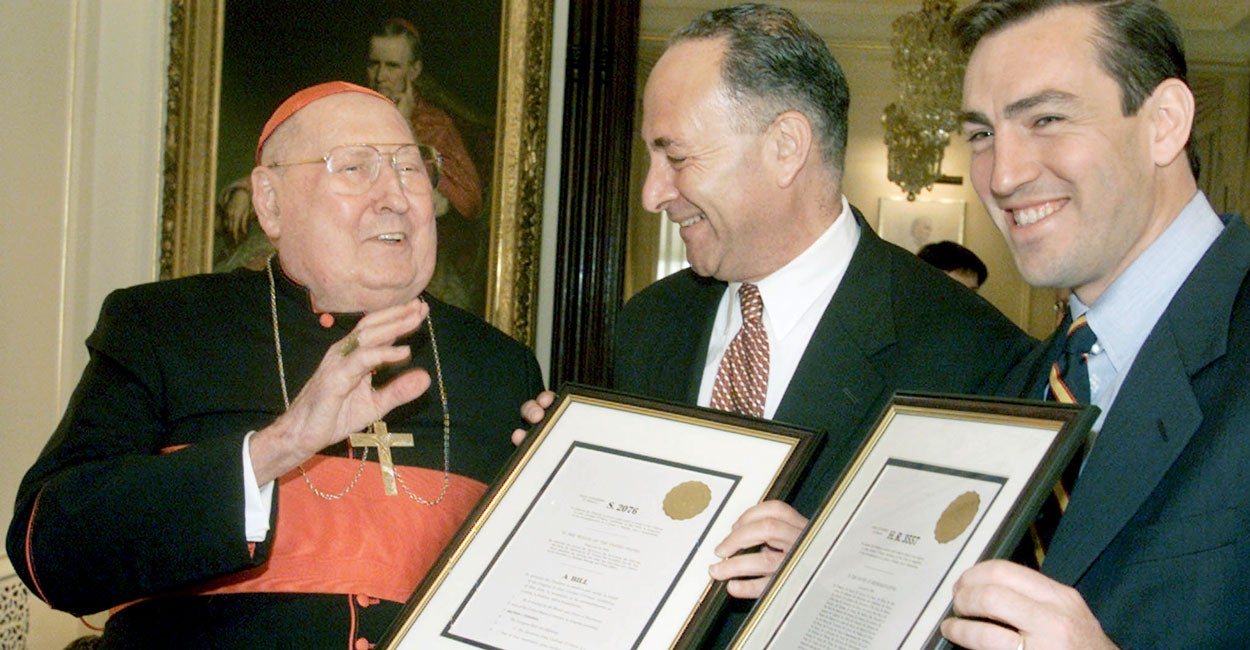
In 2000, Congress granted O’Connor the Congressional Gold Medal, citing his advocacy “of interfaith healing and understanding, particularly among individuals of the Catholic and Jewish faiths,” and noted that he had “played a significant role in helping to establish diplomatic ties between the Vatican and Israel.”
Then-President Bill Clinton bestowed the medal on O’Connor, and the Clintons were among several prominent New York Democrats who attended O’Connor’s funeral when the bishop died just months later.
To this day, O’Connor is remembered as someone whose personality allowed him to work across the political divide for common goals. Among his admirers was former New York City Mayor Ed Koch, who described him as “a great man.”
A Debt of Gratitude
I, personally, am indebted to O’Connor. He mentored and ordained Fr. John Richard Neuhaus, a Catholic priest in the archdiocese of New York. From that clerical position, Neuhaus would steward for almost two decades the most influential magazine at the intersection of religion and public life: First Things.
Years later that still thriving publication would give this journalist his first job out of college.
Recent Top Stories
Sorry, we couldn't find any posts. Please try a different search.