BBC spends day with emergency teams as Israel strikes Lebanon
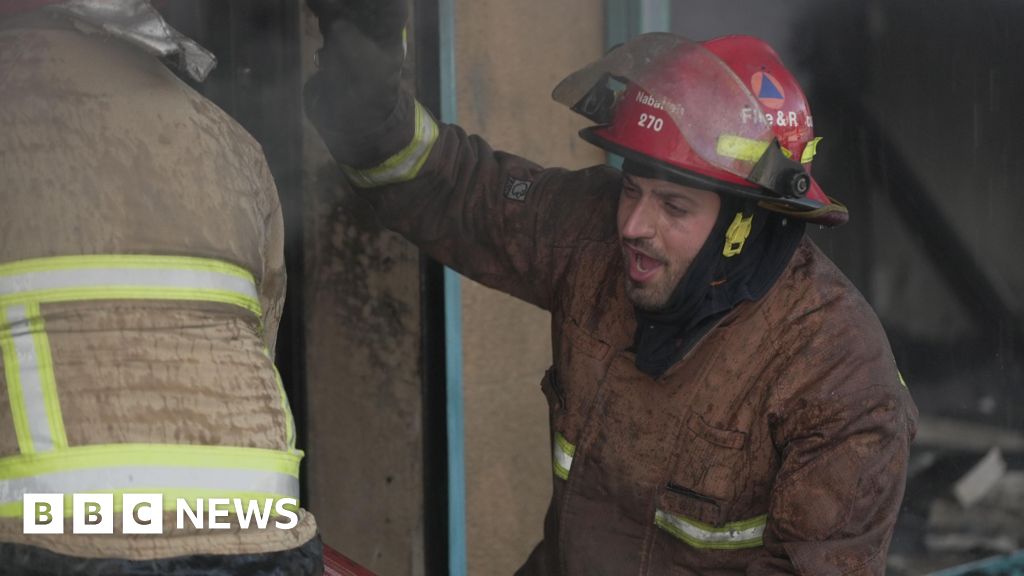
‘Follow the smoke’: BBC spends day with emergency teams as Israel strikes south Lebanon
Alice CuddySenior international reporter, Nabatieh, Lebanon
The war between Israel and Hezbollah is continuing to escalate, with hundreds of people killed in Lebanon and hundreds of thousands more forced from their homes since the beginning of the month.
Much of Israel’s air and ground operations have focused on the south of Lebanon. The BBC spent Wednesday with rescue workers in the city of Nabatieh, witnessing the pace and scale of bombings there – a day before the city and much of the land around it was included in a new set of sweeping Israeli evacuation orders.
The late afternoon silence in Nabatieh was broken by the whistle of a missile and the boom of an explosion in the valley beneath the Nabih Berri government hospital.
Medics and displaced people rushed to the hillside to peer beneath as ambulances raced to the scene with their sirens blaring.
“See how big it is,” one man said. “It lit up the sky.”
Forty-three seconds later, another explosion sounded nearby. Two more followed.
All sent plumes of grey smoke into the air around Nabatieh, clinging over apartment buildings and businesses, as chaotic search and rescue efforts got under way.
An emergency worker shouted out “follow the smoke” as ambulances tried to find their way to the scenes of the multiple strikes.
Among those racing across the city was Hussein Fakih, the regional head of the government-run Lebanese Civil Defence – the country’s primary firefighting, first aid and rescue force. He said he had been seeing the same things “almost every day” since war resumed on 2 March between Israel and the Iran-backed armed group and political movement Hezbollah – which is proscribed as a terrorist organisation by the UK, US and other countries.
“Whether that’s firefighting… or rescue operations, or searching under the rubble, or retrieving the bodies,” he said.
Lebanon was pulled into the conflict between Iran, Israel and the US when Hezbollah launched rockets and drones into Israel, in retaliation for the assassination of Iran’s supreme leader. The group also cited almost daily Israeli strikes against it since a ceasefire ended their last war in 2024.
Israel said Hezbollah’s attack justified launching a broader campaign against the group, and has since launched hundreds of strikes on Lebanon. It has accused Hezbollah of systematically using civilian infrastructure and areas for military activities, which the group has previously denied.

The BBC heard or went to the scenes of seven Israeli strikes on Wednesday. The ones we saw the aftermath of in Nabatieh were in areas that were not under official Israeli evacuation orders at the time, and locals and first responders said no warnings had been given.
The Israeli military did not respond to multiple BBC requests for comment about the specific targets of these strikes.
At the site of one of the explosions, an acrid smell lingered among the piles of debris scattered in front of a residential building. Sofas had been thrown to the ground by the strength of the explosion.
A small fire continued to burn inside the building, but rescuers at the scene rushed away to respond to one of the other strikes, saying no one had been killed or injured there.
One local resident walked up to assess the scene. He said only civilians had lived there, before walking away.

In the building next door, laundry was hung out to dry next to a pair of children’s shoes, but no-one appeared to be inside.
Before Thursday’s orders, much of Nabatieh already had the feeling of a ghost town. The city – located just 16km (10 miles) from the border with Israel – is one of the biggest in southern Lebanon.
Many residents had fled in fear, hoping to find safety further north after the war began.
Most Israeli strikes have focused on southern Lebanon, the eastern Bekaa Valley, and the southern suburbs of Beirut, known as the Dahieh – the heartlands of Hezbollah and of Lebanon’s Shia community. But some have hit areas elsewhere, including in the centre of Beirut.
But despite the escalating war, some residents in Nabatieh had stayed behind, saying they could not afford to move, or find any space at shelters, or simply did not want to leave their homes.
Among them was a family whose home was destroyed by one of the strikes on Wednesday.
“We didn’t leave because we saw on TV how people are stranded on the roads and sidewalks and I didn’t want that for my two grandkids so I decided to stay and trust in God’s will,” said 60-year-old Mona Najem.
The family were having lunch and watching TV, she said, when “suddenly half the house collapsed and we couldn’t see a thing – windows and glass got shattered”.
She grabbed her two grandchildren – aged seven and 10 – and went to hide in a small room that was still standing, until rescuers arrived and took them to the local al-Najde hospital.
“It is six of us [living there], and we are all fine – thanks to God. My older son stepped on a piece of shattered glass but it’s minor, otherwise God was merciful,” she said from a hospital bed.

Opposite Mona, her other son was holding an oxygen mask to his mouth and could not speak. She said it was because of the shock of what had happened.
“We didn’t leave in the previous war and we got used to it. Even through this, the children have sometimes played outside under the warplanes. After this hit I felt distress and I feared for them [but] they turned out to be tougher than me,” she said as her grandchildren smiled beside her.
The home of 69-year-old Entisar Yassine was also damaged by the impact of a strike, while she was on her wheelchair inside.
When the BBC arrived at the apartment with rescue workers, Entisar appeared scared and disorientated. She had attempted to clean some of the glass that had shattered in her apartment.
“I was very scared when that strike happened. I was already afraid, and my heart kept pounding from the panic and fear,” she later told the BBC from hospital.
She said she had “wanted to leave” but didn’t know where to go. Mona had her leg amputated two years ago because of a medical condition, and she worried that shelters would not have accessible toilets.
She said she hoped she would now be taken somewhere with suitable facilities, or with someone who could support her.
Until now “this war didn’t affect me, but today it did,” she said.
At a separate strike earlier in the day on Wednesday, firefighters battled for hours to put out a major fire that had hit a residential building with shops on the ground floor.
“We are in a market and these are shops. They are selling shoes and [clothes]. They are all civilians,” said a bystander, who gave his name only as Abu Mohammed.
While some have voiced anger to the BBC about Hezbollah’s decision to fire rockets into Israel earlier this month, Abu Mohammed said he supported the group, citing the ongoing Israeli strikes on Lebanon after the ceasefire.
“We could not rebuild our houses or return to our villages and cities while the Israelis were having a free hand there. Hezbollah needed to respond. It’s either you kill or get killed,” he said.

The hospitals in the area are now operating with greatly reduced staff – many of them living there.
At the hilltop Nabih Berri government hospital, staff said they were trying to transfer patients further north as soon as possible for their safety and because they were no longer able to operate at full capacity.
Head nurse Ali Omeis said it was exhausting to be dealing with another war so soon.
”It’s very aggressive, very intense every night. Every nurse in this hospital is feeling sorry about this,” he said. “We are very tired.”
On Thursday – the day after the BBC visited Nabatieh – Israel expanded its already sweeping evacuation orders for southern Lebanon to include the city, telling people to move north of the Zahrani river. At the same time, strikes in the centre of the capital Beirut intensified.
Entisar said she would move north, but hoped to return soon to her home of 25 years.
“If it is calm again, I’ll go back,” she said.
Recent Top Stories
Sorry, we couldn't find any posts. Please try a different search.