Asia stocks slump and oil rises for third day as markets track Iran war
Osmond ChiaBusiness reporter

 Getty Images
Asian stock markets fell for a third day in a row on Wednesday and oil prices moved higher as investors watch developments in the US-Israel war with Iran.
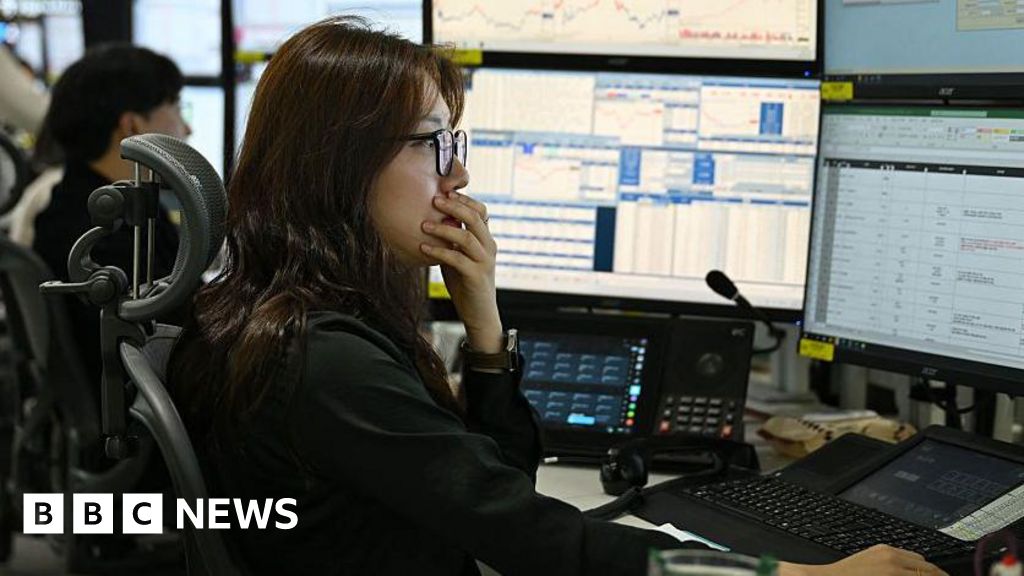
Share indexes in South Korea and Thailand temporarily halted trading after plunging by more than 8% and triggering so-called circuit breakers, which aim to avoid panic selling.
Brent crude oil was about 2.8% higher in Asia afternoon trade after surging over the last two days.
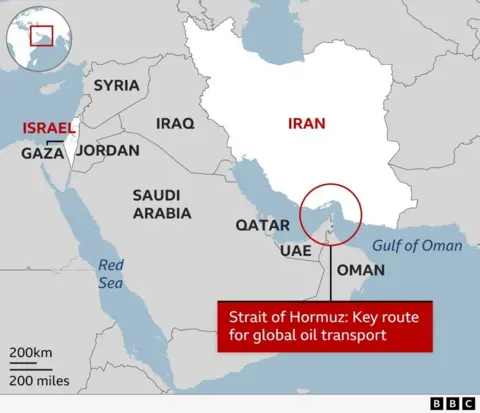
The conflict in the Middle East has rattled financial markets and global energy prices have soared this week after vessels near the crucial Strait of Hormuz shipping lane have come under attack.
South Korea’s benchmark Kospi index closed 12% lower, while the Nikkei 225 in Japan lost 3.6%.
In afternoon trading, Hong Kong’s Hang Seng index was 2.5% lower, while the Shanghai Composite in mainland China was down by 0.8%.
Around a fifth of the world’s oil and gas usually flows through the Strait of Hormuz narrow waterway between Iran and the United Arab Emirates (UAE), but traffic has almost entirely halted following Iran’s threats to “set fire” to ships.
Traffic through the strait has almost completely halted following Iran’s threats.
He said Washington will provide risk insurance “at a very reasonable price” to all shipping firms in the region to “ensure the FREE FLOW of ENERGY to the WORLD”.
Stock markets have fallen sharply since the US and Israel attacked Iran over the weekend.
Many Asian stock markets have been hit particularly hard as the region imports large amounts of energy from the Middle East that has to pass through the Strait of Hormuz.
Shares have also fallen in export-reliant countries like South Korea and Japan, which are especially vulnerable to geopolitical shocks that put shipments at risk.
South Korea’s Kospi had one of its worst days in decades. Trading was automatically halted for 20 minutes during the morning, as part of an emergency mechanism that is triggered by major falls and is designed to curb panic selling.
It was the first time the circuit breaker had been activated since August 2024.
The Kospi’s slide reflects how “fragile” market sentiment has been effected by the conflict, said Jack Lee from the research organisation China Macro Group.
Compared to most other Asian countries China has so far seen relatively little impact.
China’s financial market has been “buffered”, in part because Beijing has alternative sources of energy, including oil from Russia, said Lee.
But, with the war now in its fifth day, investors are concerned about the potential of it turning into a protracted conflict, he added.
On Tuesday, the Kospi, which reopened after a public holiday on Monday, fell by more than 7%. Japan’s Nikkei lost more than 3%, while Hong Kong’s Hang Seng and the Shanghai Composite in mainland China also fell.
The UK’s FTSE 100 closed 2.75% lower, while Germany and France’s main indexes lost more than 3.4%.
In the US, the S&P 500 index opened sharply lower but recovered some of those losses, ending nearly 1% down.
Recent Top Stories
Sorry, we couldn't find any posts. Please try a different search.