Welfare doesn’t pull people out of poverty – economic growth and freedom do – The Expose
Welfare doesn’t pull people out of poverty – economic growth and freedom do
Before the rapid expansion of the welfare state, most people were earning their way out of poverty. Across the world, economic growth driven by liberalisation helped pull almost one billion people out of extreme poverty from 1990 to 2010.
In the USA, “The most powerful anti-poverty programme had no enrolment forms, caseworkers or spending bills. It was a growing economy that helped millions of people earn their way to a better life,” Tyler Turman writes.
Let’s not lose touch…Your Government and Big Tech are actively trying to censor the information reported by The Exposé to serve their own needs. Subscribe to our emails now to make sure you receive the latest uncensored news in your inbox…
Measuring Poverty Correctly Reveals a Hard Truth About the Welfare State
By Tyler Turman, as published by The Daily Economy on 26 March 2026
America has spent more than $20 trillion on fighting poverty since the introduction of President Johnson’s Great Society programme in 1964. Sixty years later, how are we doing?
That depends, as it turns out, on how you measure it.
Last month, Senator Kennedy (R-LA) introduced a bill that would require the Census Bureau to report a new poverty metric as an alternative to the Official Poverty Measure (“OPM”) by including both cash and non-cash welfare benefits in its calculations.
As Kennedy points out, this is a much-needed fix. The OPM’s methodological weaknesses are well documented. Most notably, it ignores the hundreds of billions of dollars the government spends each year to assist low-income families through tax credits like the Earned Income Tax Credit and in-kind transfers such as Medicaid, food stamps and housing subsidies. In short, the OPM paints an egregiously inaccurate picture of material poverty in America.
Kennedy’s bill would require the Census Bureau to publish the Congressional Budget Office’s more comprehensive poverty measure alongside the OPM in its annual poverty report. A similarly constructed measure was developed by economists Richard Burkhauser and Kevin Corinth in a recent paper with the National Bureau of Economic Research. After accounting for taxes and transfers, they found that the “full-income” poverty measure sat at just 3.7 per cent in 2023 – 1.6 per cent after including health insurance – a far more optimistic look than the OPM’s 11.1 per cent from the same year.
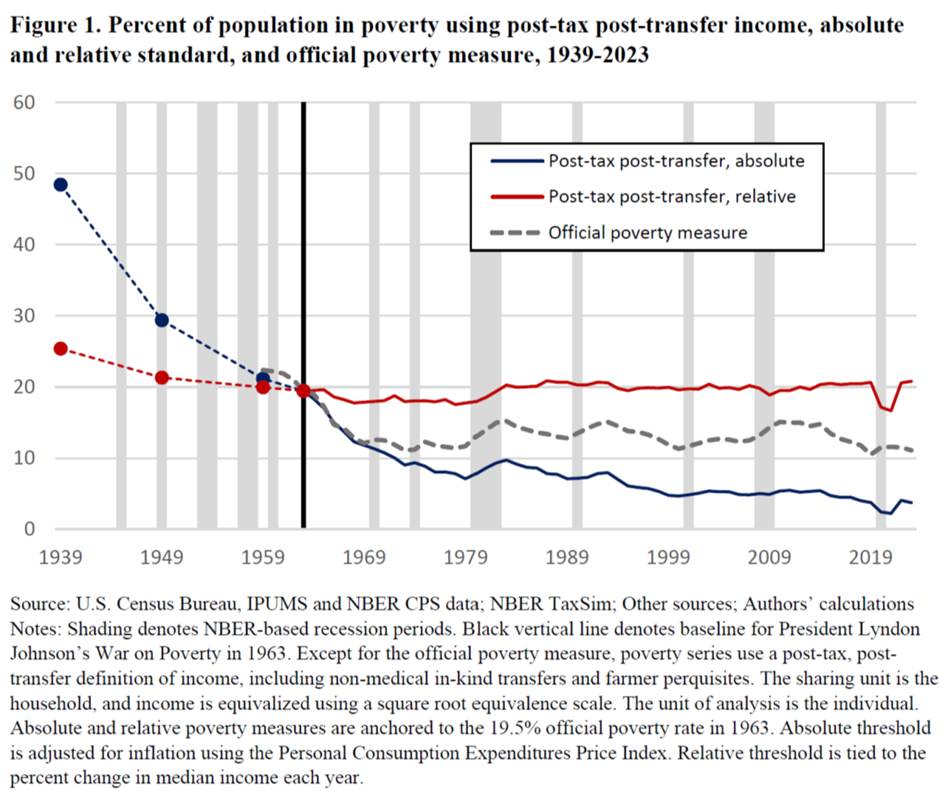
That sounds like a triumph. But Burkhauser and Corinth take it one step further and use their “full-income” measure to track changes in the poverty rate dating back to 1939.
Contrary to popular belief, they find that the greatest era of poverty reduction happened beforeJohnson declared war on it.
From 1939 to 1963, absolute full-income poverty plummeted by 29 percentage points, from 48.5 per cent to 19.5 per cent. Then, despite the government pouring trillions of taxpayer dollars into combating poverty, poverty fell by only 15.7 percentage points from 1963 to 2023. Barely half the progress in more than twice the time.
But the stagnating decline is only half the story. The more consequential difference is what drove it.
Before 1964, the main engine of poverty reduction was increases in market income – a measurement that includes wages, salaries and other forms of income from employment. From 1939 to 1959, market income poverty fell by 26.1 percentage points, nearly all of the 27.3 per cent decline in full-income poverty over the same period. In short, before the rapid expansion of the welfare state, most people were earning their way out of poverty.
After 1964, that engine stalled. Market income poverty fell by just 3.9 percentage points from 1967 to 2023, while post-tax, post-transfer poverty fell by 10 percentage points. Even though poverty has continued to decline over the past six decades, most of that was due to the ever-expanding generosity of government transfers.
While low-income Americans were benefiting from the biggest poverty reduction in the country’s history, the percentage of working-age adults relying on government transfers for more than half their income decreased from 2.9 per cent in 1939 to 2.7 per cent in 1959.
By 2023, this number had nearly tripled to 7.6 per cent, even reaching as high as 15 per cent in some years.
As Mercatus scholar Jack Salmon put it: “The War on Poverty changed the how of poverty reduction, but it didn’t accelerate the how much.”
If anything, by changing the former, it may have blunted the latter. A 76 per cent increase in real median income, paired with rising employment and higher productivity, largely driven by rapid postwar economic expansion, pulled more people out of poverty in 24 years than trillions of dollars in government-imposed wealth redistribution have done in 60.
Some may argue that this trend is to be expected. After all, reducing poverty from 48 per cent to 20 per cent is arithmetically easier than reducing it further because there are simply fewer people left below the poverty line, and those who remain tend to face the most entrenched barriers to self-sufficiency.
Fair enough. But as Burkhauser and Corinth point out, full-income poverty largely stagnated starting in the 1970s – right as welfare spending was ramping up dramatically. In short, taxpayers have been paying for a multitrillion-dollar boondoggle that has yielded increasingly diminishing marginal returns.
So, what was the main driver behind the pre-1964 miracle? Simple: Economic growth.
The pre-1964 record, along with centuries of evidence, suggests that nothing has worked better than economic growth in helping people, especially those at the bottom of the income ladder, to achieve a higher quality of life. Across the world, economic growth driven by liberalisation helped pull almost one billion people out of extreme poverty from 1990 to 2010.
The Fraser Institute’s research shows that North American states with higher and increasing levels of economic freedom tend to have more income mobility , especially among low-income households, higher economic growth, less homelessness, and lower levels of food insecurity.
The fruits of economic growth are visible in ways that poverty statistics fail to capture, especially for America’s poor. As Joseph Heath points out, 95 per cent of American households below the poverty line have electricity, indoor plumbing, a refrigerator, a stove and a colour television. More than 80 per cent have an air conditioner and a cell phone, and two-thirds own a washing machine and dryer. Economic growth, not government programmes, is what helped make these once-luxury goods unavailable to many wealthy households now accessible to nearly everyone. It continues to bear fruit today – wages for typical American workers are at all-time highs.
The most powerful anti-poverty programme had no enrolment forms, caseworkers or spending bills. It was a growing economy that helped millions of people earn their way to a better life. As such, subsequent efforts should focus on removing government-created barriers to economic growth, occupational opportunities, and job market entry rather than adding another layer of expensive, inefficient wealth transfers.
Senator Kennedy is right to say we need a more accurate measure of poverty. When analysing the best ways to combat poverty, policymakers should reflect on whether the welfare state was ever the right tool for the job.
About the Author
Tyler Turman is a Young Voices Contributor and currently works as a Research Associate for a DC-headquartered policy organisation. He is a graduate of the University of Washington, Seattle, and was part of the Fall 2024 cohort of American Institute for Economic Research’s (“AIER’s”) Research Internship Programme, where he developed an independent research project on Permanent Housing.
The Expose Urgently Needs Your Help…
Can you please help to keep the lights on with The Expose’s honest, reliable, powerful and truthful journalism?
Your Government & Big Tech organisations
try to silence & shut down The Expose.
So we need your help to ensure
we can continue to bring you the
facts the mainstream refuses to.
The government does not fund us
to publish lies and propaganda on their
behalf like the Mainstream Media.
Instead, we rely solely on your support. So
please support us in our efforts to bring
you honest, reliable, investigative journalism
today. It’s secure, quick and easy.
Please choose your preferred method below to show your support.

While previously it was a hobby culminating in writing articles for Wikipedia (until things made a drastic and undeniable turn in 2020) and a few books for private consumption, since March 2020 I have become a full-time researcher and writer in reaction to the global takeover that came into full view with the introduction of covid-19. For most of my life, I have tried to raise awareness that a small group of people planned to take over the world for their own benefit. There was no way I was going to sit back quietly and simply let them do it once they made their final move.
Recent Top Stories
Sorry, we couldn't find any posts. Please try a different search.