“Renewable” energy policies can’t work – because of physics – The Expose
“Renewable” energy policies can’t work – because of physics
The current “renewable” energy policy is in a head-on collision with physics. The physics of gradient, density and land use are the starting point for understanding why, writes Richard Lyon.
Let’s not lose touch…Your Government and Big Tech are actively trying to censor the information reported by The Exposé to serve their own needs. Subscribe to our emails now to make sure you receive the latest uncensored news in your inbox…
Chapter 1: The Physics That Demolishes Energy Policy, Or Why You Can’t Boil An Egg In A Swimming Pool
By Richard Lyon, 3 March 2026
On Saturday, I told you I’d written a book and promised to walk through its core arguments chapter by chapter. Some long-standing readers will recognise what follows from a post I wrote in 2024. This is the sharper, tighter version that became the book’s opening chapter – the foundation everything else rests on. If you’re new here, start here.
There is far more heat energy in a swimming pool than in a pan of boiling water. You can boil an egg in the pan. You can’t boil an egg in the pool. And if you doubled the size of the pool, you’d double the energy available – and still have a cold, raw egg.
This is not a riddle. It is the single most important concept in the energy debate, and almost nobody making energy policy understands it.
Gradient
To do useful work, energy must flow from a region of high concentration to a region of low concentration. This difference is called the energy gradient. The steeper the gradient, the more work you can extract. A shallow gradient means the energy is real but useless.
Think of a ski slope. A run that falls 1,000 feet over 1,000 feet of distance is steep enough to let gravity do the work. A ski queue that falls 10 feet over 100 feet is too shallow – you have to shuffle. Now join 100 ski queues end to end. The total height difference is 1,000 feet – the same as the ski run. But do you glide down it? No. Because the gradient hasn’t changed. It’s still a long, flat shuffle.
This is exactly what happens when you build more wind turbines. A gas flame at 1,500°C in a 15°C room is a ski run – a vast temperature difference that a power generation system can exploit. A wind turbine extracts energy from air moving at perhaps 25 miles an hour. That’s real energy, but it’s a tiny gradient – the difference between a breeze and no breeze. Build a thousand turbines and the total energy grows, but the gradient of each one hasn’t changed. You haven’t built a ski run. You’ve built a thousand ski queues.
Density
Energy gradient tells you whether a source can do work, and therefore why the sheer quantity of energy available tells you almost nothing about how much useful work you can extract from it. Energy density tells you whether you can build a civilisation on it.
Diesel contains roughly 44 megajoules per kilogram. The best lithium-ion battery manages about 1. That is a ratio of 44 to 1 – and the gap is not an engineering problem. It is a chemistry problem. Carbon-hydrogen bonds release enormous energy when broken. Shuttling lithium ions between electrodes releases much less. The periodic table is not subject to software updates.
This is why you can drive from London to Edinburgh on 50 litres of diesel, but need a battery weighing half a tonne to do it in an electric car. It’s why aviation runs on kerosene and always will. It is not a matter of waiting for better technology. It is a hard physical constraint.
Every successful energy transition in history has moved up the density ladder: wood to coal, coal to oil, oil to nuclear. Each step concentrated more energy into less mass, enabling capabilities that were physically impossible before. Railways. Aviation. The globalised supply chain. The direction has always been the same: concentration.
Land
There is a third concept that follows from these two: power density. How much energy can you extract from a given area of land?
A gas-fired or nuclear power station produces roughly 1,000 watts per square metre of land it occupies. A solar farm manages 20 to 30. A wind farm – once you account for the spacing turbines need to avoid stealing each other’s wind – delivers 1 to 3.
That is a factor of somewhere between 300 and 1,000. To replace a single gas plant with wind turbines, you need 300 to 1,000 times more land. That land is not empty. It is farmland, moorland, coastal seabed or someone’s horizon. It must be manufactured, transported, erected on concrete foundations, connected by access roads and linked to the grid by hundreds of miles of new transmission lines.
This is not a problem that improves with scale. It gets worse. Low power density means spreading out. Spreading out means longer transmission distances, more infrastructure and more energy consumed building and maintaining the collection network. At some point, the energy required to sustain the system begins to consume a significant fraction of the energy it produces.
The system is running to stand still.
The Floor
These three concepts – gradient, density and power density – describe the thermodynamic floor beneath civilisation. No policy, no subsidy and no amount of determination can override them. Every involuntary move down the density ladder in human history has produced not a gentle simplification but a catastrophe. The Western Roman Empire did not “transition” to a lower-energy economy. It collapsed, and half the population died.
The proposal to replace gas and nuclear with wind and solar reverses the direction of every successful energy transition in human history. It moves down the density ladder, deliberately, and hopes for the best.
That is what I mean when I say current energy policy is in a head-on collision with physics. The physics of gradient, density and land use – all of which are examined in the first section of the book – are the starting point for understanding why.
The next essay will be on Friday: what industrial civilisation actually “eats” – its metabolism – and why you can’t replace the menu with electricity.
This is the second in a series previewing the core arguments of ‘The Energy Trap: Why the Renewable Energy Transition Can’t Work – And What Can’, launching 10 April. Free PDF at pocketguideto.com. You can read subsequent articles in the series by following the links below:
- Chapter 2: What civilisation actually eats
- Chapter 3: The depleting oil inheritance
- Chapter 4: The Renewables Paradox
- Chapter 5: The Escape Hatches
About the Author
Richard Lyon is a former senior oil and gas operations manager with 35 years of international experience and academic qualifications in electrical engineering and power systems, petroleum engineering, and energy economics. He publishes articles on a Substack page titled ‘The State of Britain’, which you can subscribe to and follow HERE.
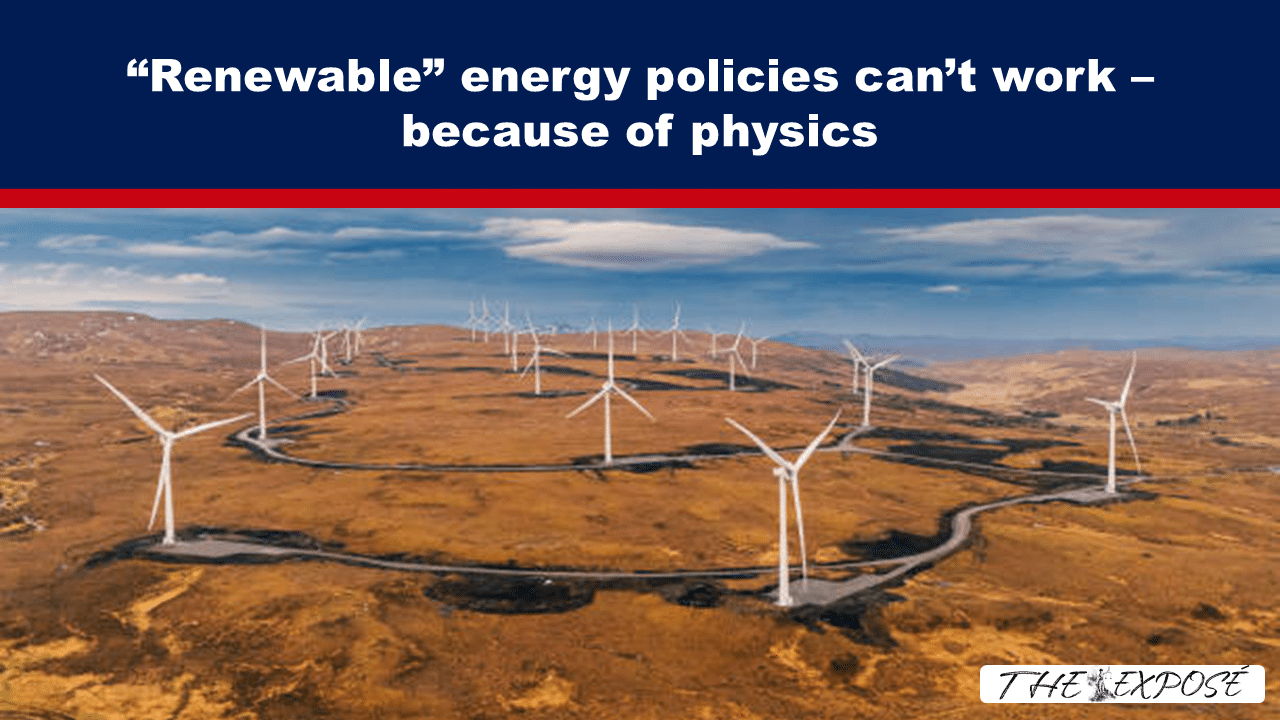
Featured image: An aerial/drone view of wind turbines in a remote location in the Scottish Highlands. Source: Getty Images
The Expose Urgently Needs Your Help…
Can you please help to keep the lights on with The Expose’s honest, reliable, powerful and truthful journalism?
Your Government & Big Tech organisations
try to silence & shut down The Expose.
So we need your help to ensure
we can continue to bring you the
facts the mainstream refuses to.
The government does not fund us
to publish lies and propaganda on their
behalf like the Mainstream Media.
Instead, we rely solely on your support. So
please support us in our efforts to bring
you honest, reliable, investigative journalism
today. It’s secure, quick and easy.
Please choose your preferred method below to show your support.

While previously it was a hobby culminating in writing articles for Wikipedia (until things made a drastic and undeniable turn in 2020) and a few books for private consumption, since March 2020 I have become a full-time researcher and writer in reaction to the global takeover that came into full view with the introduction of covid-19. For most of my life, I have tried to raise awareness that a small group of people planned to take over the world for their own benefit. There was no way I was going to sit back quietly and simply let them do it once they made their final move.
Recent Top Stories
Sorry, we couldn't find any posts. Please try a different search.