Supermajority of Voters Support Health and Medical Freedom, Poll Shows

The right of individuals to make their own health care decisions is a topic of intense public concern. Proponents of medical freedom argue that no government, business, or other institution can override a person’s ultimate authority over what medicines or vaccines they choose to take.
The health freedom movement more generally encompasses the related issues of clean air and water, over-prescription of drugs to children, pesticide use, dangerous food additives, legal immunities granted for vaccine manufacturers, and the right of doctors to speak freely about their opinions without fear of censure or loss of livelihood.
Despite the timeliness of these topics, and the passionate opinions held on them, most major media outlets, polling groups, and political strategists would have us believe that support for medical freedom is very low. On top of that claim, they insist these priorities are “bad politics” that would endanger a candidate in a close race if embraced.
To justify these claims, they point to opinion polls commissioned by established political groups that are not nearly as unhappy with the status quo as the average American is. In this way, polls are used less as a way to capture public opinion than as a tool to shape the policy landscape.
We’ve been subjected to several of these lately. What we’ve lacked is an objective poll that addresses the curiosities everyone has, with plain questions that get to the root of the controversies over health and medical issues.
Health Freedom Defense Fund and Brownstone Institute initiated such a poll to find out. This February 26-27, 2026 poll, conducted by Zogby Strategies, has documented remarkable supermajorities in favor of medical and health freedom, with numbers on objective questions exceeding 80 percent.
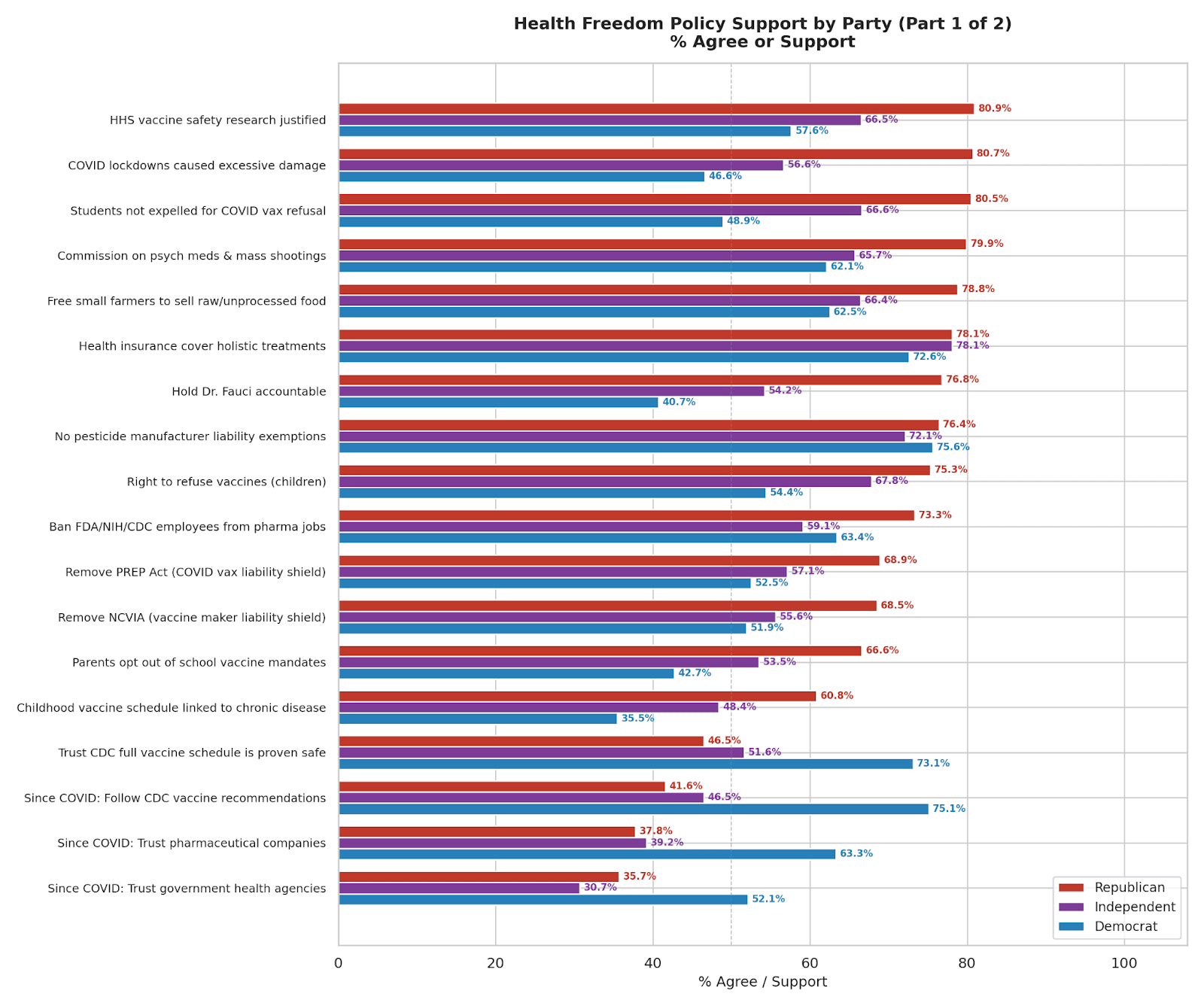
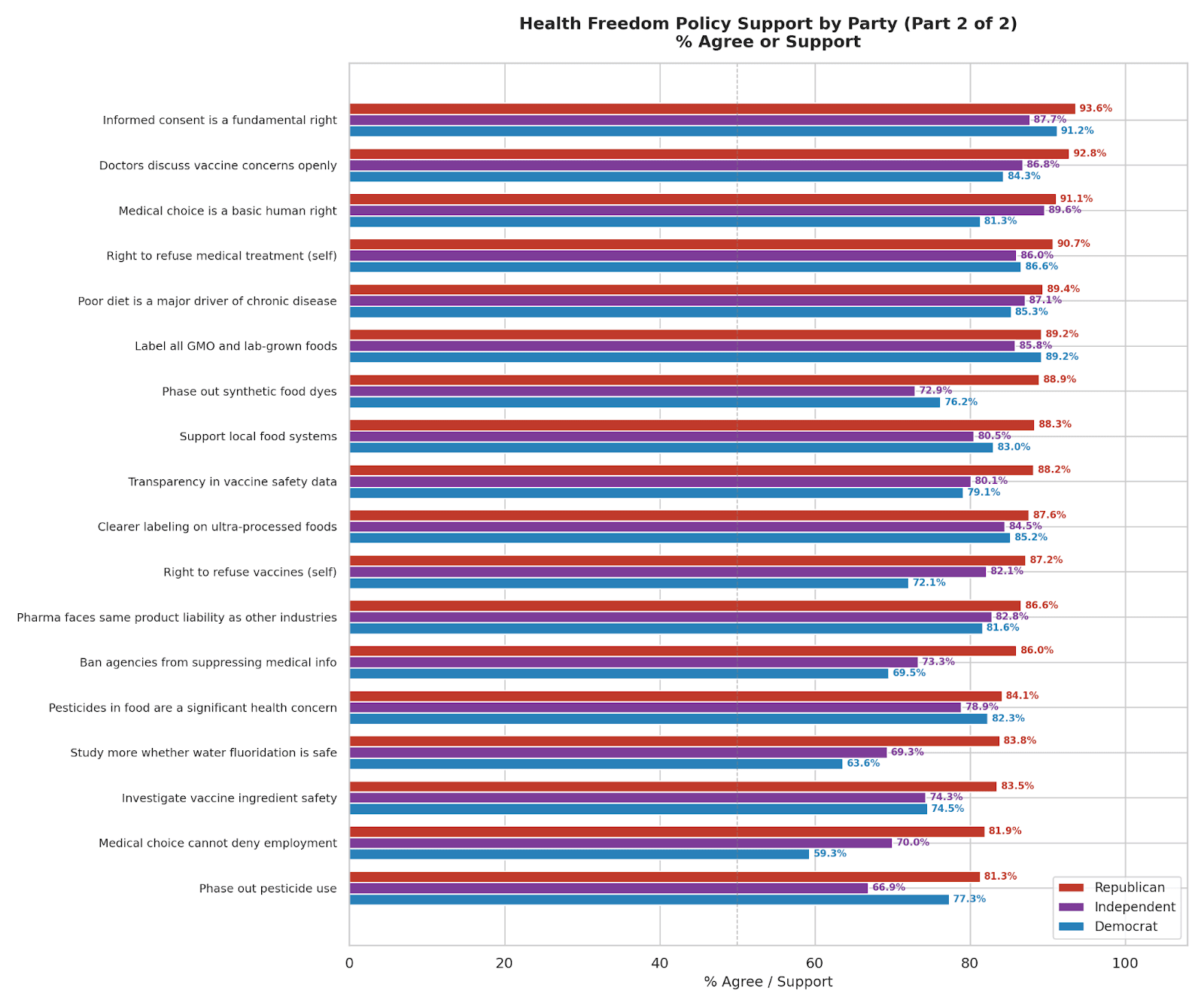
Polled were 1,000 registered voters with 93.6% definitely or very likely to vote. The party breakdown is 37% Republican, 36% Democrat, 27% Independent. Party breakdown shows broad support. The margin of error for overall results is +/- 3.2 percentage points.
Such supermajorities are rare in polling outcomes. Polling documents embedded below.
Strongest areas of agreement (broad majority support):
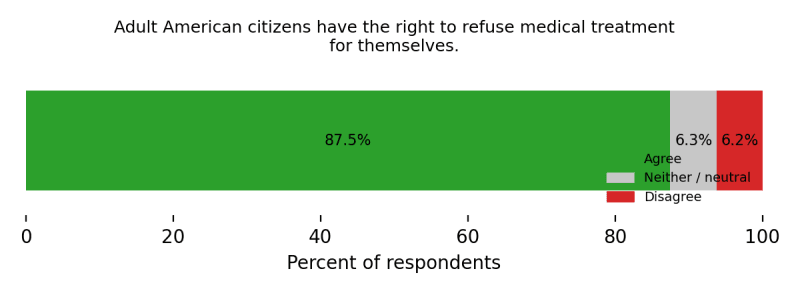
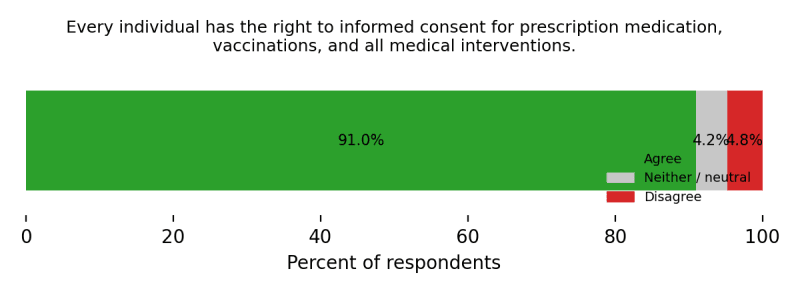
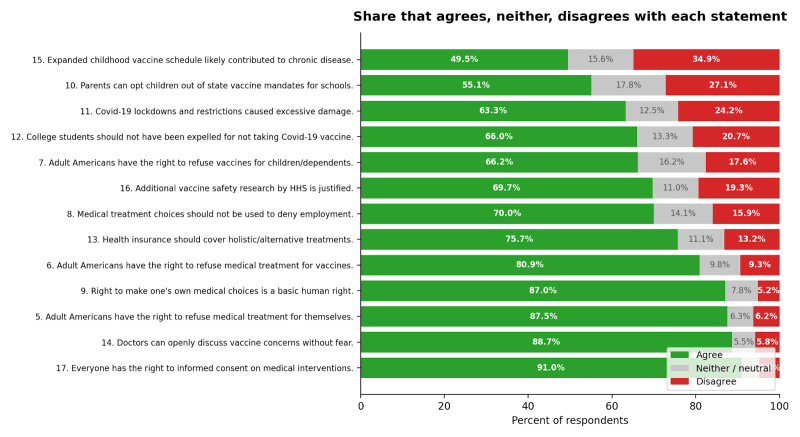
- Right to refuse medical treatment generally: 87.9% agree (58.8% strongly).
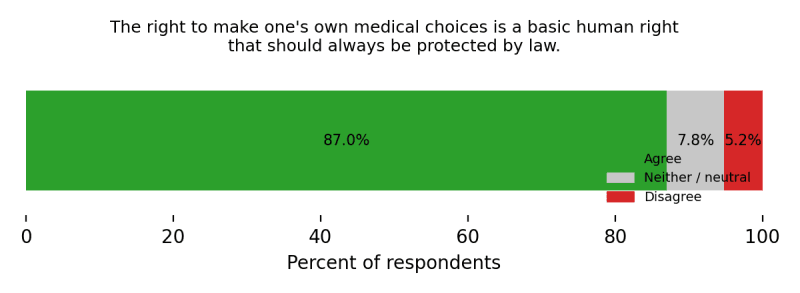
- Right to make one’s own medical choices as a basic human right protected by law: 87.2% agree (59.5% strongly).
- Doctors should discuss vaccine concerns openly without fear of medical board backlash: 88.1% agree (64.5% strongly — one of the highest “strongly agree” levels in the survey).
- Health insurance should cover chosen treatments, including holistic/alternative options: 76.1% agree (43.6% strongly).
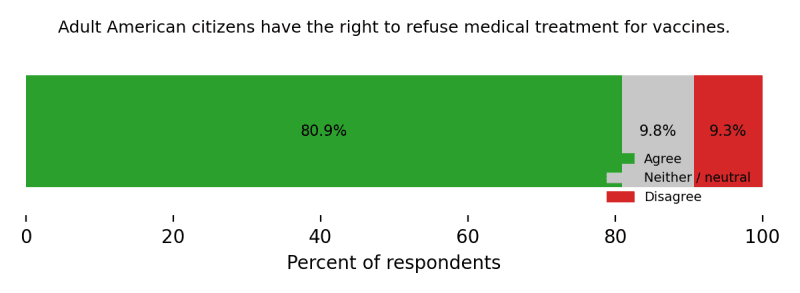
- Right to refuse vaccines for adults: 80.4% agree (50.5% strongly).
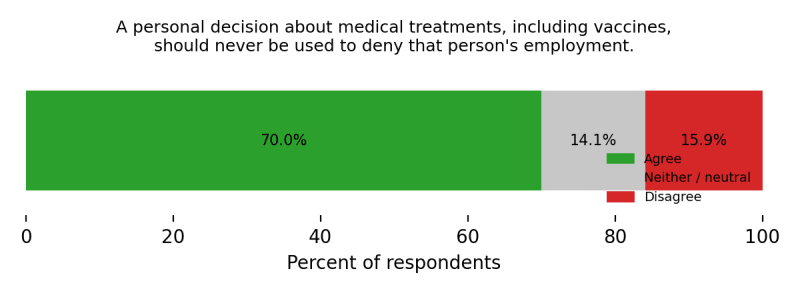
- Personal medical/vaccine decisions should never lead to employment denial: 70.6% agree (47.3% strongly).
- Parents’ right to refuse vaccines for children/dependents: 65.7% agree — still a clear majority, but softer than adult refusal (37.4% strongly agree vs. 50.5% for adults).
On matters of school vaccine mandates, results show majorities:
- Parents should be able to opt children out of school vaccine mandates: 54.5% agree (31.0% strongly). Among parents with children under 17, the agreement was 66.7%, with 42.8% strongly agreeing. To put this staggering result in context, other polls in recent years have concluded that more than 70% of the public support school vaccine mandates.
- College students should not have been expelled for refusing Covid-19 vaccine: 65.4% agree (44.4% strongly).
On matters related to the Covid-19 Era, the poll documents a strong majority opposed measures in retrospect:
- Covid lockdowns/restrictions caused excessive damage to American society: 61.9% agree (35.0% strongly) vs. 32.0% disagree.
On other matters related to medical freedom:
- Childhood vaccine schedule expansion likely contributed to rise in chronic diseases (among other factors): 48.3% agree vs. 38.2% disagree + 13.6% undecided — essentially split but less than a decade ago, a strong majority said the vaccine schedule is safe as noted in a Pew Research poll.
- HHS decision to conduct additional vaccine safety research is justified: 68.6% agree vs. ~21% disagree + 10% undecided.
- Investigating the effects of thimerosal (a mercury-based compound), aluminum, Polysorbate-80, Polyethylene Glycol, and formaldehyde used in everyday medical products; 77.8% support, 47.8% strongly. (This question concerns the ingredients in vaccines without mentioning the word vaccines yielding even stronger support.)
Overall, the poll shows very strong support (80–88%) for adult medical autonomy, the right to refuse treatment/vaccines as adults, freedom of medical speech for doctors, and protection from employment discrimination based on medical choices.
Majority support remains when the question involves children (school mandates 54–66%, parental refusal for dependents 66%). More noteworthy, however, these results illustrate erosion in public support for school vaccine mandates since 2019 as also seen in other surveys.
Retrospective judgment on Covid policies leans toward viewing them as excessively damaging. Trust in figures like Dr. Anthony Fauci and associated public health directives remain low (around 28–35%), with majorities believing guidance prioritized other interests or enabled excessive restrictions.
There is also broad approval for more vaccine safety research. The results reflect an electorate (especially among likely 2028 voters) that is protective of individual medical decision-making rights.
Finally, the poll results demonstrate that Americans will vote for candidates who protect their rights and freedoms, insist on transparency, and hold experts, pharmaceutical, and chemical companies accountable for their actions.
The lessons of this poll are palpable. If people are asked straightforward questions that impact their own health and medical wishes, and those of their families, they clearly come down on the side of freedom, transparency, honesty, and choice. This should not be surprising because these are core American values on which people are more united than divided.
All we needed was a clear poll with plain questions and no surreptitious agendas to reveal this. That said, such polls are as rare as the supermajorities they document. That’s what makes this poll different from the others. It gets to the heart of what people truly think about the critical issues of our time as they concern medical ethics and human freedom.
-

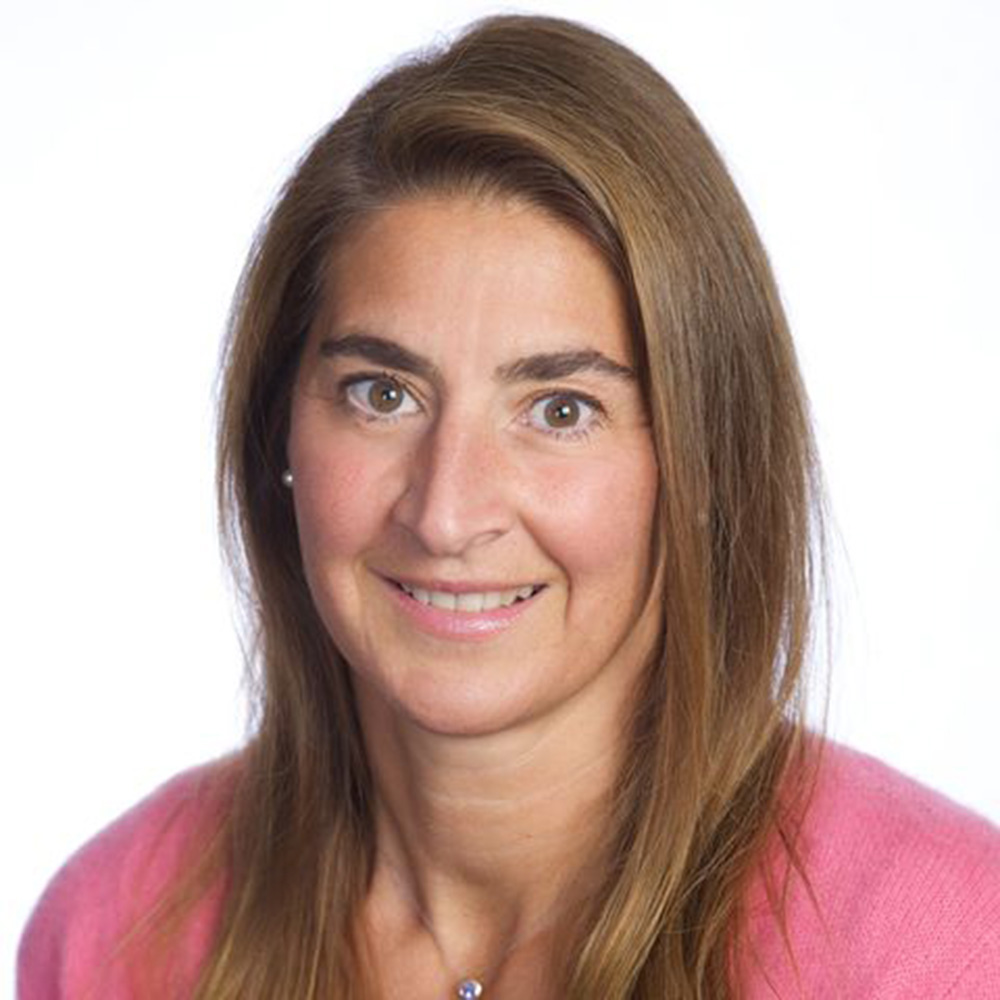
Leslie Manookian, MBA, M.L.C. Hom is president and founder of Health Freedom Defense Fund. She is a former successful Wall Street business executive. Her career in finance took her from New York to London with Goldman Sachs. She later became Director of Alliance Capital in London running their European Growth Portfolio Management and Research businesses.
-
Recent Top Stories
Sorry, we couldn't find any posts. Please try a different search.