Nepal election 2026: When is the vote and who are the main candidates?
Ayeshea PereraAsia Digital Editor

 Getty Images
Nepalis go to the polls on 5 March to elect a new government.
The general election will be the first the country has held since deadly youth-led anti-corruption protests toppled the government in September 2025.
The republic has since been governed by an interim government led by former chief justice Sushila Karki which promised to hold fresh elections and hand over power within six months.
Here is everything you need to know about Nepal’s vote.
How will the vote take place?
Nearly 19 million people will take part in the ballot for Nepal’s House of Representatives, the lower of the country’s two houses of parliament.
This figure includes 800,000 first time voters.
They will elect 275 members of parliament through a mixture of first past the post voting, and proportional representation.
More than 3,400 candidates are standing, of whom more than 1,000 are under the age of 40.
Voting will start at 07:00 local time (01:15 GMT) and continue until 17:00 local time.
However, polling booths are likely to stay open later in some parts of the country to allow all those wishing to vote to cast their ballots. In the past voting has continued until 21:00 local time in some constituencies.
Why are there two types of ballot?
Because Nepal has what is called a mixed electoral system which was introduced in its 2015 constitution.
The first system is known as First Past The Post (FPTP), meaning whoever wins the most votes wins the seat.
The second is known as Proportional Representation (PR), which takes into account the proportion of votes cast for a political party.
A total of 165 seats will be filled via the FPTP system, while the remaining 110 seats will be elected through PR.
The idea of having both systems was to ensure inclusion as well as proportional representation across society. The system makes it difficult for one party to win outright so whoever comes top in the election will most likely need to govern in a coalition.
Who are the main players in the Nepal election?
 Reuters
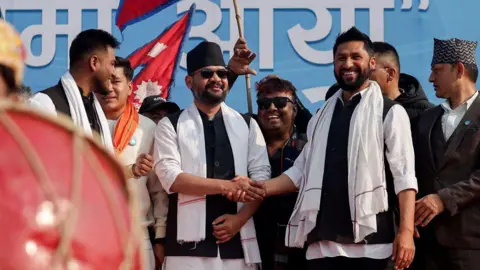
There are several political parties and politicians who are being closely watched.
Balendra Shah, the 35-year-old former mayor of Nepal’s capital Kathmandu, is one of them.
Better known as Balen, the former rapper is taking on the country’s former prime minister KP Sharma Oli in his traditionally safe seat of Jhapa 5. Oli and his government resigned last September amid mounting public anger at long-entrenched corruption and social inequality in the Himalayan republic.
Balen Shah is representing the Rastriya Swatantra Party (RSP) which came fourth in the last general election in 2022. This time, many analysts say it is likely to perform much better. Shah has been projected as the RSP prime ministerial candidate.
The Nepali Congress, which elected 49-year-old Gagan Thapa as its leader, replacing former prime minister Sher Bahadur Deuba, is another strong contender.
The other main players are Oli’s party, the Communist Party of Nepal UML, which won the largest share of seats in the last election and the Nepali Communist Party led by former Maoist leader Prachanda.
What are the key contests in the Nepal election?
Jhapa 5, which is one of five parliamentary constituencies in Nepal’s eastern Jhapa region, is a traditional stronghold of former PM KP Oli.
But this time former Kathmandu mayor and PM hopeful Balendra Shah is also contesting it for the Rastriya Swatantra Party (RSP), turning Jhapa 5 into a key election battleground.
The 15 seats in the Kathmandu Valley will also be closely watched as this is seen as a good indication of where the urban vote is going.
What are the main issues in the Nepal election?
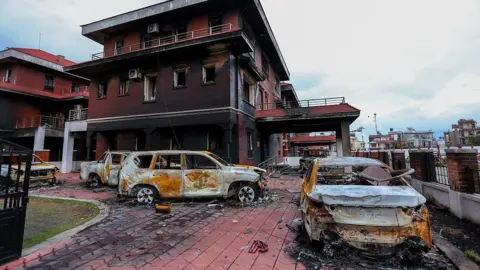
The authorities said 77 people were killed during last September’s demonstrations, many of them protesters shot by police. Crowds set fire to many buildings, including parliament, the Supreme Court and central government secretariat.
The protests were triggered by a ban on social media but fuelled by anger against corruption, unemployment and economic stagnation.
These are the main issues in the 5 March vote.
Most political parties have put particular focus on issues such as better governance, fighting corruption and reducing employment in their manifestos, which is being widely seen as a nod to the frustrations that led to the toppling of the previous government.
The Nepali Congress, for instance, has proposed holding a high-level investigation into the assets of public office holders since 1990.
This election has important geopolitical ramifications too.
Neighbouring India, which has historically had an outsized role in Nepal’s political history, is watching closely. It has had a fractious relationship with former prime minister KP Sharma Oli in the past.
This is primarily because it sees Oli as someone who has actively pursued a closer relationship with China, India’s rival, during his several terms as prime minister.
China has a major influence in Nepal and will be watching closely, as it will be hoping that any future government is supportive towards its interests in the country, including the Belt and Road Initiative (BRI).
The US has also been playing a role in this election and has been more aligned with India in terms of its strategic objectives.
 Getty Images
When will we know the result of the Nepal election?
Nepal’s Election Commission has promised to release the results of the 165 directly-elected seats within 24 hours of ballot boxes being collected from across the country – an exercise that typically takes at least a day.
Officiating Chief Election Commissioner Ram Prasad Bhandari told local reporters that tallying the results of the proportional representation vote – which determines who wins in 110 seats – could take another two to three days.
If this really were the case, that would be a huge departure from how long it typically takes for results to be released in the country.
In Nepal’s last election in 2022, it took a little more than two weeks for the final results to be released.
This is because some polling stations are located in difficult mountainous terrain which makes the task of collecting ballot boxes challenging. Some need to be carried down by hand, for instance, while others have to be airlifted in and out of polling stations.
Another reason for delay is that political parties dispatch representatives to counting centres. These representatives have been sometimes known to dispute issues like results and the validity of votes, which delays the process further.
Recent Top Stories
Sorry, we couldn't find any posts. Please try a different search.